Brazil farmers bet on environmentally friendly cotton / Photo: EVARISTO SA - AFP

 Alcaraz, Sabalenka into US Open last 16 as Williams sisters lose on return

 Williams sisters fall in thrilling return to US Open doubles

 Bangladesh measles toll nears grim 1,000-child mark

 Bolivia farmers return to streets over diesel price hikes

 Tetris distances itself from controversial White House 'arcade' games
 Africa bigger, US smaller - UN adopts new map

 Bad weather will not affect All Blacks, says captain Savea

 Mbappe misses penalty as Parrott lifts Betis past Real Madrid

 PSG still winless in Ligue 1 as Monaco go top

 Defending champion Alcaraz reaches last 16 at US Open

 Lyles ends season before Budapest due to injury flare ups

 US Republicans announce probe into environment groups

 Sabalenka survives despite 'tricky' weed smell at US Open

 S&P Revises Outlook on Freedom Holding Corp. and Core Subsidiaries to Positive

 Job growth but record-high diesel prices -- Trump's midterms mixed bag

 Women's NBA comissioner Engelbert to retire at season's end

 Luis Enrique extends contract as PSG coach until 2030

 Duplantis pulls out of Diamond League finals

 Defending champ Sabalenka, Pegula lead way into US Open fourth round

 UK hard-right party rallies behind leader after new donation scandal

 Nigeria's Dangote refinery looks to raise $1.6 bn in IPO

 Portugal extends talks to privatise national carrier TAP

 Brazil great Formiga says 2027 World Cup will 'change players' lives'

 Job growth, but surging diesel prices - Trump's midterms mixed bag

 Top seed Sabalenka powers into US Open fourth round

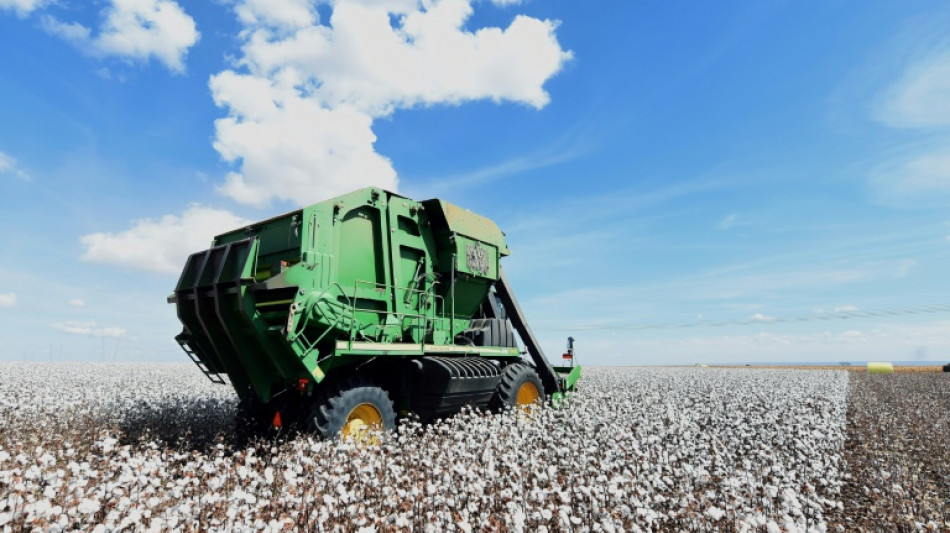
The road through Cristalina, Brazil is in the middle of the tropics, but the fields on either side look like they are covered in snow -- little white puffs of cotton stretching to the horizon.
The alabaster plants interspersed with the corn and soybean fields outside the central-western town are part of a silent revolution in Brazil: facing negative attention over the agribusiness industry's environmental impact, farmers are increasingly turning to cotton and adopting sustainable techniques to produce it.
After increasing exports 15-fold in the past two decades, Brazil is now the world's second-biggest cotton supplier, after the United States -- and the biggest producer of sustainable cotton.
No less than 84 percent of the cotton grown in the South American agricultural giant is certified by the Better Cotton Initiative (BCI), an international non-profit group to promote sustainable cotton farming.
"Consumers have changed. People don't want to buy products any more than don't respect nature and its cycles," says entomologist Cristina Schetino of the University of Brasilia, who specializes in cotton farming.
The industry is trying to improve the international image of Brazilian farming, tarnished by a history of slave labor, heavy pesticide use and the destruction of the Amazon rainforest for agriculture, a trend that has accelerated under far-right President Jair Bolsonaro -- an agribusiness ally.
In 2005, the Brazilian Cotton Producers' Association (Abrapa) launched a sustainability training program for farmers and introduced protocols on efficiently using water and pesticides and phasing out toxic products in favor of biological fertilizers.
A new tracing program launched with Brazilian clothing brands meanwhile lets consumers check how cotton goods were produced.
Last season, cotton farmers in Brazil replaced 34 percent of chemical pesticides with biological ones, Abrapa says.
They have also started using drones to apply pesticides more efficiently.
Switching to sustainable techniques is "a re-education process," says Abrapa's executive director, Marcio Portocarreiro.
"At first, farmers tend to think manly about the impact on their bottom line. But when they get past that phase... they realize that farming sustainably gives them a guaranteed market," he told AFP.
- Added value -
Located outside Cristalina, around 130 kilometers (80 miles) south of Brasilia, the capital, Fazenda Pamplona is one of Brazil's biggest proponents of sustainable cotton.
The 27,000-hectare (67,000-acre) operation, run by agribusiness giant SLC Agricola, is like a small city in the middle of the countryside, with a banquet hall, a children's park, sports fields and housing for employees.
The farm aims to retain workers by creating a home where they will want to stay, says production coordinator Diego Goldschmidt.
He stands in front of two enormous bales of cotton, labeled with QR codes that detail their harvest.
"These are already sold," he beams.
The farm produced more than 600,000 tonnes last year, 99 percent of it for export.
Sustainable cotton sells for prices up to 10 percent higher than conventional cotton.
"Besides being the right thing to do for society and the environment, it provides added value," says Goldschmidt.
- Aiming high -
But cotton remains one of the most pesticide-intensive crops, using more than double that of soy per hectare.
The problem is the prevalence of pests such as boll weevils and the absence of organic products to stop them, says Schetino.
"There's still a lot of dependence on chemical products, which have a negative environmental impact," says the entomologist, who is researching alternatives.
Brazil cultivates around 1.6 million hectares of cotton a year. It is a key supplier for the global garment industry, exporting to the likes of China, Vietnam, Pakistan and Turkey.
Abrapa has set itself the ambitious goal of surpassing the US to become the world's biggest cotton supplier in 2030.
"Brazil may not have a good image on sustainable farming yet," says Goldschmidt.
"But we will soon. There's a lot of potential."
O.Ortiz--AT