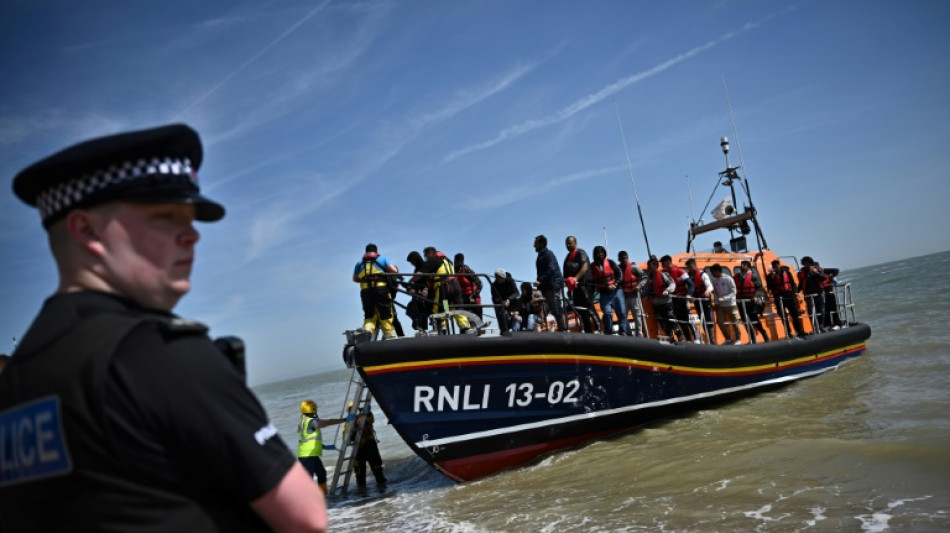
MPs question deterrent effect of UK's Rwanda migrant policy / Photo: Ben Stansall - AFP

 Carapaz out of cycling world championships

 'Fragile' Tottenham beaten by Aston Villa despite late rally

 Mourinho hails Real Madrid grit before Atletico derby clash

 Martin wins Austrian MotoGP sprint after Acosta crash

 Japan edge Fiji to win Pacific Nations Cup

 Black smoke, flames rising near Riyadh airport: residents to AFP

 UK actor Naomi Watts honoured at Spain film festival

 Japan emperor declares Asian Games open after turbulent build-up

 Asian Games open with unity message after troubled build-up

 Denmark hails 'binding' Greenland deal with Trump

 We don't want Games host Japan losing money, says Asian Olympic official

 Ed Sheeran returns to stage after Palestinian controversy

 Asian Games to open in Japan after troubled build-up

 Drone owners rush to offload devices ahead of Beijing ban

 Trump's beef policies irk Texas ranchers, testing their loyalty

 Batman Appears Atop the Sydney Opera House for Batman Day 2026
 Nvidia, OpenAI CEOs to attend Xi dinner at White House
 Anthropic picks Accenture for in-house AI safety evaluation

 Balogun returns as Monaco beat Lens to continue strong Ligue 1 start

 'Pause' on overt repression in Venezuela, but reforms still needed: HRW

 Global stocks mixed as yen falls despite Bank of Japan rate hike

 Cuba hit with seventh major blackout of the year

 Murray out with concussion so Wentz will start for Vikings

 UN chief 'deeply regrets' US visa refusal to Abbas for annual meeting
 England quick Carse to face no charges over alleged nightclub assault

British MPs on Monday told the government there was "no clear evidence" that its controversial policy to deport some asylum seekers to Rwanda would stop Channel crossings in small boats.
The House of Commons Home Affairs Committee said "much more clarity" was needed on the plan, including how much it will cost.
Instead, the MPs urged ministers to look at less eye-catching solutions to the issue, including closer cooperation with European neighbours.
"There is no clear evidence that the policy will deter migrant crossings," the cross-party committee said in a report on the "small boats" phenomenon.
In fact, it pointed out, numbers attempting the journey from northern France in inflatable dinghies and other unsuitable craft had increased since the policy was first announced in April.
It attributed this to "scaremongering" by people-smuggling gangs warning migrants about the change in the law.
The Channel crossings have put Prime Minister Boris Johnson and his government under political pressure, given that they promised to tighten Britain's borders after leaving the European Union.
More than 28,500 people -- most of them young men -- arrived in 2021. Some 13,000 have arrived already this year out of 60,000 expected this year.
Most claim asylum but the government says the costs involved in the application process -- more than £1.5 billion ($1.8 billion) -- are unsustainably high.
The first flight carrying asylum seekers was due to take off for Rwanda in mid-June but was grounded due to legal challenges.
The Home Affairs Committee said there was "no magical solution" to deal with irregular migration.
But it said "close cooperation with international partners, particularly those in France" stood more chance of success in deterring Channel crossings.
That included intelligence-sharing to smash criminal gangs behind the practice, and rebuilding connections destroyed by Brexit to enable Britain to send illegal arrivals back across the Channel.
The committee pointed out that there were a total of 48,450 asylum applications in Britain in 2021 -- a similar number to every year since 2014 and "far less" than in the early 2000s.
But it said the current asylum caseload of more than 125,000 was a result of "antiquated IT systems, high staff turnover and too few staff".
W.Moreno--AT



