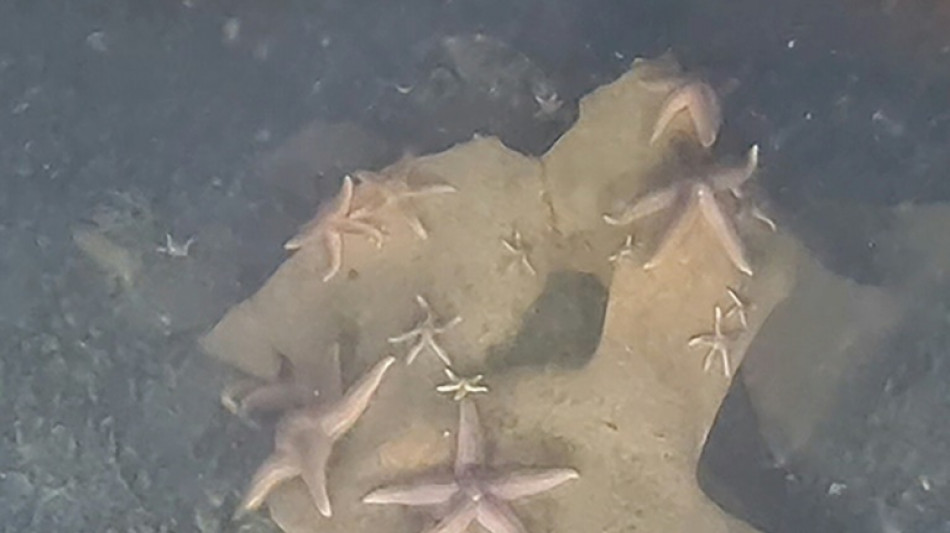
Sea life thriving on unexploded Nazi bombs, sub discovers / Photo: Andrey VEDENIN - DeepSea Monitoring Group/AFP

 Ed Sheeran set to return to stage after Palestinian controversy

 Toulouse edge Vannes, Lyon beat Pau to take Top 14 summit

 Germans arrested for Louvre stunt in Mona Lisa hall

 Saudi-led coalition says Houthis fired ballistic missile at Riyadh

 France's debt climbs to highest since 1978: ministry

 McIlroy two shots off the lead at Wentworth after eagle on 18

 Martinez brace saves Inter in Serie A top-two clash with Roma

 Rosenior abused but guides Paris FC past old club Strasbourg

 Seven-try Lyon beat Pau, climb to Top 14 summit

 Brighton defeat a 'big lesson' against complacency for Arsenal, says Arteta

 Thousands protest inaction over climate crisis in Switzerland

 Carapaz out of cycling world championships

 'Fragile' Tottenham beaten by Aston Villa despite late rally

 Mourinho hails Real Madrid grit before Atletico derby clash

 Martin wins Austrian MotoGP sprint after Acosta crash

 Japan edge Fiji to win Pacific Nations Cup

 Black smoke, flames rising near Riyadh airport: residents to AFP

 UK actor Naomi Watts honoured at Spain film festival

 Japan emperor declares Asian Games open after turbulent build-up

 Asian Games open with unity message after troubled build-up
 Denmark hails 'binding' Greenland deal with Trump
 We don't want Games host Japan losing money, says Asian Olympic official

 Ed Sheeran returns to stage after Palestinian controversy

 Asian Games to open in Japan after troubled build-up
 Drone owners rush to offload devices ahead of Beijing ban

Marine life is thriving on unexploded Nazi bombs sitting at the bottom of a German bay, a submersible has discovered, even capturing footage of starfishes creeping across a huge chunk of TNT.
The discovery, which was revealed in a study published Thursday, was "one of those rare but remarkable eureka moments," marine biologist Andrey Vedenin told AFP.
The waters off Germany's coast are estimated to be littered with 1.6 million tons of unexploded munitions left behind from both world wars.
In October last year, a team of German scientists went to a previously uncharted dump site in the Baltic Sea's Luebeck Bay and sent an unmanned submersible 20 metres down to the seafloor.
They were surprised when footage from the sub revealed 10 Nazi-era cruise missiles. Then they were stunned when they saw animals covering the surface of the bombs.
There were roughly 40,000 animals per square metre -- mostly marine worms -- living on the munitions, the scientists wrote in the journal Communications Earth & Environment.
They also counted three species of fish, a crab, sea anemones, a jellyfish relative called hydroids and plenty of starfishes.
While animals covered the hard casing of the bombs, they mostly avoided the yellow explosive material -- except for one instance.
The researchers were baffled to see that more than 40 starfishes had piled on to an exposed chunk of TNT.
"It looked really weird," said Vedenin, a scientist at Germany's Carl von Ossietzky University and the study's lead author.
Exactly why the starfishes were there was unclear, but Vedenin theorised they could be eating bacterial film collecting on the corroding TNT.
- Life on weapons of death -
The explosive chemicals are highly toxic, but the animals appeared to have found a way to live near it.
Other than the death-wish starfishes, they did not seem to be behaving strangely.
"The crabs were just sitting and picking something with their claws," Vedenin said.
To find out what kind of bombs they were dealing with, he went online and found a manual from the Nazi air force Luftwaffe describing how to handle and store V-1 flying bombs. The cruise missile exactly matched the 10 bombs from the footage.
Vedenin said "there is some irony" in the discovery that these "things that are meant to kill everything are now attracting so much life."
He compared it to how animals such as deer now thrive in radioactive areas abandoned by humans near the site of the Chernobyl nuclear disaster.
Hard surfaces on the seafloor are important for marine life that want more than mud and sand.
Animals once flocked to huge boulders that littered the Baltic Sea, however humans removed the stones to build infrastructure such as roads at the start of the 20th century.
So when the Nazi bombs are eventually cleared from the bay, the researchers called for more stones -- or concrete structures -- to be put in place to continue supporting the sea life.
The scientists also plan to return to the spot next month to set up a time-lapse camera to watch what the starfishes do next.
M.O.Allen--AT



