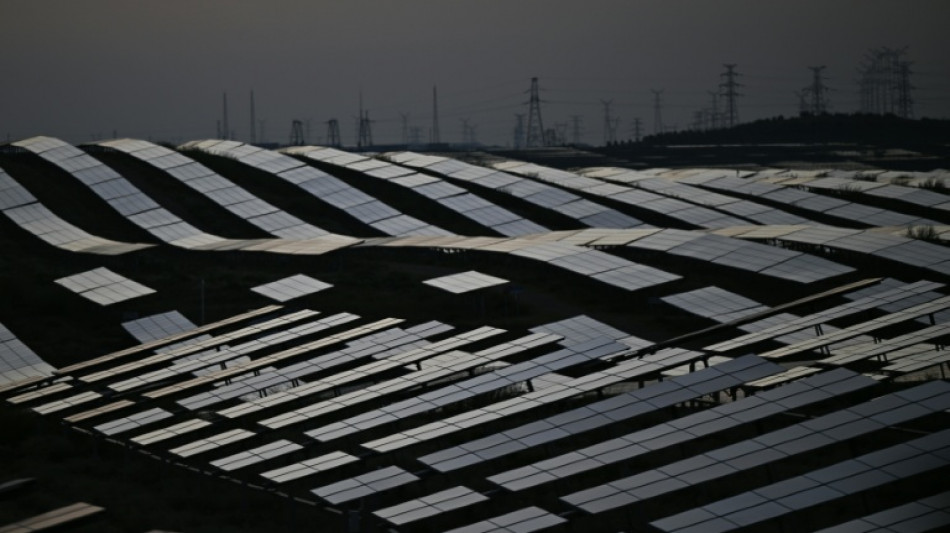
Glimmering sea of solar as China expands desert installation / Photo: Pedro Pardo - AFP

 Singer Ed Sheeran says Gaza situation 'unjustifiable' following controversy

 In 'Tenzing', a Sherpa mountaineer gets his due

 Ed Sheeran set to return to stage after Palestinian controversy

 Toulouse edge Vannes, Lyon beat Pau to take Top 14 summit

 Germans arrested for Louvre stunt in Mona Lisa hall

 Saudi-led coalition says Houthis fired ballistic missile at Riyadh

 France's debt climbs to highest since 1978: ministry

 McIlroy two shots off the lead at Wentworth after eagle on 18

 Martinez brace saves Inter in Serie A top-two clash with Roma

 Rosenior abused but guides Paris FC past old club Strasbourg

 Seven-try Lyon beat Pau, climb to Top 14 summit

 Brighton defeat a 'big lesson' against complacency for Arsenal, says Arteta

 Thousands protest inaction over climate crisis in Switzerland

 Carapaz out of cycling world championships

 'Fragile' Tottenham beaten by Aston Villa despite late rally

 Mourinho hails Real Madrid grit before Atletico derby clash

 Martin wins Austrian MotoGP sprint after Acosta crash

 Japan edge Fiji to win Pacific Nations Cup

 Black smoke, flames rising near Riyadh airport: residents to AFP

 UK actor Naomi Watts honoured at Spain film festival

 Japan emperor declares Asian Games open after turbulent build-up

 Asian Games open with unity message after troubled build-up

 Denmark hails 'binding' Greenland deal with Trump

 We don't want Games host Japan losing money, says Asian Olympic official

 Ed Sheeran returns to stage after Palestinian controversy

An ocean of blue solar panels ripples across the ochre dunes of Inner Mongolia's Kubuqi desert, a glittering example of China's almost inconceivably mammoth energy transition.
Even as other countries have put the brakes on desert solar projects for economic or technical reasons, China -- the world's largest emitter of greenhouse gases -- is ploughing ahead.
Desert solar installations are a key part of China's plans to reach carbon neutrality by 2060. The country's solar capacity dwarfs global efforts and is so substantial it may even impact local weather patterns.
"Before, there was nothing here... it was desolate," Kubuqi local Chang Yongfei told AFP as he gestured towards fields of shimmering panels.
The installations are so enormous, they are visible from space.
AFP analysis of satellite images over the last decade shows in Kubuqi alone more than 100 square kilometres of panels have been installed, an area roughly the size of Paris.
On Thursday, China pledged to expand wind and solar capacity to more than six times its 2020 levels, as it tries to slash greenhouse gas emissions by 7-10 percent from peak levels.
The "defining factor" for building in the desert is the availability of otherwise unused land, according to analyst David Fishman.
But the remote, sun-soaked terrain poses formidable challenges.
Sandstorms can degrade panel ventilators, while blistering temperatures reduce the efficiency of solar cells. Sand accumulation can demand scarce water for cleaning.
Kubuqi's solar panels are designed to counter those obstacles, with self-cleaning ventilators and double-sided cells that allow them to capture light reflected from the ground, according to Chinese state media.
- Infrastructure key -
The distance to energy-hungry urban areas, and the network sophistication required to transport the electricity, has stalled desert projects from North Africa to the United States.
The energy generated in Kubuqi is destined for densely populated Beijing, Tianjin and Hebei, hundreds of kilometres away.
And the growth of solar capacity -- overshooting a government target nearly six years early -- has not been matched by power grid development.
This causes some energy to be lost, along with congestion on power lines.
Overcoming this requires infrastructure "to effectively allocate and dispatch power around the country without allowing bottlenecks to occur", said Fishman.
Some places, including Inner Mongolia and neighbouring Ningxia and Gansu, are "restricting new project approvals unless they can explicitly demonstrate" the energy won't be wasted, he added.
Despite this, in the first half of the year, China installed more solar than the entire solar capacity in the United States as of the end of 2024.
- Coal -
The sheer scale of some desert solar fields might create their own climatic effect, according to the University of Lund's Zhengyao Lu.
Heat absorption across large areas can change atmospheric flows and have "negative secondary effects", like rainfall reduction elsewhere, he said.
However, the risks of solar energy "remain minor compared to the dangers of continuing greenhouse gas emissions", he added.
The solar expansion does not mean fossil fuels have been abandoned, especially in Inner Mongolia, a traditional mining region.
Around Kubuqi, soot-blackened trucks and chimney stacks belching smoke show the industry's persistence.
China brought more coal power online in the first half of this year than any time since 2016, a report said in August.
The polluting fuel "constitutes a real structural obstacle to the expansion of wind and solar power", NGO Greenpeace said this summer.
- 'Good transition' -
Chang, the local resident, told AFP he used to work in the coal industry.
Now, he runs a hotel made up of huts nestled in the sand dunes, not far from the solar fields.
Views of the shimmering solar cells have gone viral online, as Kubuqi has become a popular domestic holiday destination.
"The transition has been very good for the region," 46-year-old Chang said.
Quadbike tours, camel rides and dune surfing have become a new source of income for locals.
Chang worries solar expansion might swallow up the whole desert, and with it this new revenue stream.
"But I have confidence the government will leave us a little bit," he said.
"It should be enough."
Ch.P.Lewis--AT