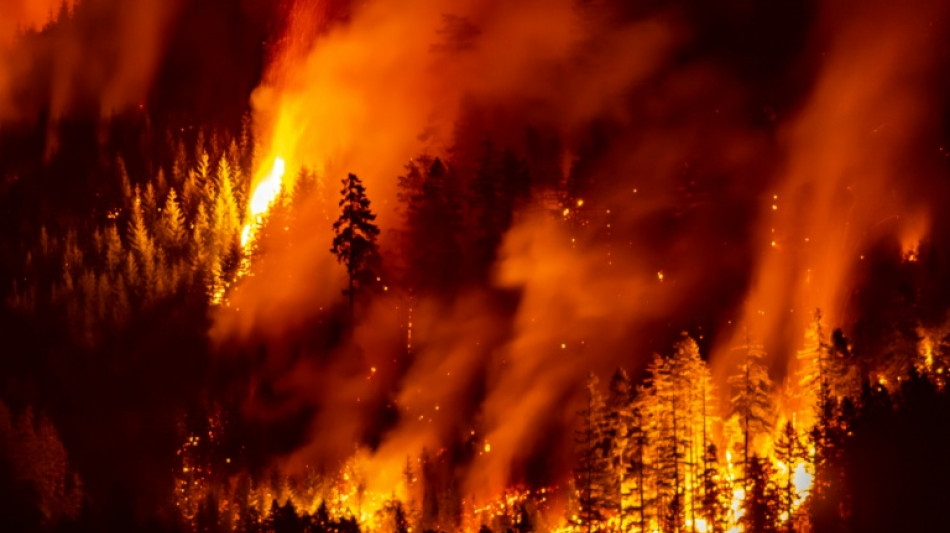
Smoke from 2023 Canada fires linked to thousands of deaths: study / Photo: Colby Rex O'Neill - AFP

 Singer Ed Sheeran says Gaza situation 'unjustifiable' following controversy

 In 'Tenzing', a Sherpa mountaineer gets his due

 Ed Sheeran set to return to stage after Palestinian controversy

 Toulouse edge Vannes, Lyon beat Pau to take Top 14 summit

 Germans arrested for Louvre stunt in Mona Lisa hall

 Saudi-led coalition says Houthis fired ballistic missile at Riyadh

 France's debt climbs to highest since 1978: ministry

 McIlroy two shots off the lead at Wentworth after eagle on 18

 Martinez brace saves Inter in Serie A top-two clash with Roma

 Rosenior abused but guides Paris FC past old club Strasbourg

 Seven-try Lyon beat Pau, climb to Top 14 summit

 Brighton defeat a 'big lesson' against complacency for Arsenal, says Arteta

 Thousands protest inaction over climate crisis in Switzerland

 Carapaz out of cycling world championships

 'Fragile' Tottenham beaten by Aston Villa despite late rally

 Mourinho hails Real Madrid grit before Atletico derby clash

 Martin wins Austrian MotoGP sprint after Acosta crash

 Japan edge Fiji to win Pacific Nations Cup

 Black smoke, flames rising near Riyadh airport: residents to AFP

 UK actor Naomi Watts honoured at Spain film festival

 Japan emperor declares Asian Games open after turbulent build-up

 Asian Games open with unity message after troubled build-up
 Denmark hails 'binding' Greenland deal with Trump

 We don't want Games host Japan losing money, says Asian Olympic official
 Ed Sheeran returns to stage after Palestinian controversy

Canada's record-breaking 2023 wildfires exposed more than 350 million people in North America and Europe to air pollution that likely contributed to tens of thousands of deaths, according to new estimates published Wednesday.
The findings "underscored that severe wildfires do not have only local consequences" but can inflict real harm a continent away, said the scientists behind the world-first research.
Extreme fire conditions, supercharged by climate change, fanned thousands of blazes across Canada between May and September 2023 that torched around 18 million hectares (44 million acres) -- an area larger than England.
The five-month wildfires were unprecedented in size and scale, releasing massive plumes of acrid smoke that turned skies yellow and triggered health warnings across North America.
But the smoke drifted as far as Europe, causing spikes in harmful PM2.5 pollutants and a measurable decline in air quality thousands of miles from the heat and flames in Canada.
In North America and Europe, an estimated 354 million people were exposed to levels of PM2.5 above the World Health Organization's (WHO) safe limit, concluded a new study into the long-range impact of the wildfires, published in the journal Nature.
This contributed to nearly 70,000 premature deaths on both continents -- most from breathing polluted air over months and a smaller number from acute exposure to wildfire smoke.
The findings were "striking" and surprised even the research team behind them, said Qiang Zhang, a professor of atmospheric chemistry at Tsinghua University in Beijing who led the study.
"While we anticipated large impacts from the record-breaking 2023 Canadian fires, the magnitude of the population exposure and related attributable mortalities are higher than expected," he told AFP.
"These results underscore that such extreme wildfires are no longer just a regional environmental issue and they have become a global public health concern."
PM2.5 pollutants are fine, airborne particles small enough to enter the bloodstream through the lungs, and are linked to higher rates of chronic bronchitis, lung cancer and heart disease.
- Widespread -
The team separated acute and chronic premature deaths due to PM2.5 exposure because they represented two very different types of health impacts from wildfire smoke exposure, Qiang Zhang said.
Acute deaths, he said, captured the short-term health impacts during "smoke days" when daily PM2.5 levels spiked "well above" WHO guidelines and could immediately trigger fatal events, such as heart attacks or respiratory failures.
Some 4,100 acute deaths were estimated in the United States, downwind from the wildfires, and another 1,300 in Canada itself.
Chronic deaths reflected the health burden of longer-term exposure, which increases the risks of cardiovascular and respiratory diseases and leads to premature death over time.
The study found that chronic health impacts from five months of breathing wildfire smoke were "substantial and widespread", with 41,900 deaths estimated in North America and 22,400 in Europe.
Such estimates were a first, Qiang Zhang said.
But that created limitations for researchers who lacked earlier references on the specific impact of wildfires on health, he said, forcing them to use broader evidence to base their estimates on.
The computer model they built, using satellite observations and machine learning, also could not account for the health impact of various pollutants in wildfire smoke, he added.
The authors said more research into this "underexplored" cost would be crucial as climate change made wildfires bigger, fiercer and more frequent.
H.Thompson--AT