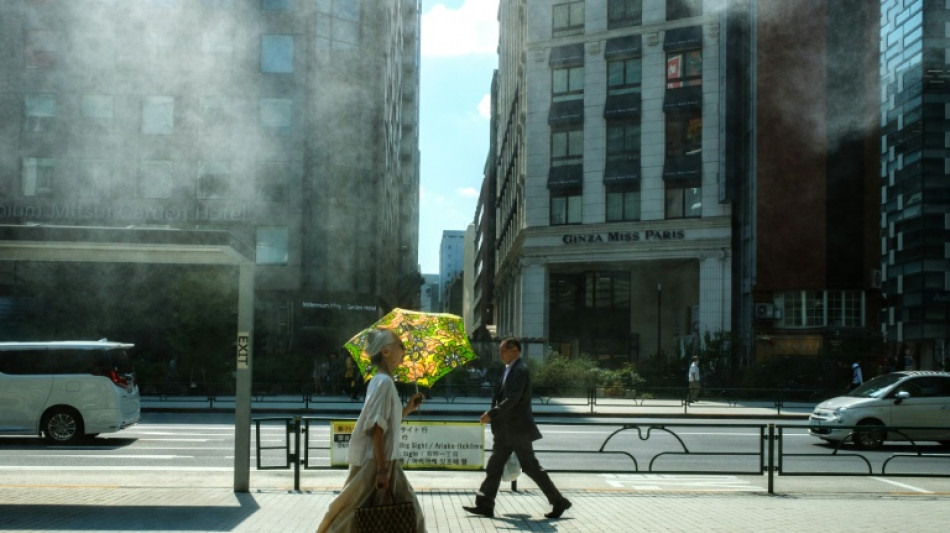
UK, Japan, South Korea endure hottest summer on record / Photo: Philip FONG - AFP

 Singer Ed Sheeran says Gaza situation 'unjustifiable' following controversy

 In 'Tenzing', a Sherpa mountaineer gets his due

 Ed Sheeran set to return to stage after Palestinian controversy

 Toulouse edge Vannes, Lyon beat Pau to take Top 14 summit

 Germans arrested for Louvre stunt in Mona Lisa hall

 Saudi-led coalition says Houthis fired ballistic missile at Riyadh

 France's debt climbs to highest since 1978: ministry

 McIlroy two shots off the lead at Wentworth after eagle on 18

 Martinez brace saves Inter in Serie A top-two clash with Roma

 Rosenior abused but guides Paris FC past old club Strasbourg

 Seven-try Lyon beat Pau, climb to Top 14 summit

 Brighton defeat a 'big lesson' against complacency for Arsenal, says Arteta

 Thousands protest inaction over climate crisis in Switzerland

 Carapaz out of cycling world championships

 'Fragile' Tottenham beaten by Aston Villa despite late rally

 Mourinho hails Real Madrid grit before Atletico derby clash

 Martin wins Austrian MotoGP sprint after Acosta crash

 Japan edge Fiji to win Pacific Nations Cup
 Black smoke, flames rising near Riyadh airport: residents to AFP

 UK actor Naomi Watts honoured at Spain film festival

 Japan emperor declares Asian Games open after turbulent build-up

 Asian Games open with unity message after troubled build-up
 Denmark hails 'binding' Greenland deal with Trump

 We don't want Games host Japan losing money, says Asian Olympic official

 Ed Sheeran returns to stage after Palestinian controversy

The UK, Japan and South Korea sweltered this year through the hottest summers since each country began keeping records, their weather agencies said Monday.
Temperatures the world over have soared in recent years as human-induced climate change creates ever more erratic weather patterns.
The UK's provisional mean June-August temperature was 16.1C, which was 1.51C above the long-term average and surpassed all years since 1884, including the previous record, set in 2018, the Met Office said.
The British summer saw four heatwaves, below-average rainfall and sustained sunshine, and followed the nation's warmest spring in more than a century.
Japan's average temperature spike was even starker over the same three summer months, at 2.36C above "the standard value", making it the hottest since records began in 1898, the Japan Meteorological Agency (JMA) said.
It was the third consecutive summer of record high temperatures, the agency noted.
This year's scorching heat left some 84,521 people hospitalised nationwide from May 1 to August 24, according to Japan's Fire and Disaster Management Agency.
In South Korea, the average June-August temperature was 25.7C, "the highest since data collection began in 1973", the Korea Meteorological Administration said in a press release.
The previous record over the same period was 25.6C, set just last year.
- 'Very hot' -
Britain -- known for its damp and grey climate -- struggled through the record hot summer, which poses a host of challenges for a country ill-equipped for such conditions.
Homes in the UK are designed to keep the heat in during the winter, and air conditioners are rare in homes and public places, such as much of London's sprawling underground "Tube" metro system.
"It's hard to spend a hot day (here)," Ruidi Luan, a 26-year-old student from China, told AFP in London during the August heatwave.
"There's no air conditioner in our dorm. It is sometimes very hot, and especially in public transport."
Drought was declared in five out of 14 regions in England, while the Environment Agency classed the water shortfall as "nationally significant", as farmers struggle with stunted harvests.
In Tokyo, Miyu Fujita, a 22-year-old businesswoman, said she had mostly socialised indoors this summer to escape the oppressive temperatures.
"When I was a child, summer was the time to go outside and play," she told AFP. "Can kids play outside now? I think it's impossible."
Japan's beloved cherry trees are blooming earlier due to the warmer climate, or sometimes not fully blossoming because autumns and winters are not cold enough to trigger flowering, experts say.
The famous snow cap of Mount Fuji was absent for the longest recorded period last year, not appearing until early November, compared with the average of early October.
- National disaster -
South Korea is meanwhile grappling with a prolonged drought that has hit the eastern coastal city of Gangneung.
A state of national disaster has been declared in the city of 200,000 people, with water levels at the Obong reservoir, the city's main source of piped water, falling below 15 percent.
The dry spell has forced authorities to implement water restrictions, including shutting off 75 percent of household meters.
Kim Hae-dong, professor of meteorological studies at Keimyung University, told AFP the hot weather streak was linked to "the weakening of Arctic cold air due to global warming".
"Because it is expected to continue weakening with global warming in place, we forecast similar weather patterns to repeat next year," he said.
Heatwaves are becoming more intense and frequent worldwide because of human-caused climate change, scientists say.
The UK's provisional record this year means all of its five warmest summers have taken place this century.
The Met Office noted "a summer as hot or hotter than 2025 is now 70 times more likely than it would be in a 'natural' climate with no human caused greenhouse gas emissions".
But the speed of temperature increases across the world is not uniform.
Of the continents, Europe has seen the fastest warming per decade since 1990, followed closely by Asia, according to global data from the US National Oceanic and Atmospheric Administration.
The United Nations warned last month that rising global temperatures are having an ever-worsening impact on the health of workers, and also hitting productivity, which they say dropped by two to three percent for every degree above 20C.
burs-jj/jkb/jhb
A.Ruiz--AT



