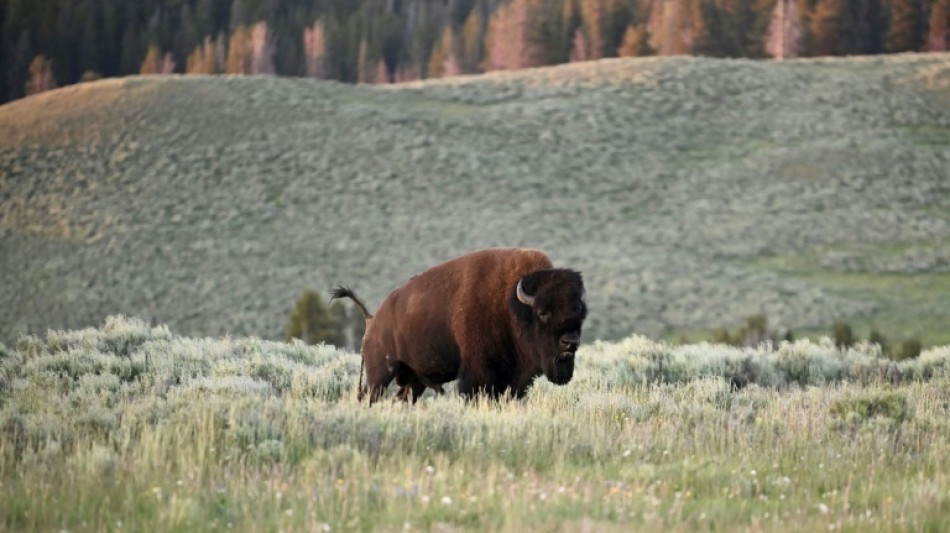
Bison herds 'reawaken' Yellowstone's prairies / Photo: Eric BARADAT - AFP/File

 IOC president impressed by 'beautiful' Asian Games wooden huts

 First Asian Games gold goes to Japan as China's 13-year-old Yu lights up pool

 Data centre command hub keeps AI up and running

 Pope Leo in France: the issues on the table

 Packing for a pope: behind the scenes on foreign trips

 Republicans find transgender issues a powerful political weapon in midterm campaigning

 German state elections threaten new shock waves for Merz

 Chile's Bachelet quits race to be next UN chief

 Raphinha treble fires perfect Barca to win at Sevilla

 Thiam makes winning heptathlon return at Decastar meet

 Czechs beat USA to qualify for Davis Cup finals

 Dortmund sink Stuttgart to climb to Bundesliga summit

 Trump says will not tolerate attempts to slow AI growth

 'It has to stop': runners protest women's murders in S.Africa district

 Fire erupts near Riyadh airport as Houthis claim strikes

 Cuba works to restore power after another blackout

 England thrash Sri Lanka again to return to top of T20 rankings

 Arsenal thrashed by Brighton, sorry Spurs lose again

 South Korea, Austria qualify for Davis Cup finals

 Seare shocks Ingebrigtsen to win world 5km gold

 Brigitte Bardot widower slams sale of star's belongings

 Aston Villa compound Tottenham's misery despite late rally

 Asian Games offer 'deepest apologies' for South Korea anthem blunder

 Inter Milan and Italy icon Mazzola dies aged 83

 Saudi capital issues first air raid alert since renewed fighting in Yemen

There are few symbols of the American West more iconic than the bison -- shaggy giants that once roamed in the tens of millions before being nearly annihilated by European settlers.
A new study published Thursday in Science finds that bringing North America's largest land mammals back to their ancient stomping grounds is breathing new life into grassland ecosystems, with benefits cascading across the food web.
Scientists have long known bison act as "keystone species," shaping prairie landscapes through grazing, wallowing and seed dispersal. Previous research has even suggested their vast herds help lock carbon in the soil.
But the latest findings, from Yellowstone National Park, reveal just how dramatic their influence can be for ecosystem health when they are allowed to roam freely through the wilderness.
By munching through grasses, bison speed up the nitrogen cycle, supercharging plants with nutrients.
The result: forage that is more than 150 percent richer in protein -- a gift to every creature that feeds on the prairie, from elk and deer to pronghorn and bighorn sheep.
"It truly is a reawakening of what had been there in the past," said Bill Hamilton, a co-lead author of the paper and professor at Washington and Lee University.
- Natural laboratory -
Bison herds were once so vast in the western United States that their hoofbeats rumbled like distant thunder. Early 19th-century estimates put their numbers between 30 and 60 million.
Then came the railroads. The building of the first Transcontinental line was accompanied by a ruthless extermination campaign -- hunters shooting from trains, carcasses left to rot -- aimed not only at supplying hides but at starving Native Americans, for whom bison were a cultural and economic lifeline.
By the early 20th century, the species was teetering on the brink. Revival efforts eventually pushed their numbers back to roughly 400,000, but nearly all survive in small, tightly managed herds on private ranches or reserves.
Only in Yellowstone National Park, home to about 5,000 animals, do bison still roam with something like their old freedom, covering nearly 1,000 miles a year on a 50-mile back-and-forth migration. For scientists, that makes the park a rare, living laboratory.
Between 2015 and 2021, a study led by National Park Service biologist Chris Geremia tracked the animals' movements and grazing patterns across their main habitats, measuring plant growth, nutrient cycling, soil chemistry and more.
- Balance restored -
They compared grazed and ungrazed patches, pairing field experiments with satellite imagery and GPS collar data to capture bison impacts across their migratory range.
Results show roaming bison keep grasses and wildflowers short, dense and protein-rich -- and plant communities surprisingly diverse.
"Grasses exude carbon into the soil after being grazed, and that actually stimulates microbial populations for up to 48 hours," explained Hamilton.
That microbial burst translated to more ammonium and nitrates for new growth -- a feedback loop that boosted both plants and animals. Bison dung and urine added another jolt of nitrogen, compounding the fertilization effect.
"We took that 150 percent increase and we calculated it across the whole migration (area), and it provides over three million kilograms more crude protein if you have bison," said co-author Jerod Merkle of the University of Wyoming.
Even areas that looked "mowed flat" by bison remained ecologically vibrant, with productivity and diversity intact.
The findings come at a fraught time for conservation, as President Donald Trump's administration tilts heavily toward agricultural interests over wildlife.
Ranchers argue that bison allowed to roam would smash fences, mix with cattle and spread disease.
But Merkle countered that the ecological payoff was undeniable.
"My vision when I see the data from our paper is, let's just pull out of the classic livestock thinking with bison, and think about them as a species that creates heterogeneity, that needs big space to move around -- and it's okay to have big groups of them sometimes," he said.
W.Stewart--AT



