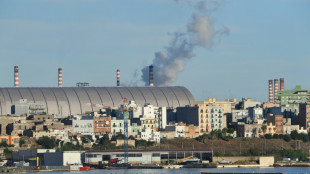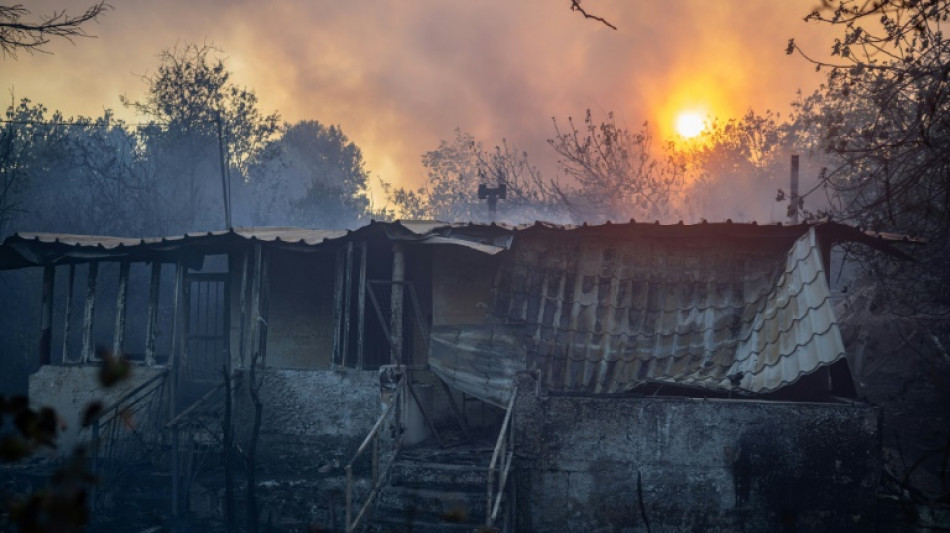
'Silent killer': the science of tracing climate deaths in heatwaves / Photo: Angelos TZORTZINIS - AFP

 Russians vote on last day of parliamentary elections
 Hong Kong pays final respects to former city leader Tung
 Typhoon put people off Asian Games opening ceremony, official says
 China's 13-year-old Yu cruises as Asian Games swimming begins

 AI 'warning shots' focus Beijing on national security risks

 Philippine tribe in limbo over US-led tech hub
 Leo XIV, first US pope transcends his restrained style
 Singer Ed Sheeran says Gaza situation 'unjustifiable' following controversy
 In 'Tenzing', a Sherpa mountaineer gets his due
 Ed Sheeran set to return to stage after Palestinian controversy
 Toulouse edge Vannes, Lyon beat Pau to take Top 14 summit

 Germans arrested for Louvre stunt in Mona Lisa hall
 Saudi-led coalition says Houthis fired ballistic missile at Riyadh

 France's debt climbs to highest since 1978: ministry

 McIlroy two shots off the lead at Wentworth after eagle on 18

 Martinez brace saves Inter in Serie A top-two clash with Roma
 Rosenior abused but guides Paris FC past old club Strasbourg
 Seven-try Lyon beat Pau, climb to Top 14 summit
 Brighton defeat a 'big lesson' against complacency for Arsenal, says Arteta
 Thousands protest inaction over climate crisis in Switzerland

 Carapaz out of cycling world championships

 'Fragile' Tottenham beaten by Aston Villa despite late rally

 Mourinho hails Real Madrid grit before Atletico derby clash
 Martin wins Austrian MotoGP sprint after Acosta crash

 Japan edge Fiji to win Pacific Nations Cup

A heatwave scorching Europe had barely subsided in early July when scientists published estimates that 2,300 people may have died across a dozen major cities during the extreme, climate-fuelled episode.
The figure was supposed to "grab some attention" and sound a timely warning in the hope of avoiding more needless deaths, said Friederike Otto, one of the scientists involved in the research.
"We are still relatively early in the summer, so this will not have been the last heatwave. There is a lot that people and communities can do to save lives," Otto, a climate scientist at Imperial College London, told AFP.
Heat can claim tens of thousands of lives during European summers but it usually takes months, even years, to count the cost of this "silent killer".
Otto and colleagues published their partial estimate just a week after temperatures peaked in western Europe.
While the underlying methods were not new, the scientists said it was the first study to link heatwave deaths to climate change so soon after the event in question.
Early mortality estimates could be misunderstood as official statistics but "from a public health perspective the benefits of providing timely evidence outweigh these risks," Raquel Nunes from the University of Warwick told AFP.
"This approach could have transformative potential for both public understanding and policy prioritisation" of heatwaves, said Nunes, an expert on global warming and health who was not involved in the study.
- Big deal -
Science can show, with increasing speed and confidence, that human-caused climate change is making heatwaves hotter and more frequent.
Unlike floods and fires, heat kills quietly, with prolonged exposure causing heat stroke, organ failure, and death.
The sick and elderly are particularly vulnerable, but so are younger people exercising or toiling outdoors.
But every summer, heat kills and Otto -- a pioneer in the field of attribution science -- started wondering if the message was getting through.
"We have done attribution studies of extreme weather events and attribution studies of heatwaves for a decade... but as a society we are not prepared for these heatwaves," she said.
"People think it's 30 (degrees Celsius) instead of 27, what's the big deal? And we know it's a big deal."
When the mercury started climbing in Europe earlier this summer, scientists tweaked their approach.
Joining forces, Imperial College London and the London School of Hygiene & Tropical Medicine chose to spotlight the lethality -- not just the intensity -- of the heat between June 23 and July 2.
Combining historic weather and published mortality data, they assessed that climate change made the heatwave between 1C and 4C hotter across 12 cities, depending on location, and that 2,300 people had likely perished.
But in a notable first, they estimated that 65 percent of these deaths -- around 1,500 people across cities including London, Paris, and Athens -- would not have occurred in a world without global warming.
"That's a much stronger message," said Otto.
"It brings it much closer to home what climate change actually means and makes it much more real and human than when you say this heatwave would have been two degrees colder."
- Underestimated threat -
The study was just a snapshot of the wider heatwave that hit during western Europe's hottest June on record and sent temperatures soaring to 46C in Spain and Portugal.
The true toll was likely much higher, the authors said, noting that heat deaths are widely undercounted.
Since then Turkey, Greece and Bulgaria have suffered fresh heatwaves and deadly wildfires.
Though breaking new ground, the study has not been subject to peer review, a rigorous assessment process that can take more than a year.
Otto said waiting until after summer to publish -- when "no one's talking about heatwaves, no one is thinking about keeping people safe" -- would defeat the purpose.
"I think it's especially important, in this context, to get the message out there very quickly."
The study had limitations but relied on robust and well-established scientific methodology, several independent experts told AFP.
Tailoring this approach to local conditions could help cities better prepare when heatwaves loom, Abhiyant Tiwari, a health and climate expert who worked on India's first-ever heat action plan, told AFP.
"I definitely see more such studies coming out in the future," said Tiwari from NRDC India.
Otto said India, which experiences tremendously hot summers, was a "prime candidate" and with a template in place it was likely more studies would soon follow.
W.Moreno--AT