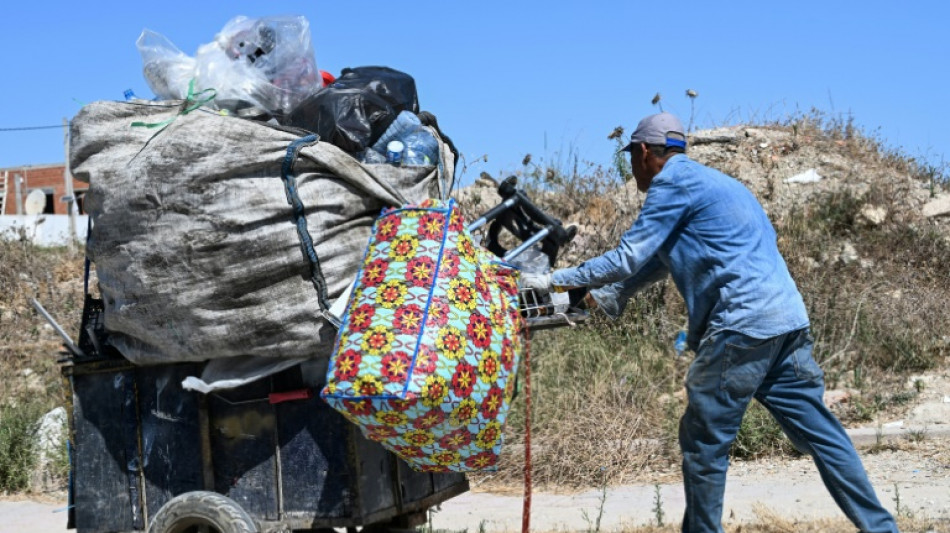
Tunisia plastic collectors spread as economic, migration woes deepen / Photo: FETHI BELAID - AFP

 Russians vote on last day of parliamentary elections

 Hong Kong pays final respects to former city leader Tung

 Typhoon put people off Asian Games opening ceremony, official says

 China's 13-year-old Yu cruises as Asian Games swimming begins

 AI 'warning shots' focus Beijing on national security risks

 Philippine tribe in limbo over US-led tech hub

 Leo XIV, first US pope transcends his restrained style

 Singer Ed Sheeran says Gaza situation 'unjustifiable' following controversy

 In 'Tenzing', a Sherpa mountaineer gets his due

 Ed Sheeran set to return to stage after Palestinian controversy

 Toulouse edge Vannes, Lyon beat Pau to take Top 14 summit

 Germans arrested for Louvre stunt in Mona Lisa hall

 Saudi-led coalition says Houthis fired ballistic missile at Riyadh

 France's debt climbs to highest since 1978: ministry

 McIlroy two shots off the lead at Wentworth after eagle on 18
 Martinez brace saves Inter in Serie A top-two clash with Roma
 Rosenior abused but guides Paris FC past old club Strasbourg
 Seven-try Lyon beat Pau, climb to Top 14 summit
 Brighton defeat a 'big lesson' against complacency for Arsenal, says Arteta

 Thousands protest inaction over climate crisis in Switzerland

 Carapaz out of cycling world championships

 'Fragile' Tottenham beaten by Aston Villa despite late rally

 Mourinho hails Real Madrid grit before Atletico derby clash

 Martin wins Austrian MotoGP sprint after Acosta crash

 Japan edge Fiji to win Pacific Nations Cup

A towel draped over his head, Hamza Jabbari sets bags of plastic bottles onto a scale. He is among Tunisia's "barbechas", informal plastic recyclers whose increasing numbers reflect the country's economic -- and migratory -- woes.
The 40-something-year-old said he starts the day off at dawn, hunching over bins and hunting for plastic before the rubbish trucks and other plastic collectors come.
"It's the most accessible work in Tunisia when there are no job offers," Jabbari said, weighing a day's haul in Bhar Lazreg, a working-class neighbourhood north of the capital, Tunis.
The work is often gruelling, with a kilogramme of plastic bottles worth only 0.5 to 0.7 Tunisian dinar -- less than $0.25.
In Tunis, it's common to see women weighed down by bags of plastic bottles along the roadside, or men weaving through traffic with towering loads strapped to their motorcycles.
"Everyone does it," said Jabbari.
- 'Supplementary job' -
Hamza Chaouch, head of the National Chamber of Recyclable Waste Collectors, estimated that there were roughly 25,000 plastic collectors across Tunisia, with 40 percent of them in the capital.
Yet, with the job an informal one, there is no official count of how many plastic collectors operate in Tunisia.
One thing is certain: their number has increased in recent years, said Chaouch, who also runs a plastic collection centre south of Tunis.
"It's because of the cost of living," he explained.
"At first, it was people with no income, but for the past two years, workers, retirees and cleaning women have also turned to this work as a supplementary job."
Around 16 percent of Tunisians lived under the poverty line as of 2021, the latest available official figures.
Unemployment currently hovers around 16 percent, with inflation at 5.4 percent.
The ranks of these recyclers have also grown with the arrival of migrants from sub-Saharan Africa -- often hoping to reach Europe but caught in limbo with both the EU and Tunis cracking down on Mediterranean crossings.
Tunisia is a key transit country for thousands of sub-Saharan migrants seeking to reach Europe by sea each year, with the Italian island of Lampedusa only 150 kilometres (90 miles) away.
Abdelkoudouss, a 24-year-old from Guinea, said he began collecting plastic to make ends meet but also to save up enough money to return home after failing two crossing attempts to Europe.
For the past two months, he has worked at a car wash, he said, but the low pay forced him to start recycling on the side.
"Life here is not easy," said Abdelkoudouss, adding he came to the capital after receiving "a lot of threats" amid tension between migrants and locals in Sfax, a coastal city in central Tunisia.
- 'Just trying to survive' -
Thousands of migrants had set up camp on the outskirts of Sfax, before authorities began dismantling the makeshift neighbourhoods this year.
Tensions flared in early 2023 when President Kais Saied said "hordes of sub-Saharan migrants" were threatening the country's demographic composition.
Saied's statement was widely circulated online and unleashed a wave of hostility that many migrants feel still lingers.
"There's a strong rivalry in this work," said Jabbari, glancing at a group of sub-Saharan African migrants nearby.
"These people have made life even more difficult for us. I can't collect enough plastic because of them."
Chaouch, the collection centre manager, was even more blunt: "We don't accept sub-Saharans at our centre. Priority goes to Tunisians."
In contrast, 79-year-old Abdallah Omri, who heads another centre in Bhar Lazreg, said he "welcomes everyone".
"The people who do this work are just trying to survive, whether they're Tunisian, sub-Saharan or otherwise," he said.
"We're cleaning up the country and feeding families," he added proudly.
M.King--AT



