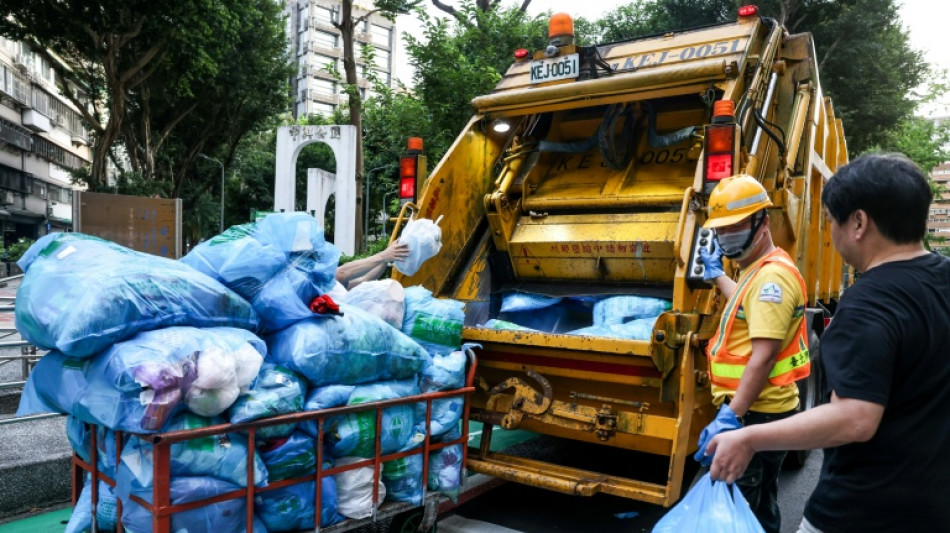
Taiwan's garbage trucks offer classical music and a catch-up / Photo: I-Hwa Cheng - AFP

 Russians vote on last day of parliamentary elections

 Hong Kong pays final respects to former city leader Tung

 Typhoon put people off Asian Games opening ceremony, official says
 China's 13-year-old Yu cruises as Asian Games swimming begins

 AI 'warning shots' focus Beijing on national security risks
 Philippine tribe in limbo over US-led tech hub

 Leo XIV, first US pope transcends his restrained style

 Singer Ed Sheeran says Gaza situation 'unjustifiable' following controversy

 In 'Tenzing', a Sherpa mountaineer gets his due

 Ed Sheeran set to return to stage after Palestinian controversy

 Toulouse edge Vannes, Lyon beat Pau to take Top 14 summit

 Germans arrested for Louvre stunt in Mona Lisa hall

 Saudi-led coalition says Houthis fired ballistic missile at Riyadh

 France's debt climbs to highest since 1978: ministry

 McIlroy two shots off the lead at Wentworth after eagle on 18

 Martinez brace saves Inter in Serie A top-two clash with Roma
 Rosenior abused but guides Paris FC past old club Strasbourg
 Seven-try Lyon beat Pau, climb to Top 14 summit
 Brighton defeat a 'big lesson' against complacency for Arsenal, says Arteta

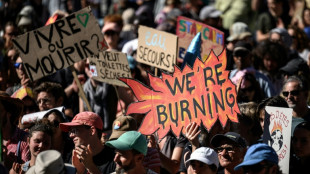 Thousands protest inaction over climate crisis in Switzerland

 Carapaz out of cycling world championships

 'Fragile' Tottenham beaten by Aston Villa despite late rally

 Mourinho hails Real Madrid grit before Atletico derby clash

 Martin wins Austrian MotoGP sprint after Acosta crash

 Japan edge Fiji to win Pacific Nations Cup

Taiwanese residents holding plastic bags of rubbish stand on a footpath as a yellow garbage truck playing classical music over a loudspeaker pulls up.
For decades, the tinkling of Beethoven's "Fur Elise" or Tekla Badarzewska-Baranowska's "Maiden's Prayer" has alerted Taiwanese households to take out their garbage.
Like clockwork, residents emerge from their apartment buildings carrying bags of pre-sorted rubbish as the musical garbage trucks approach.
"When we hear this music, we know it's time to take out the trash. It's very convenient," 78-year-old Lee Shu-ning told AFP as she waited outside her tower block in Taipei.
Residents toss plastic bags of general refuse into the yellow compaction truck, and tip food waste and recycling into bins carried by another vehicle.
For the elderly, taking out the trash has become a social event and many arrive early to sit and talk around the collection points.
"I can chat with some old neighbours and friends, it's nice," Lee said, before disposing of several bottles and cans.
"It's also a kind of exercise," she added.
But not everyone is a fan.
"I think it's quite inconvenient because it comes at a fixed time every day," said 31-year-old beautician Dai Yun-wei after dumping her rubbish in the truck.
"Sometimes we're not home or we're busy, so we can't throw away the trash."
- 'Save a lot of time' -
Taiwan's musical garbage trucks have been an almost daily feature of life on the island since the 1960s, Shyu Shyh-shiun of Taipei's Department of Environmental Protection told AFP.
Taiwan imported German garbage trucks pre-programmed with "Fur Elise", Shyu said, but added it was not clear how the "Maiden's Prayer" became part of the repertoire.
The trucks operate five days a week, usually in the late afternoon and evening.
Yang Xiu-ying, 76, has made a living out of helping her neighbours dispose of their garbage.
She receives NT$11,200 ($380) a month from 28 households in her lane to sort their trash, load it onto a trolley and take it to the refuse trucks.
"Some people get off work late, some elderly people find it inconvenient, so they take it downstairs and I dump the garbage for them," Yang said, wearing two layers of gloves and long protective sleeves.
Others have turned to digital solutions for their rubbish problem.
The young founders of Tracle created an app enabling people to book a time for their trash to be taken away.
"I think our value is that we save a lot of time for them," co-founder Ben Chen said.
"We enhance their life quality."
- Cleaning up -
Over the past 30 years, Taiwan has been cleaning up its waste management act.
An economic boom had led to an explosion of garbage, with almost no recycling, landfills overflowing and people protesting air and ground pollution.
In response, the island ramped up recycling, increased incineration and made people responsible for sorting and dumping their own trash in the trucks instead of leaving it on the ground for collection.
Taipei residents are also required to buy government-approved blue plastic bags for their general waste to encourage them to use less and recycle more.
"In the beginning, everybody feels... that it's not very convenient," Shyu said.
But once people started noticing the cleaner streets, "they feel this is a good policy".
The city's recycling rate has surged to nearly 67 percent, from two percent in 2000, and the amount of garbage sent for incineration has fallen by two-thirds, Shyu said.
And, he said, smiling, the trucks are "almost" always on time.
T.Perez--AT



