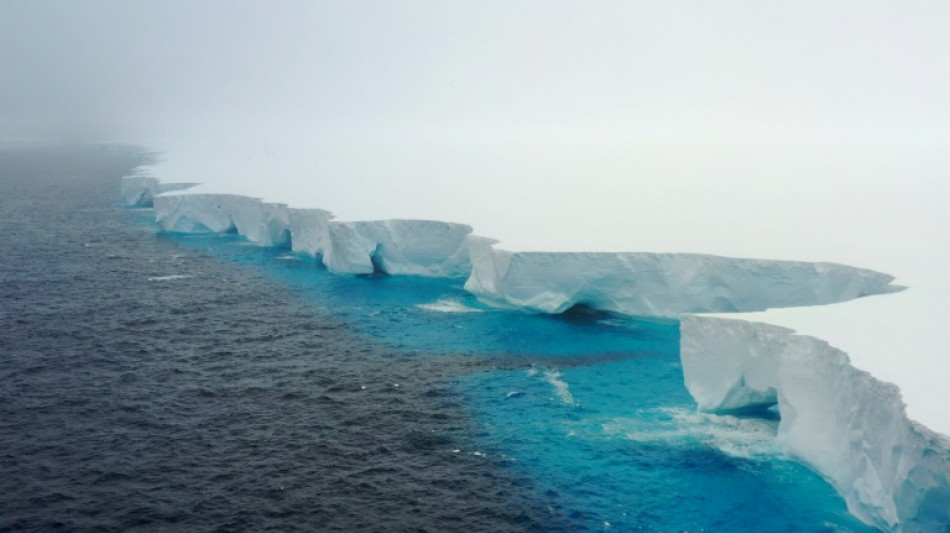
Tides could help predict when huge icebergs break loose: study / Photo: Richard Sidey - EYOS Expeditions/AFP/File

 Russians vote on last day of parliamentary elections

 Hong Kong pays final respects to former city leader Tung

 Typhoon put people off Asian Games opening ceremony, official says

 China's 13-year-old Yu cruises as Asian Games swimming begins

 AI 'warning shots' focus Beijing on national security risks

 Philippine tribe in limbo over US-led tech hub

 Leo XIV, first US pope transcends his restrained style

 Singer Ed Sheeran says Gaza situation 'unjustifiable' following controversy

 In 'Tenzing', a Sherpa mountaineer gets his due

 Ed Sheeran set to return to stage after Palestinian controversy

 Toulouse edge Vannes, Lyon beat Pau to take Top 14 summit

 Germans arrested for Louvre stunt in Mona Lisa hall

 Saudi-led coalition says Houthis fired ballistic missile at Riyadh

 France's debt climbs to highest since 1978: ministry

 McIlroy two shots off the lead at Wentworth after eagle on 18

 Martinez brace saves Inter in Serie A top-two clash with Roma

 Rosenior abused but guides Paris FC past old club Strasbourg

 Seven-try Lyon beat Pau, climb to Top 14 summit

 Brighton defeat a 'big lesson' against complacency for Arsenal, says Arteta

 Thousands protest inaction over climate crisis in Switzerland

 Carapaz out of cycling world championships

 'Fragile' Tottenham beaten by Aston Villa despite late rally

 Mourinho hails Real Madrid grit before Atletico derby clash

 Martin wins Austrian MotoGP sprint after Acosta crash

 Japan edge Fiji to win Pacific Nations Cup

Ocean tides can trigger city-sized icebergs to break off from Antarctic ice shelves, scientists said on Thursday, offering a potential way to predict these dramatic events in the future.
It is not normally possible to forecast when icebergs break free, or calve, although the timing is important because these behemoths change the shape of ice sheets and affect global sea levels.
Yet when a chunk of ice the size of Greater London suddenly broke off the Brunt Ice Shelf in 2023 and started drifting away, glaciologist Oliver Marsh was not surprised.
Marsh told AFP he had predicted that a huge iceberg breaking off was "imminent within the next weeks to months".
The British Antarctic Survey researcher had spent years studying the huge crack that would create the 550-square-kilometre (210-square-mile) iceberg named A81.
As Marsh had anticipated, the calving occurred at the peak of spring tide, when there is the biggest difference between the ocean's high and low tide.
New research led by Marsh, published in the journal Nature Communications on Thursday, used modelling to show that the calving was triggered by the tide, along with high winds and stress on the ice.
After A81 broke off, Marsh visited the ice shelf to see how open water had replaced what had previously been "ice as far as you could see".
"It was sad to see it go, in a way," he said.
A81 is currently drifting up the eastern side of the Antarctica Peninsula towards the Weddell Sea.
It remains to be seen whether it will come close to South Georgia island, which is an important breeding ground for penguins, seals and other animals.
- 'Out of balance' -
The world's biggest iceberg, A23a, ran aground not too far from South Georgia earlier this year but is not thought to pose a threat to wildlife.
Now that A23a is exposed to the waves of the Southern Ocean, its "days are numbered", Marsh said.
He emphasised that iceberg calving is a natural process which balances out the massive amount of snow that falls on Antarctica every year.
However, "now we're out of balance", Marsh added.
Antarctica loses ice in two ways -- icebergs calving and ice sheets melting.
And ice sheets are melting at a rapidly increasing rate as oceans warm due to human-driven climate change, scientists have warned.
"We don't know whether calving rates have gone up" because they happen relatively infrequently, Marsh said.
A81 was the second of three mammoth icebergs that have broken free of the Brunt Ice Shelf since 2021.
"We are expecting a very large calving event at some point from this area" in the future, Marsh said.
But he could not give a timeframe.
"Whilst we're saying we are a step closer to being able to predict these events... it is still difficult to predict."
W.Nelson--AT



