'Every day I see land disappear': Suriname's battle to keep sea at bay / Photo: Juan BARRETO - AFP

 Russians vote on last day of parliamentary elections
 Hong Kong pays final respects to former city leader Tung

 Typhoon put people off Asian Games opening ceremony, official says

 China's 13-year-old Yu cruises as Asian Games swimming begins

 AI 'warning shots' focus Beijing on national security risks

 Philippine tribe in limbo over US-led tech hub

 Leo XIV, first US pope transcends his restrained style

 Singer Ed Sheeran says Gaza situation 'unjustifiable' following controversy

 In 'Tenzing', a Sherpa mountaineer gets his due

 Ed Sheeran set to return to stage after Palestinian controversy

 Toulouse edge Vannes, Lyon beat Pau to take Top 14 summit

 Germans arrested for Louvre stunt in Mona Lisa hall

 Saudi-led coalition says Houthis fired ballistic missile at Riyadh

 France's debt climbs to highest since 1978: ministry

 McIlroy two shots off the lead at Wentworth after eagle on 18

 Martinez brace saves Inter in Serie A top-two clash with Roma
 Rosenior abused but guides Paris FC past old club Strasbourg
 Seven-try Lyon beat Pau, climb to Top 14 summit
 Brighton defeat a 'big lesson' against complacency for Arsenal, says Arteta

 Thousands protest inaction over climate crisis in Switzerland

 Carapaz out of cycling world championships

 'Fragile' Tottenham beaten by Aston Villa despite late rally

 Mourinho hails Real Madrid grit before Atletico derby clash

 Martin wins Austrian MotoGP sprint after Acosta crash

 Japan edge Fiji to win Pacific Nations Cup
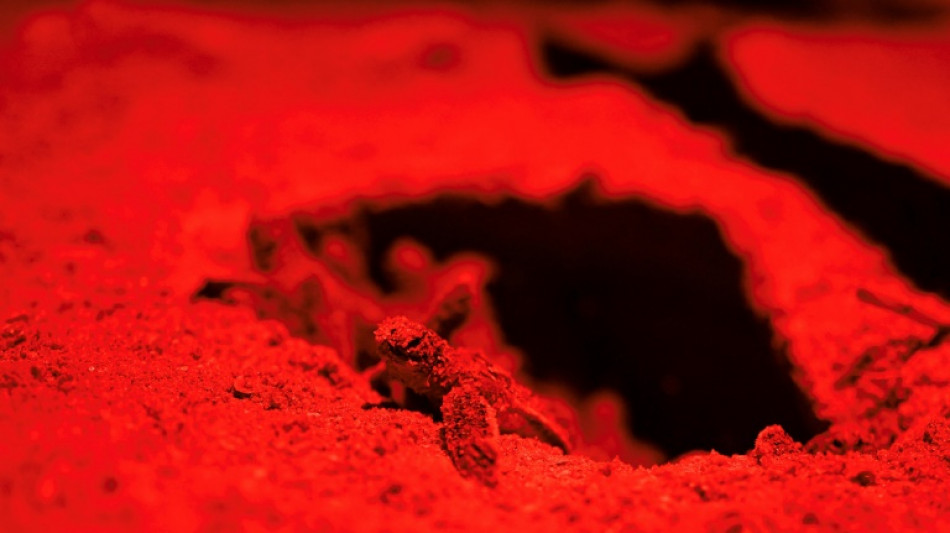
In the dead of night on a beach in Suriname's capital Paramaribo, a group of just-hatched baby sea turtles clamber out of their sandy nesting hole and race, flippers flailing, towards the sea.
For years, endangered leatherbacks and green turtles have emerged onto Braamspunt beach to lay their eggs.
But the land spit at the tip of the Suriname river estuary is rapidly vanishing as erosion, caused by rising sea levels linked to climate change, gobbles up entire swathes of Paramaribo's coastline.
"Maybe we'll get one more season out of this," Kiran Soekhoe Balrampersad, a guide who accompanied a group of tourists on a recent expedition to see the nesting turtles, told AFP.
"But after that there'll no longer be a beach," he added dolefully.
Suriname, South America's smallest country, is one of the most vulnerable in the world to rising sea levels.
Nearly seven out of ten people in the former Dutch colony of 600,000 inhabitants live in low-lying coastal areas, according to the UN Intergovernmental Panel on Climate Change.
"Every day I see a piece of my land disappear," said Gandat Sheinderpesad, a 56-year-old farmer who has lost 95 percent of his smallholding to the sea.
Local authorities have for years been trying to find a way to hold back the tide.
"Some areas are not problematic because we have 5, 10, even 20 kilometers (3, 6 or 12 miles) of mangrove" acting as a buffer between the waves and the shore, Minister of Public Works Riad Nurmohamed told AFP.
But near Paramaribo, "there is just one kilometer so it's a very vulnerable zone," he added.
In 2020, a program to restore the capital's mangroves was launched.
UN Secretary General Antonio Guterres sought to add VIP power to the initiative in 2022 by wading into the mud to personally plant seedlings.
But five years later, Sienwnath Naqal, the climate change and water management expert who led the project, surveys a scene of desolation.
The sea is now lapping at the edge of a road and the wooden stakes to which he had attached hundreds of samplings are largely bare.
High seas carried away the substrate sediment, leaving the roots exposed.
"Over the last two to three years the water forcefully penetrated the mangroves, which were destroyed," Nurmohamed said.
The dredging of sand at the entrance to Paramaribo estuary to facilitate the passage of boats headed upriver to the port also contributed to the erosion, said Naqal.
But like the Amazon rainforest in neighboring Brazil, the destruction was also deliberate in places, with farmers uprooting mangroves to make way for crops.
- 'No time to waste' -
With the water lapping at the feet of Paramaribo's 240,000 people, Suriname has changed tack and set about building a dyke.
For Sheinderpesad, the levee represents his last chance of remaining on his land.
"I have nowhere else to go. When we have the dyke, I will be safer, although I'm not sure for how long," he said.
The 4.5 kilometer-long barrier will cost $11 million, which the government has vowed to fund from state coffers.
"If you go see donors it takes years before you can start to built. We have no time to waste, we'll be flooded," Nurmohamed explained.
But plugging one hole in the country's maritime defenses will not suffice to keep the mighty Atlantic at bay.
The government wants to build up the entire network of dykes that dot the country's 380-kilometer coastline.
It's just not sure where to find the money.
"It's a colossal investment," Nurmohamed said.
The country's newly discovered offshore oil deposits may provide the answer.
Last year, French group TotalEnergies announced a $10.5 billion project to exploit an oil field off Suriname's coast with an estimated capacity of producing 220,000 barrels per day.
F.Wilson--AT



