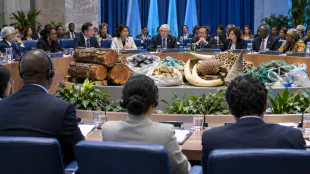
EU plans to scrap anti-greenwashing rules after pushback / Photo: Kenzo TRIBOUILLARD - AFP/File

 India's Wholesale Inflation Jumps to 12.29% as Fuel Costs Surge
 China's October Activity Data Reveal a Weak Start to the Fourth Quarter
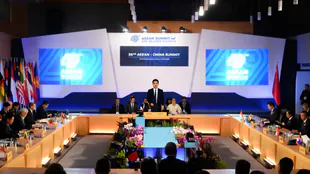 Philippines Urges ASEAN and China to Accelerate South China Sea Code of Conduct

 Mbeki Claims No Progress Since 2018; Author Cites Infrastructure and Economic Gains

 Qatar's Amir and Venezuelan Acting President Discuss Energy Cooperation

 Blue Chip Capital Group Announces Quotation of its Common Stock on the OTCID and Updates Status of Initial Regulatory Compliance
 OBI Pharma Signs Collaboration and License Agreement with Novartis

 Strategic Metals Reports Promising Results From the Rusty and Ranch Projects

 Big Mamma Founder Tigrane Seydoux Brings Italian Restaurant Group to Florida

The European Commission said Friday it intends to scrap new rules against greenwashing after they hit a roadblock in the final stretch from conservative lawmakers calling them too onerous for businesses.
The "Green Claims Directive" would require companies to provide hard facts to back up claims that their products are carbon-neutral, biodegradable or "less polluting".
Businesses would need to submit evidence for environmental claims for approval by independent verifiers -- with fines and other penalties for failure to comply.
"In the current context, the commission intends to withdraw the Green Claims proposal," the EU executive's spokesperson on environmental matters, Maciej Berestecki, told reporters.
European lawmakers and the bloc's 27 member states agreed last year to move ahead with the directive, which was being finalised in three-way negotiations with the commission with a final meeting set for Monday.
But the centre-right European People's Party -- parliament's biggest force, which is now pushing to roll back parts of the EU's green agenda -- was not satisfied with the text, and asked this week for the commission to withdraw it.
Berestecki said the EU's executive arm decided to do just that, because the "current discussions around the proposal" went against its "simplification agenda".
Currently 30 million micro-enterprises -- or 96 percent of all firms -- would be covered by the text, something the commission did not like, Berestecki explained.
EU chief Ursula von der Leyen, who hails from the EPP, has pledged to make life easier for businesses in a bid to re-launch the European economy.
Danuse Nerudova, the EPP's negotiator on the file, welcomed the commission's move, describing the proposal as "overly complex" and lacking an impact assessment to show its benefits would outweigh the burdens on businesses.
"We need regulation that is clear, proportionate, and grounded in evidence," she said in a statement to AFP. "Less bureaucracy and more competitiveness -- that's what we promised to citizens."
But fellow lawmaker Sandro Gozi, of the centrist Renew group, called the decision "shameful".
"It is unacceptable that the EPP, in tandem with the far-right, is trying to undermine a fundamental piece of legislation to protect European citizens from corporate environmental fraud," he said.
Since last year's elections saw the EU parliament shift right, the bloc has embarked on a drive to cut red tape seen as hindering economic growth -- including key parts of the environmental "Green Deal" of von der Leyen's first term.
Most strikingly, a hard-fought law requiring companies to ensure their global supply chains are free of ethical and environmental abuses has had its rollout pushed back to 2028 -- and its future is in doubt.
The green claims bill was one of several EU initiatives clamping down on greenwashing, with a separate law adopted last year that banned broad, generic claims such as labelling products "eco-friendly" or "natural".
W.Nelson--AT