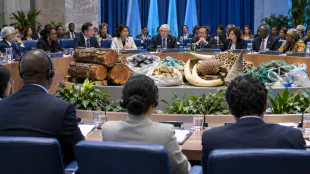
Paris makes clean water bet for River Seine bathers / Photo: JOEL SAGET - POOL/AFP

 India's Wholesale Inflation Jumps to 12.29% as Fuel Costs Surge
 China's October Activity Data Reveal a Weak Start to the Fourth Quarter
 Philippines Urges ASEAN and China to Accelerate South China Sea Code of Conduct

 Mbeki Claims No Progress Since 2018; Author Cites Infrastructure and Economic Gains

 Qatar's Amir and Venezuelan Acting President Discuss Energy Cooperation

 Blue Chip Capital Group Announces Quotation of its Common Stock on the OTCID and Updates Status of Initial Regulatory Compliance
 OBI Pharma Signs Collaboration and License Agreement with Novartis

 Strategic Metals Reports Promising Results From the Rusty and Ranch Projects

 Big Mamma Founder Tigrane Seydoux Brings Italian Restaurant Group to Florida

A year on from athletes competing in the River Seine during the 2024 Paris Summer Olympics, French authorities guarantee the water will be safe for the public to swim in this summer.
Parisians and tourists will be able to dive into the river from July 5, weather permitting, according to authorities.
The public will be able to access three bathing sites at bras Marie in the heart of the historic centre, the Grenelle district in the west of Paris, as well as Bercy in the east.
Last year, water treatment stations, holding tanks and connections to the Parisian boat sanitation system were installed.
"For the Games, we cleaned up three quarters of the Seine. And the water was 100 percent ready for bathing on dry days," said Marc Guillaume, the prefect for the Ile-de-France region that includes Paris.
According to Guillaume, the top state-appointed official for the region, the new bathing zones will be popular.
This year, the weather is predicted to be drier than the record rainfall during the Games, which had led to the cancellation of six of the eleven competitions held the river.
"It was an extraordinary moment (in 2024), but swimming during the Games was not an end in itself," Paris Mayor Anne Hidalgo had told reporters in May.
"Making the Seine swimmable is first and foremost a response to the objective of adapting to climate change, but also of quality of life," she added.
- "Bathing plan" -
Last year, Hidalgo dove into the Seine in front of journalists from around the world before the Games began.
The historic swim signalled the end of years of efforts to clean the Seine and the river which flows into it, the Marne.
Work had started in the 1990s, with an initial investment of more than nine billion euros (10.4 billion dollars) from the greater Paris sanitation authorities.
Following initial efforts, the "bathing plan" leading up to the 2024 Paris Games was launched in 2016. The French state and local authorities had invested another 1.4 billion euros (1.6 billion dollars).
The plan was focused on preventing the city's waste waters from flowing into the Seine.
The mid-19th century Parisian sewage system often overflows on rainy days, causing rain and waste waters to pour into the river.
- "Insufficient" testing -
Flags will inform bathers about pollution levels in the water every day, and if it rains the sites will likely close on the day after, said Paris city official Pierre Rabadan.
"We're not tossing a coin, we're relying on scientific data," he said, adding that no athlete had fallen ill after swimming in the river last summer.
The presence of the fecal bacteria escherichia coli (E. coli) and enterococci in the Seine will be assessed daily using live sensors and samples.
According to the association France Nature Environment Ile-de-France, the planned tests are "insufficient".
There are "many viruses which cannot be tested for" in the Seine, said honorary president of the association Michel Riottot.
Swallowing too much water from the river could lead a person to catch hepatitis, gastroenteritis or skin diseases, former research engineer Riottot told AFP.
Chemical pollution will not be measured either, added Riottot.
"If there is occasional pollution upstream, we will be informed, so we will be able to take necessary measures," said Rabadan.
The number of species of fish in the Seine increased from four in 1970 to thirty-six reported in February -- a sign that water sanitation has improved over the years.
In early June, the Paris City Council gave legal rights and a personhood status to the Seine to protect its fragile ecosystem, as part of a global movement to grant legal personhood to nature.
B.Torres--AT