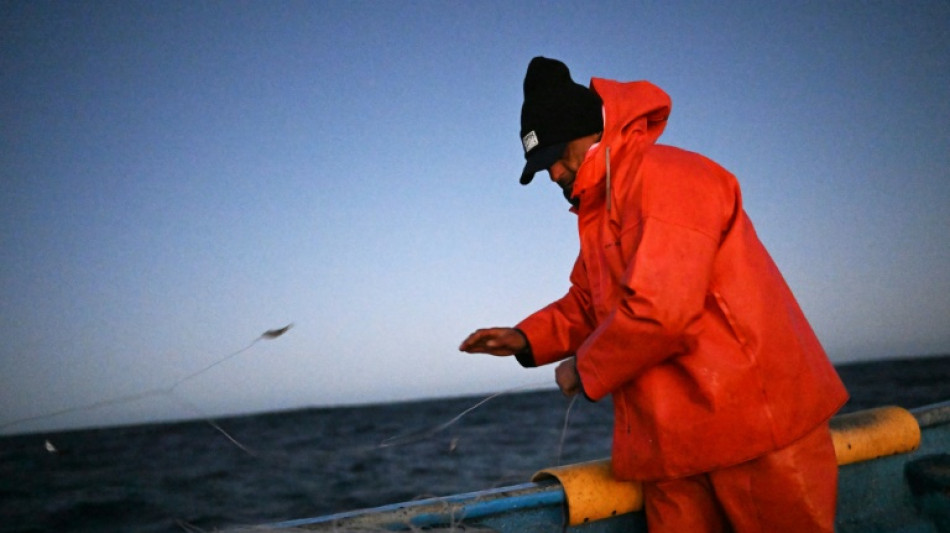
Missing merluza: Chile's battle to save its favorite catch / Photo: RODRIGO ARANGUA - AFP

 Germans vote in elections threatening fresh blow to Merz

 US fears rapid escalation in Mideast after Houthis attack Riyadh

 Japan triathlete Hojo wins first gold of Asian Games

 IOC president impressed by 'beautiful' Asian Games wooden huts

 First Asian Games gold goes to Japan as China's 13-year-old Yu lights up pool

 Data centre command hub keeps AI up and running

 Pope Leo in France: the issues on the table

 Packing for a pope: behind the scenes on foreign trips

 Republicans find transgender issues a powerful political weapon in midterm campaigning

 German state elections threaten new shock waves for Merz

 Chile's Bachelet quits race to be next UN chief

 Raphinha treble fires perfect Barca to win at Sevilla

 Thiam makes winning heptathlon return at Decastar meet

 Czechs beat USA to qualify for Davis Cup finals

 Dortmund sink Stuttgart to climb to Bundesliga summit

 Trump says will not tolerate attempts to slow AI growth

 'It has to stop': runners protest women's murders in S.Africa district

 Fire erupts near Riyadh airport as Houthis claim strikes

 Cuba works to restore power after another blackout

 England thrash Sri Lanka again to return to top of T20 rankings

 Arsenal thrashed by Brighton, sorry Spurs lose again

 South Korea, Austria qualify for Davis Cup finals

 Seare shocks Ingebrigtsen to win world 5km gold

 Brigitte Bardot widower slams sale of star's belongings

 Aston Villa compound Tottenham's misery despite late rally

Before setting sail for the South Pacific, Chilean fisherman Rodrigo Gallardo blesses himself to invoke heavenly protection and luck in his pursuit of an increasingly elusive catch: hake.
Strong winds make for a choppy seven-nautical-mile (13 kilometer) voyage from the port of Valparaiso to deep waters that decades ago were teeming with Chile's favorite fish.
But several hours later, when Gallardo reels in a longline studded with sardines (these small fry are used as bait) just a single hake has bitten.
"In the past, the hold was completely full," the 46-year-old lamented.
The South Pacific hake, or merluccius gayi, provides a living for some 4,000 small-scale fishermen in Chile, a country with over 6,000 kilometers of coastline, which has a voracious appetite for "merluza."
But the attraction for cod's more affordable cousin is proving fatal.
Along central Chile's traditional fishing heartland, more and more boats are returning to port with empty holds as overfishing and climate change decimate hake stocks.
In the past two decades, Chile's hake population has declined by 70 percent according to the Fisheries Development Institute (IFOP).
Gallardo, 46, blames years of regulations that benefitted commercial "bottom" trawlers, which use drag nets to scoop up huge amounts of deep-water fish, like hake, depleting ocean stocks.
Commercial fisheries, for their part, blame illegal fishing by small-scale fishermen like Gallardo.
- Regulations fall short -
Chile has been fighting a high stakes battle against overfishing for years.
With several species in severe decline by the early 2010s, from hake to jack mackerel and jumbo squid, the government introduced annual biomass (weight) quotas designed to determine sustainable fishing levels.
Chile also designated over 40 percent of its waters as Marine Protected Areas, where fishing is restricted, and signed up to the United Nations High Seas Treaty on protecting marine biodiversity.
A decade on, the populations of some species, such as sardines, cuttlefish and horse mackerel -- Chile's biggest fish export -- have begun to recover.
The hake numbers, however, continue to make for grim reading.
An IFOP study from 2024 showed a 17 percent drop in the biomass of hake stocks compared to the previous year.
- Drop in the ocean -
Rodrigo Catalan, conservation director of the Chilean chapter of the World Wildlife Fund, blames a mix of "illegal fishing, over-exploitation and climate change" for making hake increasingly scarce.
In 2023, authorities seized 58 tons of illegal hake, the second-largest seizure by species after anchovies.
The authorities suspect it's just a drop in the ocean.
Because hake is usually caught close to shore, it's easy to quickly reel it in without being noticed.
Much of the illegal catch winds up for sale in small quantities on markets, which also makes it difficult to detect, according to the National Fisheries Service.
Experts say climate change is also wreaking havoc with fish stocks.
Alicia Gallardo, a researcher at the University of Chile, said that rising sea temperatures was causing hake to migrate further south in search of colder currents, and was also affecting reproduction rates.
- Too many nets, too few fish -
Having to share an ever-shrinking catch -- the annual quota for hake now stands at 35,000 tons, down from 118,000 in 2001 -- has caused tempers in Chile to flare.
"There aren't enough fish for so many fishermen," Liesbeth van der Meer, director of the ocean conservation NGO Oceana remarked.
Small-scale fishermen in Valparaiso clashed with police during three days of protests in March over delays in adopting a bill that boosted their share of the catch quota for hake, among other species.
Chile's biggest commercial fishery PacificBlu threatened to close shop, with the loss of 3,200 jobs, if its share was cut but later revoked the threat.
The bill, which increases the quota for artisanal fishing from 40 percent to 45 percent, was finally adopted by the Senate this week.
A.Ruiz--AT



