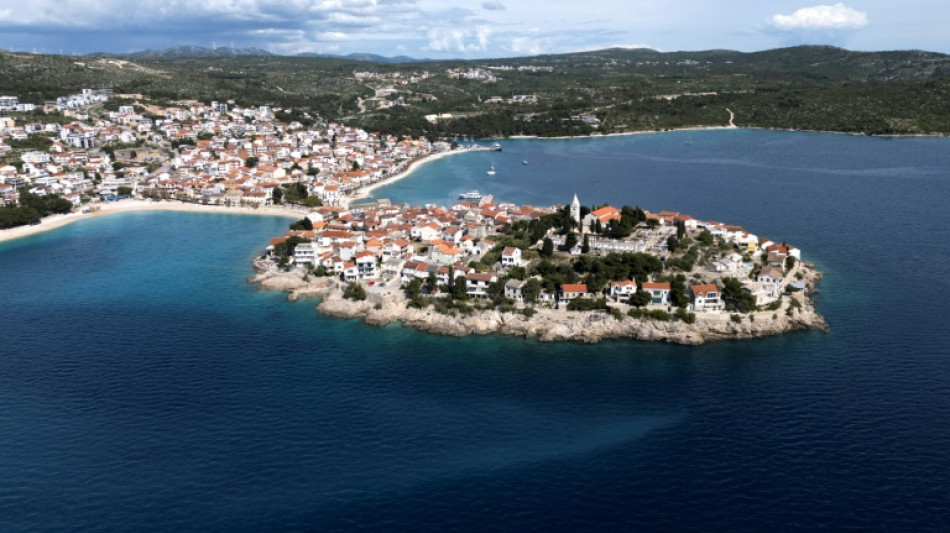
Booming tourism takes its toll on Croatia's coast / Photo: ELVIS BARUKCIC - AFP

 Germans vote in elections threatening fresh blow to Merz

 US fears rapid escalation in Mideast after Houthis attack Riyadh

 Japan triathlete Hojo wins first gold of Asian Games

 IOC president impressed by 'beautiful' Asian Games wooden huts

 First Asian Games gold goes to Japan as China's 13-year-old Yu lights up pool

 Data centre command hub keeps AI up and running

 Pope Leo in France: the issues on the table

 Packing for a pope: behind the scenes on foreign trips

 Republicans find transgender issues a powerful political weapon in midterm campaigning

 German state elections threaten new shock waves for Merz

 Chile's Bachelet quits race to be next UN chief

 Raphinha treble fires perfect Barca to win at Sevilla

 Thiam makes winning heptathlon return at Decastar meet

 Czechs beat USA to qualify for Davis Cup finals

 Dortmund sink Stuttgart to climb to Bundesliga summit

 Trump says will not tolerate attempts to slow AI growth

 'It has to stop': runners protest women's murders in S.Africa district

 Fire erupts near Riyadh airport as Houthis claim strikes

 Cuba works to restore power after another blackout

 England thrash Sri Lanka again to return to top of T20 rankings

 Arsenal thrashed by Brighton, sorry Spurs lose again

 South Korea, Austria qualify for Davis Cup finals

 Seare shocks Ingebrigtsen to win world 5km gold

 Brigitte Bardot widower slams sale of star's belongings

 Aston Villa compound Tottenham's misery despite late rally

With its rugged coastline, pristine waters and more than a thousand inlets and islands, Croatia has seen a tourist boom in recent years. Last year alone, more than 20 million visited the Balkan nation, much of which stretches along the Adriatic Sea.
But the environmental impact of tourism on the nearly 6,000-kilometre (3,720-mile) coastline and marine life is troubling experts -- and prompting calls for action.
Sakarun beach on Dugi Otok island is often called "Croatia's Caribbean". Tourist boats drop anchor in the turquoise waters of the bay and head for its white sands.
Some visitors complained, however, about unsightly swathes of Posidonia or dark Mediterranean seagrass on the shore, which led to its removal.
The heavy machinery involved also removed sediment, resulting in the gradual disappearance of the sandy beach over the last decade.
Croatia only has only a small number of sandy and pebble beaches, while the rest are rocky.
"We don't have many sandy beaches so it's important that the sand we have is protected," said geologist Kristina Pikelj, from Zagreb University Faculty of Science.
In 2021, she launched a project to monitor Sakarun, and to educate locals and tourists about the vital role played by the so-called "lungs of the sea".
Posidonia -- a key store of carbon and producer of oxygen -- is critical to slowing the effects of climate change, as well as being vital for marine habitats and providing an erosion buffer for the beaches.
For the past three years Posidonia, which was once used as a vineyard fertiliser, has been left on the beach, spread apart in piles.
"We understand the tourist aspect, to show them the sand, this bay is beautiful and people really enjoy it," said Pikelj.
Marija Meklav, one of three students participating in the fieldwork at Sakarun, added: "We are trying to raise public awareness and achieve something directly through field and laboratory work.
"Our generation can achieve something in this regard," the 24-year-old said.
- Artificial beaches -
With tourist numbers growing, local authorities have been expanding beach capacity for tourists in search of sun, sea and sand.
At some locations so-called beach nourishment -- adding sediment to repair natural erosion -- has been carried out.
But the technique has also been used to cover natural rocky parts with gravel or even concrete. During winter, the sea carries it away, meaning the costly process has to be repeated every season
Dalibor Carevic, from Zagreb University Faculty of Civil Engineering said in places like Primosten, often called "the town of beaches" on the central coast north of Split, the practice has gone too far.
Experts repeatedly warned against the removal of hundreds of metres of rocks along one of its central beaches.
The rocks were ground and mixed with quarry stones to make an artificial pebble beach that opened in 2011, with the process repeated every year.
In less than a decade the coastline at the Mala Raduca beach has shifted by some 20 metres towards the sea, satellite pictures show.
Primosten's veteran mayor Stipe Petrina, though, said beach nourishment was essential for a town dependent entirely on tourism.
"One cannot have a capacity for 15,000 people and beaches for 2,000," he told AFP comparing it with a ski resort that hosts thousands of skiers but only offers a few hundred metres of slopes.
When tourism started to take off in the 1960s, locals ground rocks to make access to the sea easier.
"Once there were vineyards here that could have remained but we would have all emigrated. The question is what is better," said Petrina.
"In another Primosten bay there are rocks but I cannot see many tourists there," Petrina said.
The town of 2,800 people hosted nearly 90,000 tourists last year, mostly between July and August.
In early May, German tourist Karin Hoggermann watched trucks bringing new gravel to prepare the beach for the season.
"For swimming and going in the sea, for kids, it's better that they repair the beach. Tourists would not come if they would not do that," she said.
- 'Conquest of the sea' -
Unlike in Italy, Spain, the Netherlands or France, which also use beach nourishment, few rivers flow into the Adriatic Sea off Croatia, making its ecosystem more vulnerable as it is less accustomed to additional sediment input.
Excessive construction even in protected marine areas, concreting, non-compliance with regulations and huge fleets of charter boats also take their toll.
The number of car parks, marinas, ports and roads are also growing.
One long-term solution is to raise awareness among locals and authorities as well as education, experts said, urging consultation for more sustainable solutions.
"That conquest of the sea is not good and should be discouraged," said Carevic.
N.Walker--AT



