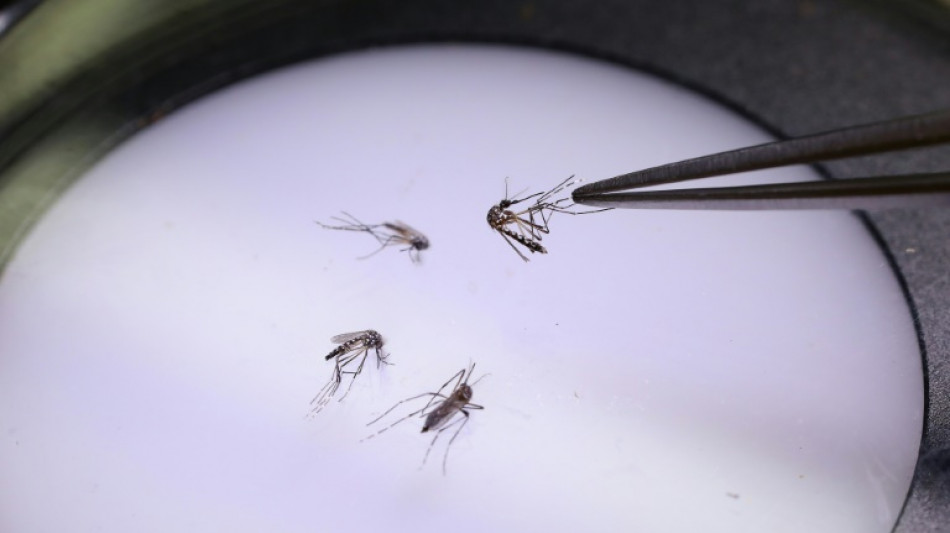
Invasive species cost trillions in damages: study / Photo: JAIME SALDARRIAGA - AFP/File

 Germans vote in elections threatening fresh blow to Merz

 US fears rapid escalation in Mideast after Houthis attack Riyadh

 Japan triathlete Hojo wins first gold of Asian Games

 IOC president impressed by 'beautiful' Asian Games wooden huts

 First Asian Games gold goes to Japan as China's 13-year-old Yu lights up pool

 Data centre command hub keeps AI up and running

 Pope Leo in France: the issues on the table

 Packing for a pope: behind the scenes on foreign trips

 Republicans find transgender issues a powerful political weapon in midterm campaigning

 German state elections threaten new shock waves for Merz

 Chile's Bachelet quits race to be next UN chief

 Raphinha treble fires perfect Barca to win at Sevilla

 Thiam makes winning heptathlon return at Decastar meet

 Czechs beat USA to qualify for Davis Cup finals

 Dortmund sink Stuttgart to climb to Bundesliga summit

 Trump says will not tolerate attempts to slow AI growth

 'It has to stop': runners protest women's murders in S.Africa district

 Fire erupts near Riyadh airport as Houthis claim strikes

 Cuba works to restore power after another blackout

 England thrash Sri Lanka again to return to top of T20 rankings
 Arsenal thrashed by Brighton, sorry Spurs lose again

 South Korea, Austria qualify for Davis Cup finals

 Seare shocks Ingebrigtsen to win world 5km gold

 Brigitte Bardot widower slams sale of star's belongings

 Aston Villa compound Tottenham's misery despite late rally

From river-clogging plants to disease-carrying insects, the direct economic cost of invasive species worldwide has averaged about $35 billion a year for decades, researchers said Monday.
Since 1960, damage from non-native plants and animals expanding into new territory has cost society more than $2.2 trillion, 17 times higher than previous estimates, they reported in the journal Nature Ecology & Evolution.
The accelerating spread of invasive species -- from mosquitoes to wild boar to tough-to-eradicate plants -- blights agriculture, spreads disease and drives the growing pace of species extinction.
Earlier calculations based on highly incomplete data were already known to fall far short of reality.
To piece together a more accurate picture, an international team of researchers led by Ismael Soto, a scientist at the University of South Bohemia in the Czech Republic, compiled data on 162 invasive species whose costs have been well documented in at least a handful of countries.
They then modelled the economic impact for 78 other countries such as Bangladesh and Costa Rica, for which no data was previously available.
"We expected an underestimation of invasion costs, but the magnitude was striking," Soto told AFP.
Due mainly to high volumes of trade and travel, tens of thousands of animal and plant species have taken root, sometimes literally, far from their places of origin.
Europe is by far the continent most affected by the phenomenon, followed by North America and Asia.
"Plants were the most economically damaging group, both for damage and management," Soto said. "Cost hotspots include urban coastal areas, notably in Europe, eastern China, and the US."
Animals can cause devastating damage too.
Wild boar, for example, destroy crops, cornfields and vineyards, while mosquitoes -- with expanding ranges due to global warming -- impose direct costs to human health by spreading diseases such as dengue and malaria.
Another example is Japanese knotweed, an invasive plant that is very common in Europe and requires costly eradication programmes.
"Our study is based on only 162 species," Soto noted. "Our figure is probably still an underestimate of a wider problem, and therefore the real economic costs could be even higher."
Using a broader definition -- including indirect costs such as lost income -- the UN's biodiversity expert group, IPBES, has calculated the total cost to society of invasive species at about $400 billion annually.
K.Hill--AT



