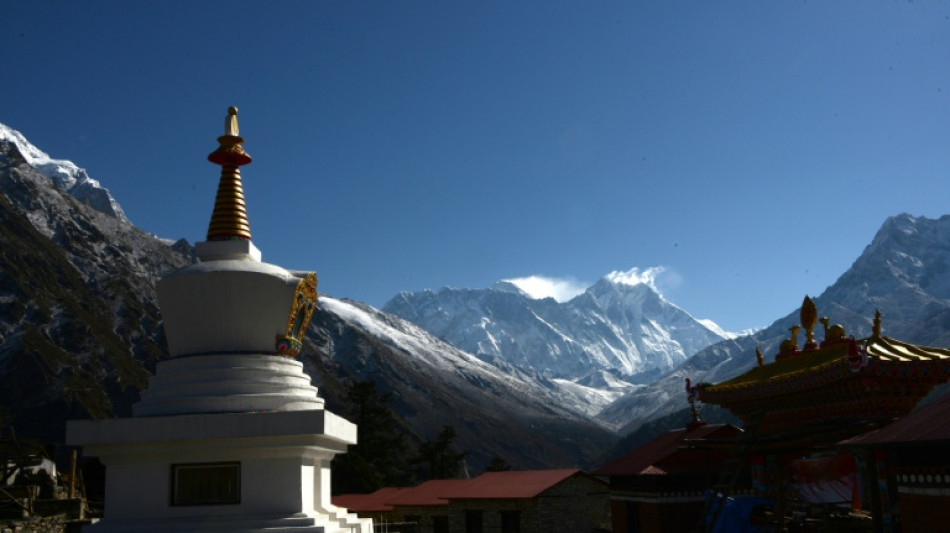
British climbers summit Everest in record bid / Photo: PRAKASH MATHEMA - AFP/File

 Park Jin-young Denies Cult Allegations Against Firstfruits Group

 MotorTrend's Top Electric Vehicle Picks for 2026

 St Francis School Leads €60,000 EU Project to Transform Early Childhood Education
 ELEKTROS Invites Shareholders to Shine Bright as the Holiday Season Nears, with Focus on Lithium, Critical Minerals and EV Innovation

 How to Find Joy in a Simpler, More Intentional Lifestyle

 Ukrainian MP Oleksiy Kucherenko Accidentally Exposes Himself During Live TV Interview
A British team of veteran ex-special forces soldiers summited Everest on Wednesday, expedition organisers said, in a bid to fly from London, climb the highest peak and return home within seven days.
The four men, who include government minister Alistair Carns, left London on Friday, pre-acclimatised to the low oxygen at high altitudes -- including the controversial assistance of xenon gas, a method that has raised eyebrows in the mountaineering community.
The men, who slept in special low-oxygen tents before departure from Britain, are raising funds for veterans' charities.
"All four of them, along with a photographer and five Sherpa team reached the summit this morning at 7:10 am," expedition organiser Lukas Furtenbach, of Austria-based Furtenbach Adventures, told AFP.
The team, who also include Garth Miller, Anthony Stazicker and Kevin Godlington, are now descending from the 8,849-metre (29,032-foot) peak.
"They will down descend to the base camp by evening and, weather permitting, will be back home within seven days," Furtenbach said.
The team is raising money for veterans' charities, especially focused on supporting children whose parents were killed in conflict.
"I've seen, on multiple operations in Afghanistan, individuals who haven't returned," Carns, 45, who carried out five tours of Afghanistan, said before his departure.
Carns, a colonel in the Royal Marine reserves, is the most highly decorated British lawmaker since World War II.
"I think, from my perspective, doing something to support those children left behind is the most honourable thing we can do," Carns said.
For decades, the dream of reaching the summit of Mount Everest has required at least two months on the mountain doing a series of acclimatisation rotations.
But the team took a different route, heading directly to Everest's base camp on Saturday, straight after arriving from London.
Areas above 8,000 metres are known as the "death zone" because thin air and low oxygen levels heighten the risk of altitude sickness.
They pre-acclimatised at home using hypoxic tents and special training techniques, before being administered xenon gas two weeks before departure.
Inhaling the gas prompts the production of the hormone erythropoietin (EPO) in the body, which encourages the formation of oxygen-carrying red blood cells to improve performance.
"Xenon seems to provide protective mechanisms to prevent high altitude sickness, which is mainly triggered by a lack of oxygen. Xenon increases erythropoietin and thereby haemoglobin. The body is able to transport more oxygen," said Michael Fries, a German doctor who works with Furtenbach.
"You can say that xenon inhalation mimics the effects of a classical rotation to high altitude."
The men are not the fastest to climb Everest -- that record is held by Nepali climber Lhakpa Gelu Sherpa, who climbed from base camp to the the summit in 10 hours and 56 minutes in 2003.
R.Chavez--AT