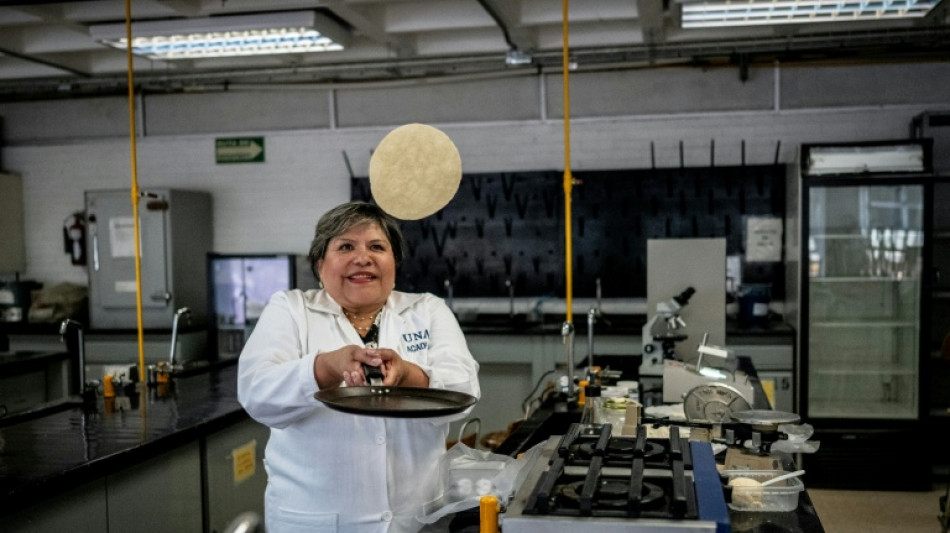
Scientists in Mexico develop tortilla for people with no fridge / Photo: Carl de Souza - AFP

 Drones hit Moscow as Russians go to the polls

 New England boss Fleming says 'wrong' to ask Stokes to end retirement

 Germans vote in elections threatening fresh blow to Merz

 US fears rapid escalation in Mideast after Houthis attack Riyadh

 Japan triathlete Hojo wins first gold of Asian Games

 IOC president impressed by 'beautiful' Asian Games wooden huts

 First Asian Games gold goes to Japan as China's 13-year-old Yu lights up pool

 Data centre command hub keeps AI up and running

 Pope Leo in France: the issues on the table

 Packing for a pope: behind the scenes on foreign trips

 Republicans find transgender issues a powerful political weapon in midterm campaigning

 German state elections threaten new shock waves for Merz

 Chile's Bachelet quits race to be next UN chief

 Raphinha treble fires perfect Barca to win at Sevilla

 Thiam makes winning heptathlon return at Decastar meet

 Czechs beat USA to qualify for Davis Cup finals

 Dortmund sink Stuttgart to climb to Bundesliga summit

 Trump says will not tolerate attempts to slow AI growth

 'It has to stop': runners protest women's murders in S.Africa district

 Fire erupts near Riyadh airport as Houthis claim strikes

 Cuba works to restore power after another blackout

 England thrash Sri Lanka again to return to top of T20 rankings

 Arsenal thrashed by Brighton, sorry Spurs lose again

 South Korea, Austria qualify for Davis Cup finals

 Seare shocks Ingebrigtsen to win world 5km gold

Peering through a microscope, food scientist Raquel Gomez studies microorganisms that add nutrients and preserve tortillas for several weeks without refrigerators -- a luxury in impoverished Mexican communities.
The humble tortilla is a Mexican staple, consumed in tacos and other dishes by millions every day, from the Latin American nation's arid northern deserts to its tropical southern jungle.
Most Mexicans buy fresh corn tortillas from small neighborhood shops.
The wheat flour version developed by Gomez and her team contains probiotics -- live microorganisms found in yogurt and other fermented foods.
As well as the nutritional benefits, the fermented ingredients mean the tortilla can be kept for up to a month without refrigeration, much longer than a homemade one, according to its creators.
It was developed "with the most vulnerable people in mind," Gomez, a professor at the National Autonomous University of Mexico (UNAM), told AFP in her laboratory.
Nearly 14 percent of children under five suffer from chronic malnutrition in Mexico, according to official figures.
In Indigenous communities, the figure is around 27 percent.
- Fridges unaffordable -
The tortilla developed by Gomez is not yet commercially available, but it could benefit people like Teresa Sanchez.
The 46-year-old housewife smokes meat using a wood-burning stove in her house with wooden walls and a metal roof.
Like most of her neighbors in the town of Oxchuc, in the southern state of Chiapas, Sanchez has no refrigerator, so she uses the methods handed down by her Indigenous Tzeltal ancestors.
"My mother taught me and grandparents always do it this way," she told AFP.
"Where are you going to get a refrigerator if there's no money?"
Less than two-thirds of people in Chiapas, a poverty-plagued region with a large Indigenous population, have a refrigerator -- the lowest among Mexico's 32 states.
The average maximum temperature in Chiapas rose from 30.1 to 32 degrees Celsius between 2014 and 2024, according to official estimates.
Half of its territory is considered vulnerable to climate change.
While Oxchuc is located in a mountainous, temperate area, the lack of refrigerators forces its inhabitants to rely on traditional food preservation methods.
"We think about what we're going to eat and how many of us there are. We boil it, and if there's some left over, we boil it again," Sanchez said.
Sometimes meat is salted and left to dry under the sun.
Tortillas are stored in containers made from tree bark.
For that reason, Sanchez only shops for the bare necessities, although her budget is limited anyway.
"I don't have that much money to buy things," she said.
- No preservatives -
Gomez and her team use prebiotics -- which are mainly found in high-fiber foods -- to feed probiotic cultures and produce compounds beneficial to health, she said.
Thanks to the fermented ingredients, no artificial preservatives are needed in the laboratory developed tortilla, Gomez said.
That is another benefit because such additives have potentially toxic effects, said Guillermo Arteaga, a researcher at the University of Sonora.
One of the most commonly used additives in processed wheat flour tortillas is calcium propionate, which is considered harmful to the colon's microbiota, Arteaga said.
Although her tortilla is made from wheat flour -- a type eaten mainly in northern Mexico -- Gomez does not rule out using the same method for corn tortillas, which are preferred by many Mexicans but can go bad quickly in high temperatures.
The researchers patented their tortilla in 2023. UNAM signed a contract with a company to market the food, but the agreement fell through.
Gomez, who won an award in December from the Mexican Institute of Industrial Property, still hopes to find partners to distribute her tortillas.
She is confident that even though they were developed in a laboratory, consumers will still want to eat them.
T.Sanchez--AT



