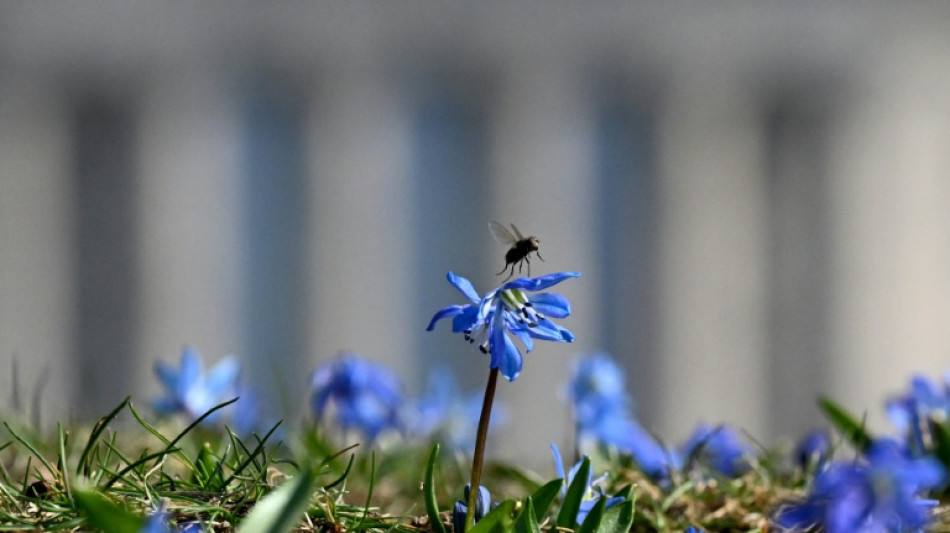
UK scientists fear insect loss as car bug splats fall / Photo: RALF HIRSCHBERGER - AFP

 Drones hit Moscow as Russians go to the polls

 New England boss Fleming says 'wrong' to ask Stokes to end retirement

 Germans vote in elections threatening fresh blow to Merz

 US fears rapid escalation in Mideast after Houthis attack Riyadh

 Japan triathlete Hojo wins first gold of Asian Games

 IOC president impressed by 'beautiful' Asian Games wooden huts

 First Asian Games gold goes to Japan as China's 13-year-old Yu lights up pool

 Data centre command hub keeps AI up and running

 Pope Leo in France: the issues on the table

 Packing for a pope: behind the scenes on foreign trips

 Republicans find transgender issues a powerful political weapon in midterm campaigning

 German state elections threaten new shock waves for Merz

 Chile's Bachelet quits race to be next UN chief

 Raphinha treble fires perfect Barca to win at Sevilla

 Thiam makes winning heptathlon return at Decastar meet

 Czechs beat USA to qualify for Davis Cup finals

 Dortmund sink Stuttgart to climb to Bundesliga summit

 Trump says will not tolerate attempts to slow AI growth

 'It has to stop': runners protest women's murders in S.Africa district

 Fire erupts near Riyadh airport as Houthis claim strikes

 Cuba works to restore power after another blackout

 England thrash Sri Lanka again to return to top of T20 rankings

 Arsenal thrashed by Brighton, sorry Spurs lose again

 South Korea, Austria qualify for Davis Cup finals

 Seare shocks Ingebrigtsen to win world 5km gold

A UK-wide decline in bug splats recorded on car number plates indicates an "alarming" fall in the number of flying insects, UK scientists said in a survey published Wednesday.
The 2024 Bugs Matter report revealed the numbers of flying insects found stuck to vehicle number plates had dropped by nearly 63 percent since 2021.
Flying insects play a vital role in maintaining a healthy environment, as a food source for birds and other wildlife species, as well as acting as pollinators for crops and keeping pests under control.
The survey, led by Kent Wildlife Trust and charity Buglife, relies on citizen scientists who log their journeys and record the number of insect splats found on the front number plate of their cars.
Analysis of more than 25,000 journeys showed a sharp decline in splats across the UK between 2021 and 2024.
This included a 44-percent drop between 2022 and 2023, slowing down to an eight percent decline from 2023 to 2024.
"This huge decrease in insect splats over such a short time is really alarming," said Lawrence Ball, a conservation scientist at Kent Wildlife Trust.
According to Ball, the decrease is a result of a general-long term decline in insect numbers compounded by a short-term decline which is "perhaps linked to the extreme climate in the UK in recent years".
"Similar declining insect trends have been reported by many other scientific studies around the world," according to the survey report.
Scientists say the decline is driven by human activity, including habitat loss, pesticide use, land and water pollution, and climate change.
The latest data "suggests that the abundance of flying insects in our countryside has fallen again," said Andrew Whitehouse from Buglife.
The report noted 60 percent fewer bug splats on average in urban areas, compared to the countryside, "highlighting the impact we have had on nature in our towns and cities".
The Bugs Matter survey is based on the "windscreen phenomenon", an anecdotal observation that people are finding fewer insect splats on their windscreens compared to before.
This year's survey will run from May 1 to September 30, and is expanding to Ireland for the first time. Residents can take part by recording journeys on an app.
Ch.Campbell--AT



