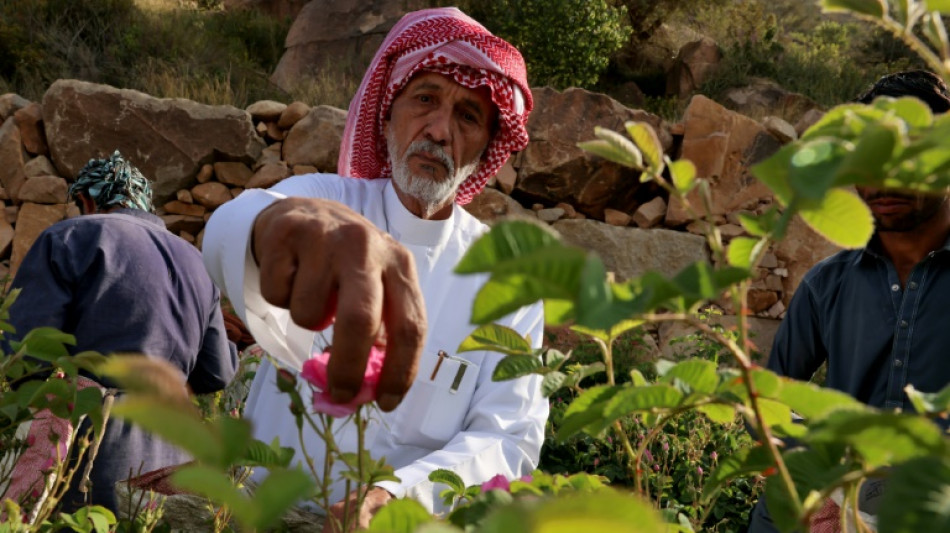
Saudi 'city of roses' offers fragrant reminder of desert's beauty / Photo: Fayez Nureldine - AFP

 Drones hit Moscow as Russians go to the polls

 New England boss Fleming says 'wrong' to ask Stokes to end retirement

 Germans vote in elections threatening fresh blow to Merz

 US fears rapid escalation in Mideast after Houthis attack Riyadh

 Japan triathlete Hojo wins first gold of Asian Games

 IOC president impressed by 'beautiful' Asian Games wooden huts

 First Asian Games gold goes to Japan as China's 13-year-old Yu lights up pool

 Data centre command hub keeps AI up and running

 Pope Leo in France: the issues on the table

 Packing for a pope: behind the scenes on foreign trips

 Republicans find transgender issues a powerful political weapon in midterm campaigning

 German state elections threaten new shock waves for Merz

 Chile's Bachelet quits race to be next UN chief

 Raphinha treble fires perfect Barca to win at Sevilla

 Thiam makes winning heptathlon return at Decastar meet

 Czechs beat USA to qualify for Davis Cup finals

 Dortmund sink Stuttgart to climb to Bundesliga summit

 Trump says will not tolerate attempts to slow AI growth

 'It has to stop': runners protest women's murders in S.Africa district

 Fire erupts near Riyadh airport as Houthis claim strikes

 Cuba works to restore power after another blackout

 England thrash Sri Lanka again to return to top of T20 rankings

 Arsenal thrashed by Brighton, sorry Spurs lose again

 South Korea, Austria qualify for Davis Cup finals

 Seare shocks Ingebrigtsen to win world 5km gold

After decades spent pruning thorny bushes and working arduous harvests, Khalaf Allah al-Talhi has perfected the art of capturing the fragrant aroma of the desert rose in a bottle.
"I love roses and take care of them more than I care for my own children," the 80-year-old told AFP from his flower farm in western Saudi Arabia's Taif.
Known as "the city of roses", the hills of Taif produce around 300 million of the area's signature pink roses annually at 800 flower farms.
By his own estimates, Talhi grows around five to six million of those.
The arrival of spring's mild climate is met with the blooming of roses that carpet the vast, rolling desert landscapes with vibrant shades of pink.
The blooms are then hand-picked from daybreak to late in the evening by an army of labourers.
The petals are soaked and boiled for hours in vats, where the rose's scent is extracted through an intricate process capturing the steam that is then distilled into aromatic oil.
The flowers have long been used to make rose water to wash the walls of the Kaaba at the Grand Mosque in Mecca, and perfumes made from Taif roses are popular with pilgrims visiting the kingdom.
- 'Many rose lovers' -
"The quantity of Taif roses is small, so only limited amounts are exported because it's not enough to meet local demand. Here in Saudi Arabia, we have many rose lovers who only prefer rose perfume," Talhi said.
A modest quantity of oil is exported to craft perfumes or to be added to cosmetic products such as moisturisers and soaps.
According to the economic database TrendEconomy, Saudi Arabia in 2023 exported just $141 million worth of perfume products, which includes rosewater.
At harvest time, workers on Talhi's farm pick tens of thousands of flowers daily.
"We were born on farms and have always worked in agriculture," said Talhi, wearing a white robe and a red checkered headscarf.
But now the greater frequency of erratic weather -- including searing summer heat, frigid winters and unexpected flooding -- presents a potent threat to Taif's famed roses.
- 'My soul' -
Climate scientists have issued regular warnings that every fraction of a degree of global warming increases the intensity and frequency of extreme weather events such as heatwaves, heavy rainfall and droughts.
Saudi Arabia, with its arid climate and vast deserts, is particularly vulnerable.
"Climate change accelerates soil degradation in processes such as salinisation, erosion, and desertification, which diminishes the quality and productivity of arable land in Saudi Arabia," read a report published by the Atlantic Council.
The think tank estimated that wheat yields were expected to decline by 20 to 30 percent by 2050 in Saudi Arabia because of heat stress and not enough irrigation water, while reductions are also expected for date palms and other staple crops.
The weather in the deserts around Taif has been no exception, according to Talhi.
"Last year and the year before, it was extremely cold. Some farmers didn't harvest a single flower from their fields."
Thankfully, this season has been more forgiving.
"There are weather changes, but this year the conditions have been very mild," he said.
While the weather may now be less reliable, Talhi himself has proven to be a source of stability.
Despite his advancing years, the octogenarian rises every day before sunrise to work the fields alongside his staff, and he often labours away until late into the night.
"This farm is my soul and beating heart," he told AFP.
"God willing, nothing will separate me from it, except death."
S.Jackson--AT



