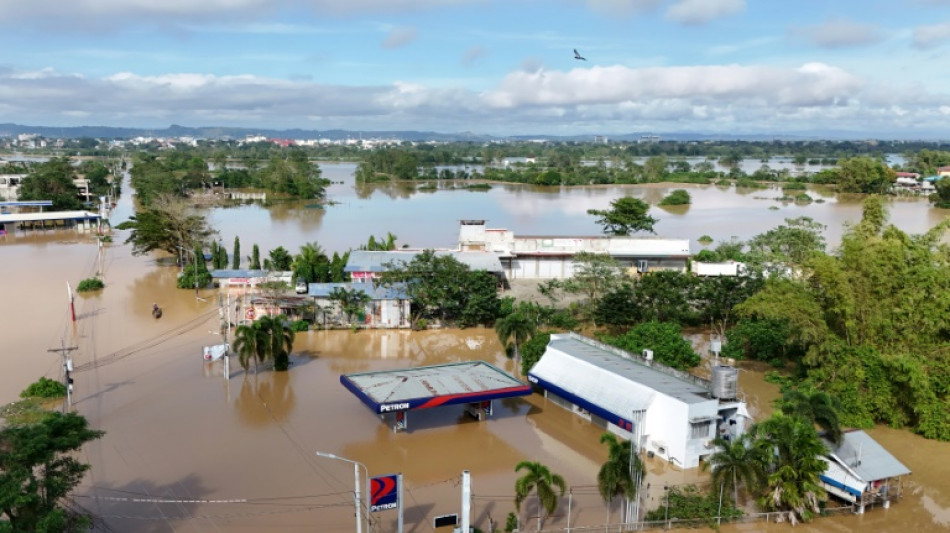
Climate change intensified back-to-back Philippines storms: study / Photo: John Dimain - AFP

 Reusser retains world time-trial title

 Man City outgun Sunderland despite Brobbey hat-trick, Liverpool win at Bournemouth

 Top US, Chinese economic officials meet ahead of Trump-Xi summit

 Erdogan's LGBTQ crackdown 'first step of election campaign': activist

 Mass drone barrage on Moscow kills two

 82-year-old dies after beach fight in Greece over sun lounger

 US warns of rapid escalation in Mideast war

 Iran 'put hearts on the court' to win Asian Games basketball bronze

 School girl Yu helps China dominate in Asian Games swimming openers

 Myanmar win first Asian Games teqball gold as Spain great Puyol watches

 China's 13-year-old Yu scorches to first major gold at Asian Games

 Russians vote on last day of parliamentary elections

 Hong Kong pays final respects to former city leader Tung

 Typhoon put people off Asian Games opening ceremony, official says

 China's 13-year-old Yu cruises as Asian Games swimming begins

 AI 'warning shots' focus Beijing on national security risks

 Philippine tribe in limbo over US-led tech hub

 Leo XIV, first US pope transcends his restrained style

 Singer Ed Sheeran says Gaza situation 'unjustifiable' following controversy

 In 'Tenzing', a Sherpa mountaineer gets his due

 Gridko's New Live Drive PTO Roll-Off Trailer Wins the Heavy-Duty TRAILmakER Award 2026 at NATDA Awards

 Chile's Bachelet quits race to be next UN chief

 Raphinha treble fires perfect Barca to win at Sevilla

 Thiam makes winning heptathlon return at Decastar meet

 Czechs beat USA to qualify for Davis Cup finals

Human-induced climate change fuelled a rare string of back-to-back typhoons that battered the Philippines this year and boosted the chances of powerful storms making landfall, a new study said on Thursday.
Five typhoons and a tropical storm hit the Philippines in a 23-day period across October and November, killing more than 170 people and causing at least $235 million in damage, according to local authorities.
About 20 big storms and typhoons hit the Southeast Asian nation or its surrounding waters each year, killing scores of people.
However, it is rare for multiple major weather events to hit over such a short period.
To assess the role of climate change in the string of storms, scientists from the World Weather Attribution (WWA) network used modelling to compare weather patterns in today's world against a hypothetical world without human-induced warming.
"Our results show that conditions conducive to the development of consecutive typhoons in this region have been enhanced by global warming," they said in a study published late Thursday.
"The chance of multiple major typhoons making landfall will continue to increase as long as we continue to burn fossil fuels."
The research, which uses a peer-reviewed methodology, found climate change made the conditions that formed and fuelled the typhoons twice as likely.
Globally, the number of tropical cyclones is not increasing significantly.
However, warmer seas are helping fuel an increasing number of strong storms and a warmer atmosphere holds more moisture, which results in storms that drop more rain.
- 'Difficult to recover' -
The study found that the warmer climate makes it 25 percent more likely that at least three Category 3-5 typhoons will make landfall in the Philippines in a year.
"Such consecutive extreme events make it difficult for populations to recover," the scientists warned.
And the world's current warming trajectory puts the Philippines on course for even worse effects, the study said.
Tropical storm Trami, considered by Philippines civil defence officials as the deadliest storm to hit the country this year, submerged hundreds of villages in the northern Philippines and displaced more than half a million residents.
Super Typhoon Man-yi, which brought havoc to Catanduanes province last month, also caused a province-wide power outage that authorities are still struggling to rectify.
"While it is unusual to see so many typhoons hit the Philippines in less than a month, the conditions that gave rise to these storms are increasing as the climate warms," said Ben Clarke, a researcher at Imperial College London's Centre for Environmental Policy.
The study warned that the repeated storms created a "perpetual state of insecurity", with about 13 million people affected by at least three of the extreme weather systems.
The Philippines needs major investment to tackle the challenges it faces from climate change, the scientists said.
"But of course funding adaptation isn't enough to protect the Philippines from climate change," said Friederike Otto, the scientist who leads WWA.
"Unless the world stops burning fossil fuels, typhoons will continue to intensify."
Ch.P.Lewis--AT