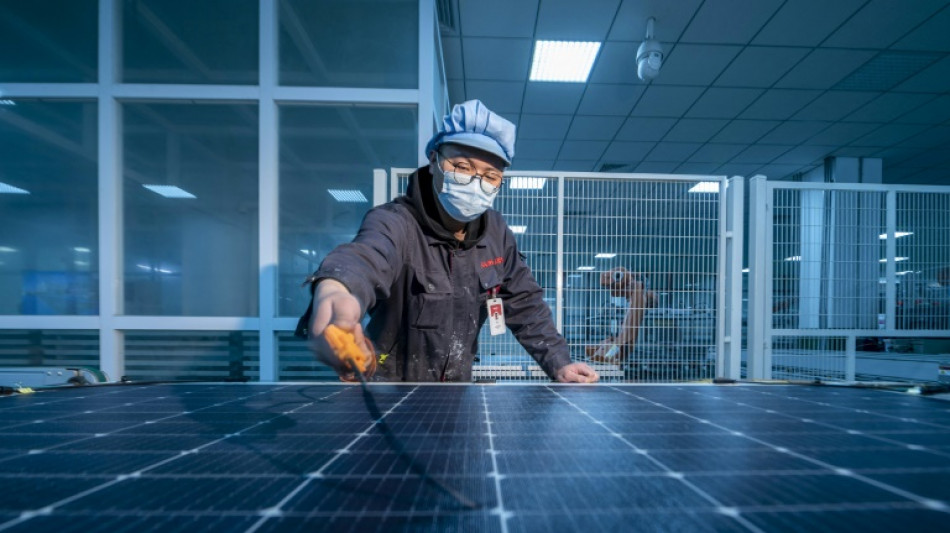
China's solar goes from supremacy to oversupply / Photo: STR - AFP

 Liverpool boss Iraola urges Isak to raise his level

 Evenepoel wins record 4th straight world time-trial title
 France's Macron, Canada's Carney announce closer ties

 Carrick defends troubled Man Utd after Fulham escape

 Horror movie 'Resident Evil' tops N. American box office

 Germany's Merz vows to stay course despite new vote losses

 Man City outgun Sunderland despite Brobbey hat-trick, Man Utd rescue Fulham draw

 Mourinho blames ref committee for Real Madrid derby defeat

 Maresca craves a 1-0 win after eight-goal Man City thriller
 Atletico Madrid beat Real Madrid in tense derby clash

 Reusser retains world time-trial title

 Man City outgun Sunderland despite Brobbey hat-trick, Liverpool win at Bournemouth

 Top US, Chinese economic officials meet ahead of Trump-Xi summit

 Erdogan's LGBTQ crackdown 'first step of election campaign': activist
 Mass drone barrage on Moscow kills two

 82-year-old dies after beach fight in Greece over sun lounger

 US warns of rapid escalation in Mideast war

 Iran 'put hearts on the court' to win Asian Games basketball bronze

 School girl Yu helps China dominate in Asian Games swimming openers
 Myanmar win first Asian Games teqball gold as Spain great Puyol watches

 China's 13-year-old Yu scorches to first major gold at Asian Games
 Russians vote on last day of parliamentary elections

 Hong Kong pays final respects to former city leader Tung

 Typhoon put people off Asian Games opening ceremony, official says
 China's 13-year-old Yu cruises as Asian Games swimming begins

Strong state support and huge private investment have made China's solar industry a global powerhouse, but it faces new headwinds, from punitive tariffs abroad to a brutal price war at home.
Officials meeting in Baku next month for the COP29 summit hope to agree on new finance targets to help developing countries respond to climate change, including ditching fossil fuels.
Last year, countries agreed to triple global installed renewable energy capacity by 2030.
China is installing almost twice as much solar and wind power as every other country combined.
And it dominates the market.
It makes eight out of every 10 solar panels and controls 80 percent of every stage of the manufacturing process.
It is also home to the world's top 10 suppliers of solar panel manufacturing equipment, and its related exports hit a record $49 billion last year, according to Wood Mackenzie.
That supremacy is not accidental: Chinese state support has been key, analysts say.
Beijing invested over $50 billion in new solar supply capacity from 2011 to 2022, according to the International Energy Agency.
The industry has also benefited from access to cheap raw materials, readily available capital from state-owned banks, and huge engineering manpower.
"Chinese producers were ahead of everyone else on cost," said Lauri Myllyvirta, co-founder of the Centre for Research on Energy and Clean Air, a climate think tank.
"That meant new investment takes place in China, because that's where it's most competitive," he told AFP.
The focus has driven a "steep learning curve... both in solar cell technology and manufacturing know-how", added Johannes Bernreuter, a longtime solar industry analyst.
That in turn has created "an efficient industry ecosystem", he said.
- 'Overcapacity'-
As countries around the world race to convert their power systems, China's solar supremacy has become a growing concern.
The United States and other Western countries have accused Beijing of deliberate "overcapacity" and flooding global markets with cut-price solar exports intended to undercut competition.
Washington has doubled tariffs on Chinese panels to 50 percent, part of a broader package targeting $18 billion worth of Chinese imports in strategic sectors including electric vehicles, batteries, critical minerals and medical products.
The European Union is also probing Chinese-owned solar panel manufacturers for allegedly receiving unfair subsidies.
Most US solar panel imports now come from Southeast Asia, but Washington says Chinese manufacturers have relocated operations there to circumvent barriers.
China also accounts for almost all of Europe's imports of solar panels from outside the bloc.
That means many markets will struggle to catch up "with two decades of very forceful and very successful industrial policy in China", said Myllyvirta.
China's solar industry faces its own struggles though, beyond trade barriers in the West.
The sector's supersonic expansion has overleveraged the domestic industry, overloaded China's grid and sparked a brutal price war, experts say.
Industry leaders have reportedly warned of an "ice age" and urged government intervention to stem slumping prices, but there has been little sign of relief.
This year saw a wave of bankruptcies, and new solar projects fell by over 75 percent in the first half of 2024, an industry group said in July.
- 'Lots of companies will fail' -
The price wars, which are so fierce that solar export earnings fell last year despite volumes hitting a new high, are like a "snake eating its own tail", warned analyst David Fishman.
Companies get stuck "in this circle of competition where whoever is able to endure the pain for longest comes out as the victor," said Fishman, a senior manager at the Lantau Group specialising in China's power sector.
"Lots of companies will fail along the way."
And while the manufacturing glut has helped China hit a wind and solar installation target nearly six years ahead of schedule, the country's grid is struggling to keep up.
Increasingly, renewable supply is being blocked to prevent the grid from becoming overwhelmed, a process known as curtailment.
Solar curtailment rose four percent in the first quarter of 2024 from a year earlier, according to Fitch Ratings.
Authorities will soon be forced to "stop approving new projects or allowing projects to connect to the grid if it means curtailment rates are at risk of going higher", Fishman said.
"They've got to build," he added. "They have to catch up."
Blocked in the West and running out of track at home, China's solar is seeking new markets, and this year, Europe was overtaken by Asia as the biggest export market for solar products, according to an industry body.
Exports to Africa also soared 187 percent year-on-year in 2023, though the continent still buys a small fraction compared to Europe, according to energy think tank Ember.
The industry is now in a "restructuring and shakeout phase", said Bernreuter.
After that, "the Chinese solar industry will march on with unperturbed pace and a more global manufacturing footprint".
M.King--AT



