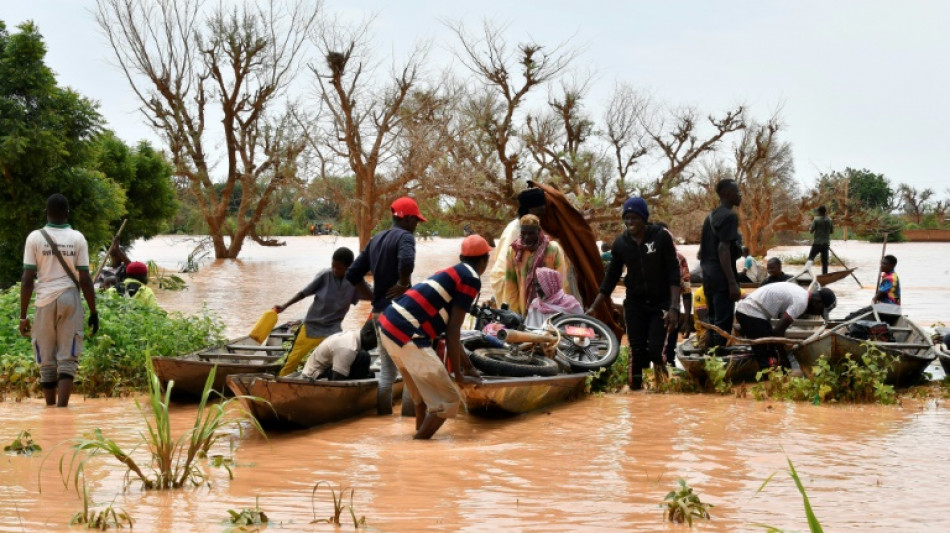
Floods hit millions in West and Central Africa / Photo: BOUREIMA HAMA - AFP/File

 Gary, Indiana Blackout Exposes FEMA Relief Disparities Along Racial Lines

 Turkish Energy Minister Highlights Qatar as Key Partner for Regional and Global Energy Security

 London Museum Granted 24/7 License Ahead of November Opening

 Dana White Confirms Flight to Washington for Trump Meeting on Press Secretary Role

 Dengue Fever Expands Into High Himalayas as Climate Change Warms Nepal

 IoT Refrigerator Hacks Disrupt Blood Labs and Supermarkets Across Europe and US

 Post-election pressures complicate US and Israeli decisions on Iran

 UN members approve talks on treaty protocol against environmental crime

 Family-run West Sussex beach café prepares for first winter season

 CT scans reveal health and burial clues from Egypt’s Braided Lady mummy

 Oxford faces complaints over lecturer’s classroom attire

Parts of Central and West Africa have seen heavy flooding over an unusually intense rainy season, unleashing a humanitarian crisis in which hundreds have been killed and hundreds of thousands displaced.
The summer of 2024 was the hottest ever recorded on Earth and record after record has tumbled over the past year.
Heatwaves, droughts and deadly flooding have followed in their wake, provoked by unrelentless global warming.
Here is a round-up of the impact of the flooding:
- Chad: 1.5 million victims -
Weeks of torrential rains in Chad have left 341 people dead and some 1.5 million affected since July, the UN's Office for the Coordination of Humanitarian Affairs (OCHA) said in early September.
The flooding has hit all of the country's 23 provinces, it said.
It cited government data which said some 164,000 houses had been destroyed, 66,700 heads of cattle lost, with 259,000 hectares (640,000 acres) of fields ruined.
It said refugee communities in the east of the country are particularly vulnerable, with 40,000 refugees hit, according to the UN refugee agency, UNHCR.
- Niger: nearly 650,000 displaced -
In Niger, heavy rains since June have killed 273 and affected more than 700,000, authorities said early this month.
The flooding has devastated infrastructure, destroyed nearly 50,000 houses and disrupted the education of more than 39,000 children, according to the UNHCR.
The disruption has particularly hit southern regions where a large number of refugees have sought shelter.
- Nigeria: 225,000 displaced -
Neighbouring Nigeria has seen 29 of its 36 states -- mostly in the north -- hit by rising waters in the River Niger and its major Benue tributary since mid-July.
More than 600,000 people have been affected, the UNHCR says.
At least 200 people have been killed and more than 225,000 displaced, many of whom were already uprooted by conflicts and climate change.
The Nigerian government says over 115,265 hectares of farmland have also been damaged, and one child in six had faced hunger between June and August, an increase of 25 percent compared to the same period last year.
- South Sudan, Sudan: 1.2 million uprooted -
Meanwhile, in the east, in Sudan and South Sudan, floods have left dozens dead and uprooted 1.2 million people, according to the UN's humanitarian agencies.
South Sudan, one of the poorest countries in the world, has lived through its most serious floods for decades.
The UN's humanitarian agency, OCHA, said that as of September 5 "flooding has affected more than 710,000 people across 30 of 78 counties".
"Floods have caused extensive damage to homes, crops and critical infrastructure, disrupting education and health services and increasing the risk of disease outbreaks," it said.
Neighbouring Sudan is hit by flooding every year but the war between rival generals which has been going on for more than 16 months has driven millions of displaced into flood-vulnerable zones.
OCHA says that more than 490,000 people are affected by rain and flooding, especially in the north and east of the country.
At least 132 people have died, according to the health ministry on August 26.
The UNHCR on September 6 said that more than 35,000 houses had been destroyed and nearly 45,000 damaged. Thousands of children were threatened by a cholera epidemic caused by the floods and the stagnation of flood waters.
R.Lee--AT