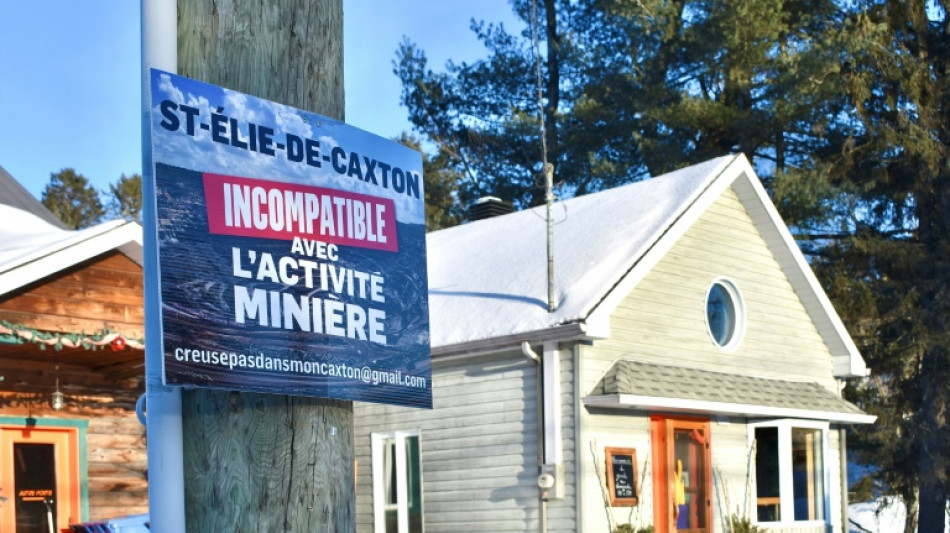
In Canada's Quebec, residents miffed over mining boom / Photo: Genevieve Normand - AFP

 New Zealanders pick endangered black robin as Bird of the Year

 Asia stocks rise on AI, US-China trade talks optimism

 Malaysia's 'elephant whisperer' fights to save Borneo's endangered giants
 'I live in fear': 1.5 million Pakistani children sexually exploited online

 Cowboys beat Commanders, Vikings down Bears as star QBs injured

 4 Hacks for Yearlong Savings on Your Kids' Wardrobes

 Forest fire threatens tourist town in Colombian Andes

 Torres on target again as PSG beat 10-man Marseille in Ligue 1

 Germany's Merz vows to stay course despite new election defeats

 Carrick demands Man Utd response after 'pathetic' jibes

 Liverpool boss Iraola urges Isak to raise his level

 Evenepoel wins record 4th straight world time-trial title

 France's Macron, Canada's Carney announce closer ties
 Carrick defends troubled Man Utd after Fulham escape

 Horror movie 'Resident Evil' tops N. American box office

 Germany's Merz vows to stay course despite new vote losses

 Man City outgun Sunderland despite Brobbey hat-trick, Man Utd rescue Fulham draw

 Mourinho blames ref committee for Real Madrid derby defeat

 Maresca craves a 1-0 win after eight-goal Man City thriller
 Atletico Madrid beat Real Madrid in tense derby clash

 Reusser retains world time-trial title

 Man City outgun Sunderland despite Brobbey hat-trick, Liverpool win at Bournemouth

 Top US, Chinese economic officials meet ahead of Trump-Xi summit
 Erdogan's LGBTQ crackdown 'first step of election campaign': activist
 Mass drone barrage on Moscow kills two

Canada's Quebec province is rich with minerals needed for everything from electric cars to cell phones, but residents living atop the potential windfall are worried their backyards will be dug up -- and they won't get a dime.
In recent months, tens of thousands of mining exploration permits have been issued in the province amid a global rush for critical and strategic minerals such as graphite, lithium, zinc, nickel and cobalt.
But under provincial mining exploration rules, subsoil in Quebec does not belong to landowners.
In Saint-Elie-de-Caxton, a town of 2,000 people about halfway between Montreal and Quebec City, residents are fed up. Signs around town proclaim "Saint-Elie, incompatible with mining activity" or "Don't Dig in my Caxton."
"We are at war, says Gilbert Guerin, spokesman for the "Don't Dig in my Caxton" committee, pointing to a map delineating exploration claims that have effectively parceled off the town for future mines.
In Quebec, it only takes a few clicks on a website and about Can$75 (US$55) to stake a mining claim covering up to 100 hectares (250 acres) -- an opportunity open to locals and foreigners alike.
"I bought here. I thought I would be sovereign in my own home, but I came to understand that what's underground did not belong to me," says Yvan Lafontaine, surveying his property in the neighboring village of Saint-Mathieu-du-Parc from atop an observation tower he had built.
When Lafontaine learned that a company had acquired the mining rights to the subsoil beneath his land, what the nature lover calls his little "paradise," he fought back by staking 12 claims surrounding the property.
Currently, more than 350,000 claims have been registered, covering 10 percent of Quebec. The southern areas of the province -- where most of the population lives -- is the most sought after.
According to an AFP analysis of government data, the number of claims issued significantly increased from September 2022 to the end of February 2024, with about 160,000 granted -- a 140 percent increase over the previous 18-month period.
- 'Wild West' -
For Saint-Elie resident Julie Hamelin, the mining exploration regulations in Quebec are "outdated."
"It's something out of the Wild West, this way of staking claims," she said, urging provincial authorities to protect inhabited lands from mining.
Guerin, a former civil servant, says he is worried about the "irreversible consequences" that a mining project would have, particularly on the region's groundwater.
To try to discourage mining companies from moving in, residents of Saint-Elie-de-Caxton spent thousands of dollars to buy up more than 220 exploration claims around the village.
Faced with growing public discontent, the Quebec government has announced it intends to modernize its mining law, and insisted in an email to AFP "that no exploration can be carried out without the consent of the owner of private land."
But mining companies definitely are eyeballing Quebec's potential for resources extraction.
"There is a lot of graphite in Quebec. It could be the most important reserve in the world," says Hugues Jacquemin, chief executive of Northern Graphite.
"We absolutely must develop this sector because it is essential for the manufacture of batteries and electric vehicles," he told AFP during a visit to a mine at Lac-des-Iles, 260 kilometers (160 miles) north of Montreal.
Canada is seeking to develop a battery supply chain independent from China, which has until now dominated the market in these critical minerals.
The development of the electric vehicle sector is a priority for both Quebec and Canada, which boasts of being one of the only countries in the world to have all of the necessary minerals to produce batteries.
But in Saint-Elie-de-Caxton and its surrounding areas, not all citizens are on board with the official plans.
"I don't think we should go in this direction," says Hamelin. "The solution is downscaling by using what we already have."
B.Torres--AT