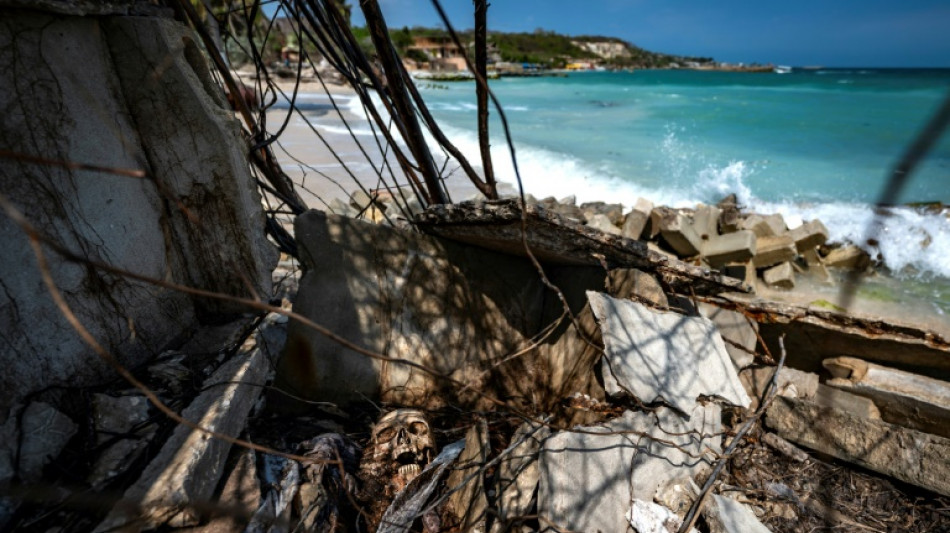
Colombia's Caribbean jewel slowly sinking as sea waters rise / Photo: Luis ACOSTA - AFP

 New Zealanders pick endangered black robin as Bird of the Year

 Asia stocks rise on AI, US-China trade talks optimism

 Malaysia's 'elephant whisperer' fights to save Borneo's endangered giants

 'I live in fear': 1.5 million Pakistani children sexually exploited online

 Cowboys beat Commanders, Vikings down Bears as star QBs injured
 4 Hacks for Yearlong Savings on Your Kids' Wardrobes

 Forest fire threatens tourist town in Colombian Andes

 Torres on target again as PSG beat 10-man Marseille in Ligue 1

 Germany's Merz vows to stay course despite new election defeats

 Carrick demands Man Utd response after 'pathetic' jibes

 Liverpool boss Iraola urges Isak to raise his level

 Evenepoel wins record 4th straight world time-trial title

 France's Macron, Canada's Carney announce closer ties
 Carrick defends troubled Man Utd after Fulham escape

 Horror movie 'Resident Evil' tops N. American box office

 Germany's Merz vows to stay course despite new vote losses

 Man City outgun Sunderland despite Brobbey hat-trick, Man Utd rescue Fulham draw

 Mourinho blames ref committee for Real Madrid derby defeat

 Maresca craves a 1-0 win after eight-goal Man City thriller

 Atletico Madrid beat Real Madrid in tense derby clash

 Reusser retains world time-trial title

 Man City outgun Sunderland despite Brobbey hat-trick, Liverpool win at Bournemouth

 Top US, Chinese economic officials meet ahead of Trump-Xi summit
 Erdogan's LGBTQ crackdown 'first step of election campaign': activist

 Mass drone barrage on Moscow kills two

A skeleton lies exposed to the elements as turquoise Caribbean waters lap the shores near a shattered tomb -- a grisly reminder that the Colombian city of Cartagena is slowly being swallowed by the sea.
With low-lying communities worldwide on the front lines of the climate crisis fight, Cartagena is conspicuously vulnerable.
On Tierra Bomba, a small island in the bay of Cartagena, the cemetery once built at a safe distance from the shore has been devastated by repeated flooding, while houses have tumbled into the waves.
Kelly Mendoza has seen two of her neighbors lose their homes, and at night the 31-year-old hears the surf crashing against her bedroom wall.
"I get scared when the wave hits the wall because I think it is going to fall," and "I will find myself in the sea, in my bed."
Cartagena, a tourist hotspot in the north of the country, could find itself almost a meter underwater by the end of this century, experts say.
"The increase in sea levels in the coastal area of Cartagena is due to two factors," said Canadian environmental scientist Marko Tosic, one of the authors of a study showing waters there were rising faster than the global average.
He said global warming -- which melts polar ice caps and glaciers -- had combined with erosion and the "sinking of the land... due to tectonic factors" and the presence of submarine volcanoes, to hasten rising sea levels in the region.
These volcanic formations "are muddy, and little by little gravity puts pressure" on them, causing the terrain to flatten and the city to sink, Tosic added.
- New enemy, new fortress -
The study, published in 2021 by the scientific journal Nature, said the sea level in Cartagena has risen by about 7.02 millimeters (0.27 inches) per year since the beginning of the 21st century, "a rate higher" than the global average of 2.9 millimeters.
Researchers said the sea in the bay could rise 26 centimeters by 2050 and 76 centimeters by 2100.
It is a "very small change, we are talking about millimeters over the years, but... the flooding will be felt," said Tosic.
On the mainland, AFP recently saw workers at a flooded restaurant scrambling to try to remove water lapping at their clients' feet.
Cartagena, a UNESCO World Heritage site, is a colonial-era city that was once a hotspot of conflict between European powers vying for control of the "New World" -- resulting in the Spanish building some of South America's most extensive military fortification around the city.
The historic old town, massive fortress and gorgeous beaches have made Cartagena a tourist drawcard.
Now, machines are hard at work building a new fortress -- 4.5 kilometers (2.7 miles) of seawall to protect the city from encroaching waters.
Along the shoreline, high-rise buildings stand just meters from the ocean.
According to the mayor's office, some 80 percent of neighborhoods in the largely flat and sea-level city would be at risk of flooding without this protection.
- Fleeing the sea -
Tosic warned that poor populations had fewer tools to protect themselves from the forces of nature.
Mauricio Giraldo, a representative of local fishermen, complains that the seawall protects luxury hotels and tourist spots, but is changing the sea current and doesn't offer a safeguard to areas where the most vulnerable live.
Over decades, the sea "has devastated 250 homes in the community, the health center, docks... it took away several community halls, electrical infrastructure" and the cemetery, said community leader Mirla Aaron on Tierra Bomba.
The island is home to "black communities who were enslaved" and who "refuse to lose their identity," the 53-year-old said. "We are not leaving, we will not abandon this territory because it is ours."
At 87 years old, Ines Jimenez recalls when she was younger she had to move back in with her parents after her house flooded.
She has spent much of her life watching her neighbors fleeing "a little further back" from the sea.
F.Wilson--AT

