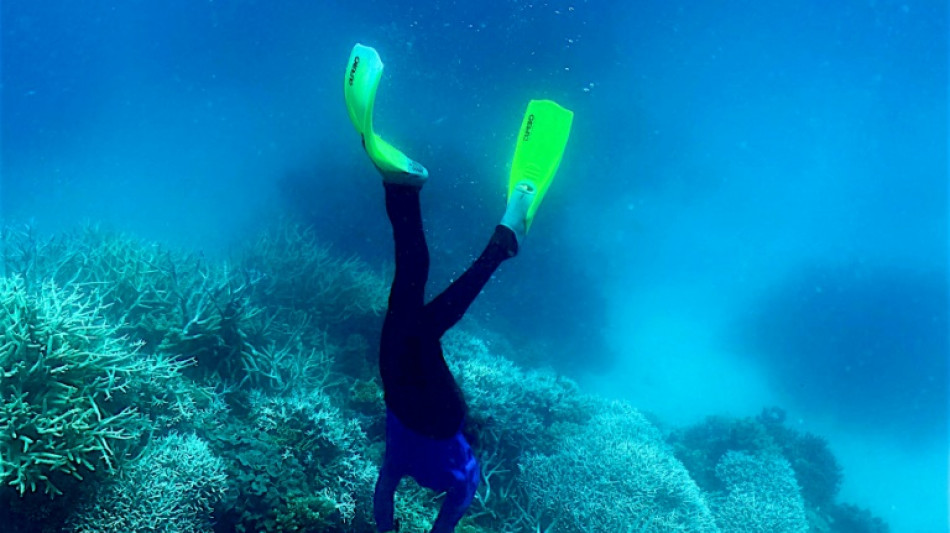
Australia's Great Barrier Reef in grip of 'mass bleaching event' / Photo: Glenn NICHOLLS - AFP

 New Zealanders pick endangered black robin as Bird of the Year

 Asia stocks rise on AI, US-China trade talks optimism

 Malaysia's 'elephant whisperer' fights to save Borneo's endangered giants

 'I live in fear': 1.5 million Pakistani children sexually exploited online

 Cowboys beat Commanders, Vikings down Bears as star QBs injured
 4 Hacks for Yearlong Savings on Your Kids' Wardrobes

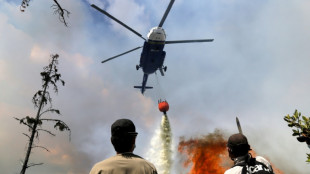 Forest fire threatens tourist town in Colombian Andes

 Torres on target again as PSG beat 10-man Marseille in Ligue 1

 Germany's Merz vows to stay course despite new election defeats

 Carrick demands Man Utd response after 'pathetic' jibes

 Liverpool boss Iraola urges Isak to raise his level

 Evenepoel wins record 4th straight world time-trial title

 France's Macron, Canada's Carney announce closer ties
 Carrick defends troubled Man Utd after Fulham escape

 Horror movie 'Resident Evil' tops N. American box office

 Germany's Merz vows to stay course despite new vote losses

 Man City outgun Sunderland despite Brobbey hat-trick, Man Utd rescue Fulham draw

 Mourinho blames ref committee for Real Madrid derby defeat

 Maresca craves a 1-0 win after eight-goal Man City thriller

 Atletico Madrid beat Real Madrid in tense derby clash

 Reusser retains world time-trial title

 Man City outgun Sunderland despite Brobbey hat-trick, Liverpool win at Bournemouth

 Top US, Chinese economic officials meet ahead of Trump-Xi summit
 Erdogan's LGBTQ crackdown 'first step of election campaign': activist

 Mass drone barrage on Moscow kills two

A "mass bleaching event" is unfolding on Australia's famed Great Barrier Reef, authorities said Friday, as warming seas threaten the spectacular home to thousands of marine species.
Often dubbed the world's largest living structure, the Great Barrier Reef is a 2,300 kilometre (1,400 mile) expanse of tropical corals that house a stunning array of biodiversity.
But repeated mass bleaching events have threatened to rob the tourist drawcard of its wonder, turning banks of once-vibrant corals into a sickly shade of white.
"We know the biggest threat to coral reefs worldwide is climate change. The Great Barrier Reef is no exception," Environment Minister Tanya Plibersek said in a statement.
"We need to act on climate change. We need to protect our special places and the plants and animals that call them home."
The damaging mass bleaching event -- the seventh since 1998 -- was confirmed by government scientists following aerial surveys of 300 shallow reefs.
The Australian Reef Authority said it would now need to conduct further surveys to assess the severity and extent of bleaching.
Coral bleaching occurs when underwater temperatures are more than 1 degree warmer than the long-term average.
As corals come under heat stress, they expel algae living within their tissues -- draining them of their vibrant colours.
Ocean temperatures along the Great Barrier Reef have approached record levels in the past few weeks, according to official monitoring.
Richard Leck, head of oceans at World Wildlife Fund Australia, said it was likely that masses of coral would die if ocean temperatures did not cool rapidly in the coming weeks.
"This bleaching event is unfolding in an area where corals have not been previously exposed to these extreme temperatures," he said.
Leck said climate change was "putting tremendous pressure" on the Great Barrier Reef.
The current bleaching event followed similar setbacks in the Northern Hemisphere last year, Leck added, which caused major coral mortality in Florida and the Caribbean.
Some species of bleached coral have proven remarkably resilient and can recover if ocean temperatures cool.
But professor Terry Hughes, one of Australia's foremost coral reef scientists, said bleaching events were now happening so frequently that reefs were struggling to recover.
- Recovery in danger -
"The reef is no longer capable of recovering to the mix of coral species and the sizes of corals that were there 20 years ago," he told AFP.
"The irony is that the corals that are now prevalent on most parts of the Great Barrier Reef are fast growing and rapidly regain cover, but the kicker is that they are heat sensitive and are less tolerant to the next inevitable beaching event."
Hughes said the heat stress had increased in the past few days and would likely worsen in the coming two weeks.
The fate of the reef has been a recurrent source of tension between the Australian government and the United Nations' World Heritage Committee.
The World Heritage Committee has threatened to put the reef on a list of "in danger" global heritage sites, a move that would likely damage its allure for international tourists.
Behind-the-scenes diplomacy and fierce lobbying from Australia has so far kept it off the list.
Before this event, Australia's Great Barrier Reef suffered mass coral bleaching in 1998, 2002, 2016, 2017, 2020 and 2022.
W.Moreno--AT

