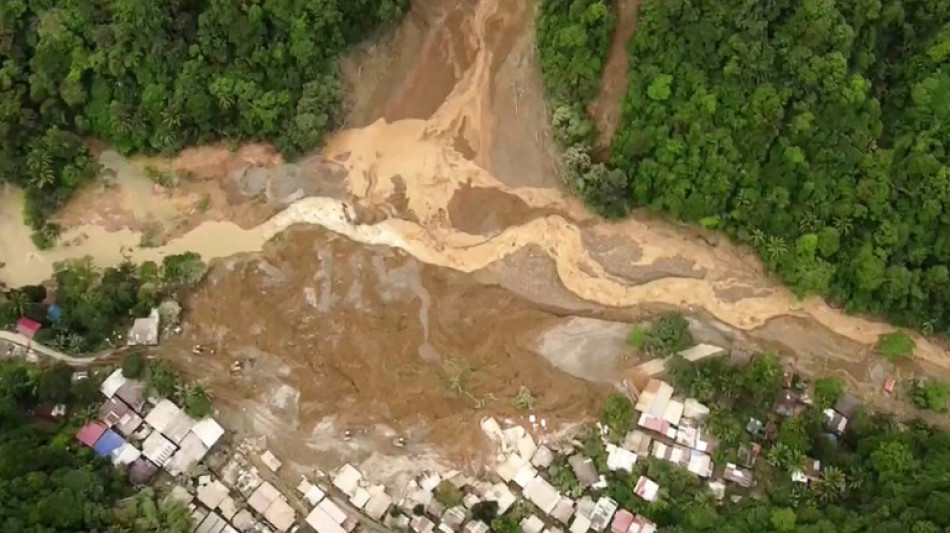
Faulty warnings, deforestation turned Philippine rains 'deadly': study / Photo: Renante Naparan - AFP/File

 'I live in fear': 1.5 million Pakistani children sexually exploited online

 Cowboys beat Commanders, Vikings down Bears as star QBs injured

 Braves clinch division title as Red Sox reach MLB playoffs
 Bordeaux-Begles hammer Stade Francais despite Jalibert injury

 Milan and Juventus end blips with home wins

 Bridgeman wins PGA Biltmore title with sizzling 61

 Williams injured as Bears shut down by Vikings

 US warns of rapid escalation in Middle East war

 Germany's far-right AfD celebrates another state election win

 Russia vows revenge for election-day attacks as poll shows ruling party win

 Spaun late shows snatches PGA Championship win

 Conceicao strikes as Juventus beat Atalanta

 Britain, Zverev-inspired Germany, Spain complete Davis Cup finals

 Man Utd salvage Fulham draw as pressure mounts on Carrick

 Spanish civil war drama 'The Black Ball' wins at Toronto festival

 Germany's Merz shaken by far-right and far-left gains in state votes

 Macron welcomes Canada's Carney to French Atlantic territory

 Fiorentina frustrate Napoli with Serie A draw, Como upset

 Five-star Man City top Premier League after Sunderland thriller

 Ukrainian drones hit Moscow on last day of Russian elections

 Multi-Asset Trading Venue Monochrome Exchange Announces IEO of Its Native Token, $MCR

 South Korea break Japan hearts to win Asian Games basketball gold

 Acosta takes first victory at Austrian MotoGP

 PSG president Nasser al-Khelaifi under investigation in France for conflict of interest

 China swim sensation, 13, sets Games record after Japan win early

Faulty warning systems, poverty and deforestation of mountains in the southern Philippines turned recent unseasonably heavy rains into deadly disasters, scientists said in a report Friday.
More than 100 people were killed in landslides and floods in January and February on the country's second-largest island of Mindanao as the northeast monsoon and a low pressure trough brought downpours.
A study by the World Weather Attribution group found the unsually heavy rain in eastern Mindanao was not "particularly extreme".
But with people living in landslide-prone areas and shortcomings in weather alerts, the rains became "devastating".
"We can't just blame the rain for the severe impacts," said Richard Ybanez, chief science research specialist at the University of the Philippines' Resilience Institute.
"A range of human factors is what turned these downpours into deadly disasters."
In the deadliest incident, more than 90 people were killed when the side of a mountain collapsed and smashed into a gold mining village on February 6, burying buses and houses.
While climate change was likely one of the drivers of the heavy rain, the report said scientists were not able to quantify its impact due to the lack of available data.
"However, we did detect a strong trend in the historical data -- compared to the pre-industrial climate, the heaviest five-day periods of rainfall now drop around 50 percent more rainfall on Mindanao island in the December to February period," said Mariam Zachariah of the Grantham Institute at Imperial College London.
The scientists found that a higher-than-average rate of poverty in the mountainous region had left people vulnerable to the impacts of heavier rainfall, while "intensified deforestation" had increased the risk of landslides.
"Across the region of study, construction in areas declared 'no-build zones' raises these dangers considerably," the report said.
The report said policies, laws and funding of disaster risk management "have largely stalled over the past decades" and were concentrated on post-disaster response.
For example, automated sensors for rainfall and stream level in the region "have not been recording data since at least 2022", after funding for maintenance and data transmission was cut.
The report also faulted the country's weather forecasts and warnings, which "have limited granularity on local risk and lack instructions on where and when to evacuate".
"Evacuations from high-risk locations were carried out when the island was hit by the rainfall in late January. However, many people were still in harm's way," said Ybanez.
"It is critical that both early warning systems and assessment of landslide-prone areas are improved to avoid similar disasters in the future," he said.
The report also warned that the recent rains would have been "more extreme" were it not for the El Nino weather phenomenon causing drier conditions across the country.
The tropical archipelago nation -- which is ranked among the most vulnerable countries to the impacts of climate change -- is usually affected by around 20 major storms a year.
A.Moore--AT