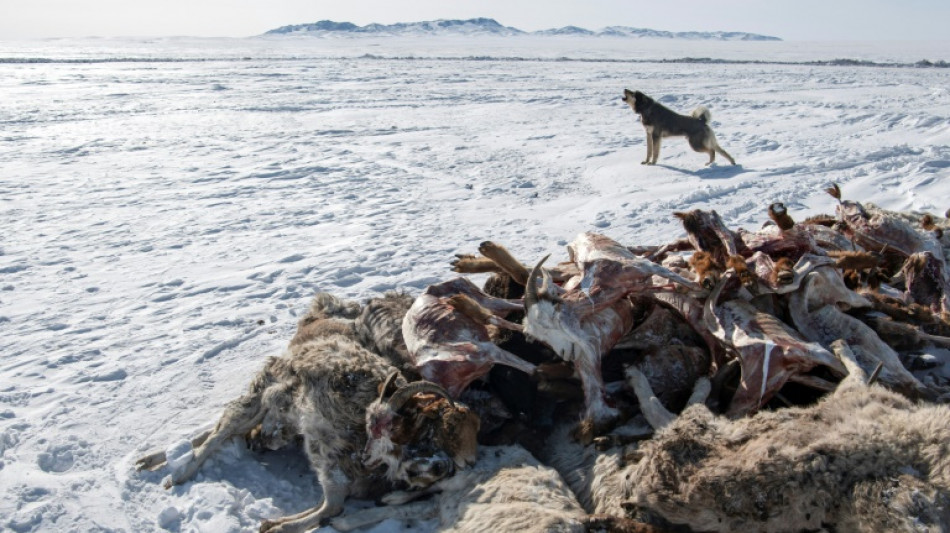
2 million animals dead as extreme winter weather hits Mongolia / Photo: Byambasuren BYAMBA-OCHIR - AFP

 'I live in fear': 1.5 million Pakistani children sexually exploited online

 Cowboys beat Commanders, Vikings down Bears as star QBs injured

 Braves clinch division title as Red Sox reach MLB playoffs
 Bordeaux-Begles hammer Stade Francais despite Jalibert injury

 Milan and Juventus end blips with home wins

 Bridgeman wins PGA Biltmore title with sizzling 61

 Williams injured as Bears shut down by Vikings

 US warns of rapid escalation in Middle East war

 Germany's far-right AfD celebrates another state election win

 Russia vows revenge for election-day attacks as poll shows ruling party win

 Spaun late shows snatches PGA Championship win

 Conceicao strikes as Juventus beat Atalanta

 Britain, Zverev-inspired Germany, Spain complete Davis Cup finals

 Man Utd salvage Fulham draw as pressure mounts on Carrick

 Spanish civil war drama 'The Black Ball' wins at Toronto festival

 Germany's Merz shaken by far-right and far-left gains in state votes

 Macron welcomes Canada's Carney to French Atlantic territory

 Fiorentina frustrate Napoli with Serie A draw, Como upset

 Five-star Man City top Premier League after Sunderland thriller

 Ukrainian drones hit Moscow on last day of Russian elections

 Multi-Asset Trading Venue Monochrome Exchange Announces IEO of Its Native Token, $MCR

 South Korea break Japan hearts to win Asian Games basketball gold

 Acosta takes first victory at Austrian MotoGP

 PSG president Nasser al-Khelaifi under investigation in France for conflict of interest

 China swim sensation, 13, sets Games record after Japan win early

More than two million animals have died in Mongolia so far this winter, a government official said Monday, as the country endures extreme cold and snow.
The landlocked country is no stranger to severe weather from December to March, when temperatures plummet as low as minus 50 degrees Celsius (minus 58 Fahrenheit) in some areas.
But this winter has been more severe than usual, with lower than normal temperatures and very heavy snowfall, the United Nations said in a recent report.
As of Monday, 2.1 million head of livestock had died from starvation and exhaustion, Gantulga Batsaikhan of the country's agriculture ministry said.
Mongolia had 64.7 million such animals, including sheep, goats, horses and cows, at the end of 2023, official statistics show.
The extreme weather is known as "dzud" and typically results in the deaths of huge numbers of livestock.
The United Nations said climate change is increasing the frequency and intensity of dzuds.
Mongolia has experienced six dzuds in the past decade, including the winter of 2022-23 when 4.4 million head of livestock perished.
This year's dzud has been exacerbated by a summer drought that prevented animals from building up enough fatty stores to survive the harsh winter.
- 'Praying for warmer weather' -
Seventy percent of Mongolia is experiencing "dzud or near dzud" conditions, the UN said.
That compares with 17 percent of the country at the same time in 2023.
"The winter started with heavy snow but suddenly air temperatures rose, and the snow melted," herder Tuvshinbayar Byambaa told AFP.
"Then the temperatures dropped again, turning the melting snow into ice."
That ice makes it hard for the livestock to break through to the grass below, he said, preventing them from grazing and forcing many herders to borrow money for feed.
"The weather changes are so sudden these days," Tuvshinbayar said.
The deadliest dzud on record was the winter of 2010-11, when more than 10 million animals died -- almost a quarter of the country's total livestock at the time.
Snowfall this year -- the heaviest since 1975 -- has compounded herders' woes, trapping them in colder areas and making them unable to buy food and hay for their animals from the nearby towns.
Mongolia is one of the most sparsely populated countries in the world and about one-third of its population of 3.3 million people is nomadic.
The government has promised to help, launching a campaign to deliver hay fodder to herders in a bid to prevent further losses of crucial commodities like meat and cashmere, one of the country's top exports.
But for now, Tuvshinbayar and his fellow herders can only pray for warmer weather.
"It is becoming too hard to be a herder -- we suffer drought and flood in summer and dzud in winter," he told AFP.
"I'll start losing my animals if the snow does not melt in the coming months," he added.
"All herders are praying for warmer weather to melt this ice, so our animals can reach the grass."
A.Moore--AT