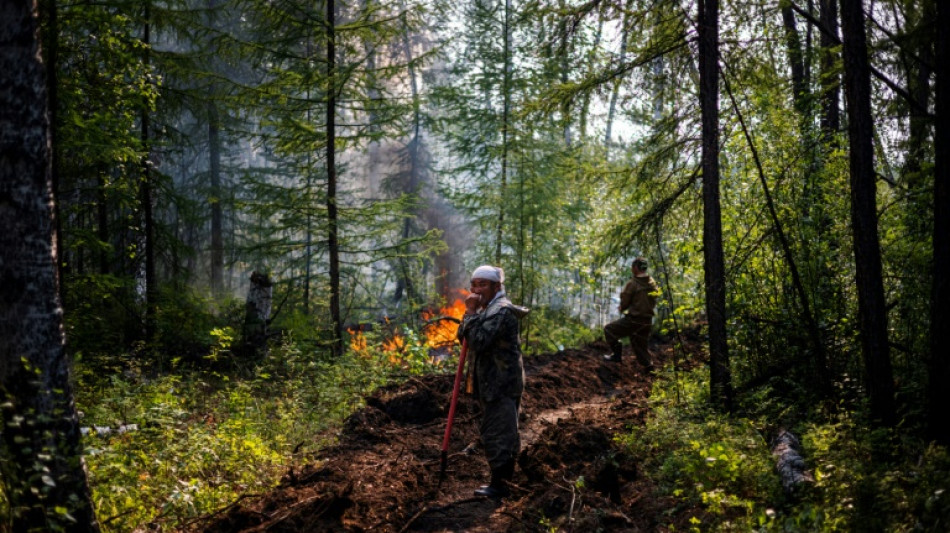
Scientists warn missing Russian data causing Arctic climate blind spots / Photo: Dimitar DILKOFF - AFP/File

 'I live in fear': 1.5 million Pakistani children sexually exploited online

 Cowboys beat Commanders, Vikings down Bears as star QBs injured
 Braves clinch division title as Red Sox reach MLB playoffs
 Bordeaux-Begles hammer Stade Francais despite Jalibert injury

 Milan and Juventus end blips with home wins
 Bridgeman wins PGA Biltmore title with sizzling 61

 Williams injured as Bears shut down by Vikings

 US warns of rapid escalation in Middle East war

 Germany's far-right AfD celebrates another state election win
 Russia vows revenge for election-day attacks as poll shows ruling party win

 Spaun late shows snatches PGA Championship win

 Conceicao strikes as Juventus beat Atalanta
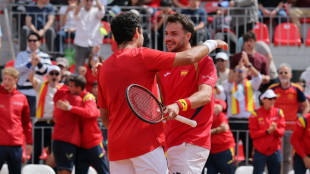 Britain, Zverev-inspired Germany, Spain complete Davis Cup finals

 Man Utd salvage Fulham draw as pressure mounts on Carrick

 Spanish civil war drama 'The Black Ball' wins at Toronto festival

 Germany's Merz shaken by far-right and far-left gains in state votes

 Macron welcomes Canada's Carney to French Atlantic territory
 Fiorentina frustrate Napoli with Serie A draw, Como upset

 Five-star Man City top Premier League after Sunderland thriller

 Ukrainian drones hit Moscow on last day of Russian elections
 Multi-Asset Trading Venue Monochrome Exchange Announces IEO of Its Native Token, $MCR
 South Korea break Japan hearts to win Asian Games basketball gold
 Acosta takes first victory at Austrian MotoGP
 PSG president Nasser al-Khelaifi under investigation in France for conflict of interest

 China swim sensation, 13, sets Games record after Japan win early

Loss of scientific data from Russia's Arctic monitoring stations following the invasion of Ukraine has worsened information gaps that could have serious implications for tracking and predicting climate change globally, researchers warned Monday.
The Arctic is warming between two and four times faster than the rest of the planet and holds glaciers, forests and carbon-rich frozen soils at risk of irreversible change that could reverberate across the planet.
Monitoring relies heavily on data from stations spread across the vast and diverse region, but Moscow's assault on Ukraine in February 2022 triggered a freeze in scientific cooperation in the Arctic -- and elsewhere.
Russia represents almost half the landmass of the entire Arctic region, creating a massive information gap, said lead author Efren Lopez-Blanco, of Aarhus University, who led the study published in Nature Climate Change.
Researchers sought to quantify just how much of an impact this has had on scientific understanding of the changes taking place in the Arctic.
"One of the immediate issues that arises if we neglect the Russian boreal forest is that we have an underestimation of biomass, soil organic carbon," Lopez-Blanco told AFP.
"This has potentially global consequences for important processes such as permafrost thawing, shifts in biodiversity, or even greenhouse gas emissions."
- Sharing problems -
The researchers focused on around 60 research stations making up part of a large territorial network called INTERACT.
Using computer models, they looked at eight factors -- including air temperature, rainfall, snow depth, vegetation biomass and soil carbon -- and found that even before the conflict in Ukraine the network had gaps, with stations concentrated in warmer, wetter areas, leaving other areas under-represented.
Without Russia, which accounts for 17 of the 60 stations, this bias increased, with the loss of areas such as Siberia's huge taiga forest.
The research highlights the logistical challenges of monitoring such a vast and often inhospitable region, as well as inherent problems with voluntary data sharing.
As a result, projects have been delayed or cancelled, while the regional Arctic Council forum -- long held up as a model of cooperation -- is now divided between the West (Canada, Denmark, Finland, Iceland, Norway, Sweden and the United States) and Russia.
Dmitry Streletskiy, a researcher at George Washington University, who was not involved in the paper and whose work on permafrost uses another monitoring group, CALM, said of nearly 80 Russian sites registered in their network, around 55 normally share data every year.
But so far, only 37 have provided 2023 data, he said, although some may send information later.
One solution, he said, would be to treat key climate metrics the same way weather data is, and have a United Nations system to ensure continuous monitoring.
Streletskiy said data is being collected but not shared, potentially leading to gaps in global understanding.
"It's like these big communal apartments. You have a lot of rooms, and some neighbours are nice, some are not," he said.
"But if you aren't aware that your neighbour has a room with a leaking roof, you will only find out when the entire house is flooded. That's pretty much what's happening."
J.Gomez--AT



