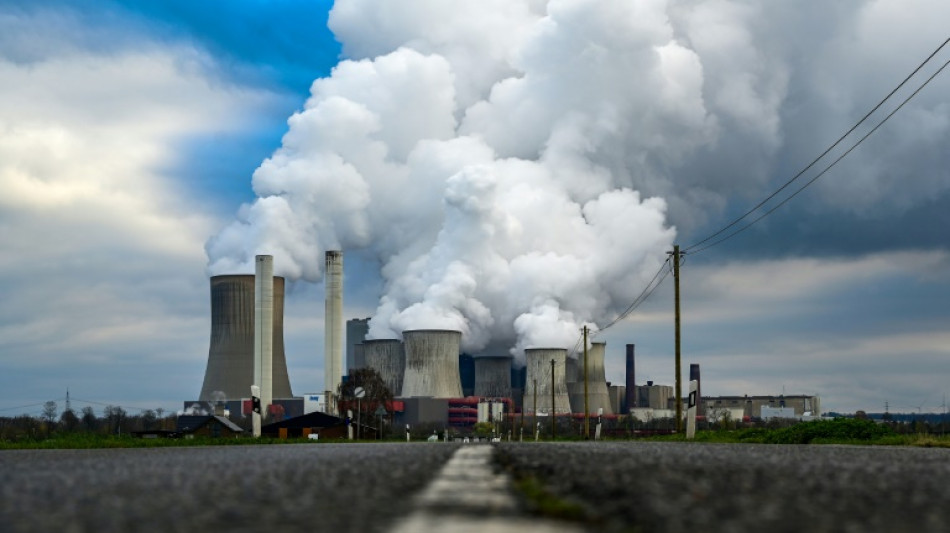
Expected CO2 levels in 2024 threaten 1.5C warming limit: Met Office / Photo: INA FASSBENDER - AFP/File

 'I live in fear': 1.5 million Pakistani children sexually exploited online

 Cowboys beat Commanders, Vikings down Bears as star QBs injured
 Braves clinch division title as Red Sox reach MLB playoffs
 Bordeaux-Begles hammer Stade Francais despite Jalibert injury

 Milan and Juventus end blips with home wins
 Bridgeman wins PGA Biltmore title with sizzling 61

 Williams injured as Bears shut down by Vikings

 US warns of rapid escalation in Middle East war
 Germany's far-right AfD celebrates another state election win
 Russia vows revenge for election-day attacks as poll shows ruling party win

 Spaun late shows snatches PGA Championship win

 Conceicao strikes as Juventus beat Atalanta
 Britain, Zverev-inspired Germany, Spain complete Davis Cup finals

 Man Utd salvage Fulham draw as pressure mounts on Carrick

 Spanish civil war drama 'The Black Ball' wins at Toronto festival

 Germany's Merz shaken by far-right and far-left gains in state votes

 Macron welcomes Canada's Carney to French Atlantic territory

 Fiorentina frustrate Napoli with Serie A draw, Como upset

 Five-star Man City top Premier League after Sunderland thriller

 Ukrainian drones hit Moscow on last day of Russian elections

 Multi-Asset Trading Venue Monochrome Exchange Announces IEO of Its Native Token, $MCR

 South Korea break Japan hearts to win Asian Games basketball gold

 Acosta takes first victory at Austrian MotoGP

 PSG president Nasser al-Khelaifi under investigation in France for conflict of interest

 China swim sensation, 13, sets Games record after Japan win early

Increased carbon dioxide in the atmosphere this year will exceed key trajectories for limiting warming to 1.5C, Britain's Met Office predicted Friday, with researchers reaffirming that that only "drastic" emissions cuts can keep the target in sight.
Rising emissions from fossil fuels and deforestation are set to be compounded in 2024 by the cyclical El Nino weather phenomenon, which reduces the ability of tropical forests to absorb carbon.
The Met forecast this will drive a "relatively large" rise in annual average CO2 concentrations measured this year at the Mauna Loa Observatory in Hawaii -- around 2.84 parts per million (ppm) higher than in 2023.
Researchers said that will likely take the world outside the main pathways set out by the UN's Intergovernmental Panel on Climate Change (IPCC) to limit warming to 1.5 degrees Celsius above pre-industrial levels -- the more ambitious goal of the 2015 Paris Agreement.
"It's looking vanishingly unlikely that we'll limit warming to 1.5," Richard Betts, the Met Office author of the CO2 forecast, told AFP.
"Technically speaking, we could still do it if emissions were to be reduced drastically starting immediately, but the scenarios that the IPCC uses show the buildup of CO2 in the atmosphere slowing already in order to meet that target."
Scientists warn that the world is edging closer to experiencing individual years of warming of 1.5C or more, although that would not by itself amount to a breach of the Paris target, which is measured over an average of roughly two decades.
The IPCC has already suggested that if emissions continue as they are, the world would breach 1.5C in the early 2030s.
"We're not seeing any signs of avoiding that in terms of the buildup of CO2 in the atmosphere," Betts said.
- Warming effect -
The UN's World Meteorological Organization last week confirmed 2023 was the warmest year on record "by a huge margin", putting the annual average global temperature at 1.45C above pre-industrial levels (1850-1900).
This year could be even hotter because the naturally-occuring El Nino climate pattern, which emerged mid-2023, usually increases global temperatures for one year after.
El Nino also brings hotter and drier conditions across tropical forests and peatlands that reduces their ability to absorb carbon from the atmosphere.
Normally around half of humanity's emissions are taken back out of the atmosphere by ecosystems and absorption in the ocean.
"That free service is weakened when there's an El Nino happening, so that means more of our emissions are staying in the atmosphere this year," Betts said.
There was particular concern over regions of the Amazon, which have already seen severe drought, heat and fires, he added.
UN experts have calculated that emissions need to be slashed nearly in half this decade to keep the 1.5C limit in play.
But carbon pollution has continued to increase.
Mauna Loa, which has been monitoring atmospheric CO2 levels since 1958, has traced a trend line that may fluctuate but has generally continued to climb.
To predict CO2 concentrations this year at Mauna Loa, considered representative of global averages, the Met Office uses emissions data combined with observations and forecasts of ocean surface temperatures in the equatorial east Pacific -- an indicator for El Nino.
Betts said that even without the El Nino effect, the estimated buildup of CO2 in the atmosphere would be at the "very, very upper limit of consistency" with the IPCC 1.5C scenarios.
He stressed that while these are not the only ways to keep the 1.5C limit in reach, all possible paths would involve "urgent emissions cuts".
W.Morales--AT



