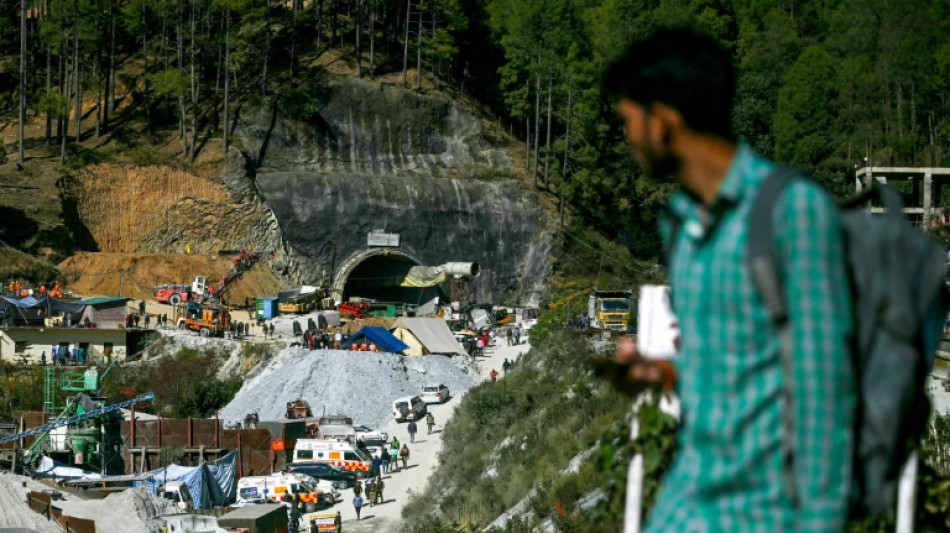
India tunnel collapse 'wake-up call' for Modi's infrastructure drive / Photo: Arun SANKAR - AFP

 Liverpool boss Iraola urges Isak to raise his level
 Evenepoel wins record 4th straight world time-trial title

 France's Macron, Canada's Carney announce closer ties
 Carrick defends troubled Man Utd after Fulham escape

 Horror movie 'Resident Evil' tops N. American box office

 Germany's Merz vows to stay course despite new vote losses

 Man City outgun Sunderland despite Brobbey hat-trick, Man Utd rescue Fulham draw

 Mourinho blames ref committee for Real Madrid derby defeat

 Maresca craves a 1-0 win after eight-goal Man City thriller

 Atletico Madrid beat Real Madrid in tense derby clash

 Reusser retains world time-trial title

 Man City outgun Sunderland despite Brobbey hat-trick, Liverpool win at Bournemouth

 Top US, Chinese economic officials meet ahead of Trump-Xi summit
 Erdogan's LGBTQ crackdown 'first step of election campaign': activist

 Mass drone barrage on Moscow kills two

 82-year-old dies after beach fight in Greece over sun lounger

 US warns of rapid escalation in Mideast war

 Iran 'put hearts on the court' to win Asian Games basketball bronze

 School girl Yu helps China dominate in Asian Games swimming openers

 Myanmar win first Asian Games teqball gold as Spain great Puyol watches

 China's 13-year-old Yu scorches to first major gold at Asian Games

 Russians vote on last day of parliamentary elections
 Hong Kong pays final respects to former city leader Tung

 Typhoon put people off Asian Games opening ceremony, official says

 China's 13-year-old Yu cruises as Asian Games swimming begins

India's aggressive infrastructure push into the ecologically fragile Himalayan mountains has been given a "wake-up call" by the collapse of a road tunnel that trapped 41 men, environmental experts say.
The partial cave-in of the under-construction Silkyara road tunnel in northern Uttarakhand state nearly two weeks ago -- with the desperate men still awaiting rescue on Friday -- was only the latest disaster in the geologically unstable region.
Added to that are the challenges caused by rising global temperatures unleashing a cascade of extreme weather that scientists warn will get worse.
"The scale and extent of the infrastructure development needs a complete rethink," Shripad Dharmadhikary, an environmental researcher and veteran activist, told AFP.
India's monsoon rains mean flooding is common, but major infrastructure projects in the mountains -- including hydroelectric dams, railways and roads -- are being built in areas hit ever harder by storm surges and landslides.
"It is one thing to build roads for local connectivity," Dharmadhikary said.
"But roads for big hydropower projects are much wider, increasing vulnerability and risk... Scale makes a big difference."
- 'Risks ignored' -
Raghav Chandra, ex-chairman of the National Highways Authority of India (NHAI), warned Friday that "building a tunnel through a mountain is perilous", but dangers were multiplied when such large-scale projects are poorly carried out.
"The accident is a wake-up call about the perils of undertaking massive construction projects in the fragile Himalayan range, which is under threat from intense human activity and the vagaries of the climate crisis," Chandra wrote in the Hindustan Times, alongside another top ex-NHAI official, BS Singla.
The Himalayas -- the world's highest mountain range, with peaks driven upwards by colliding continental plates -- is one of the globe's most seismically active regions, with earthquakes common.
Scientists say glaciers in the Himalayas are melting faster than ever due to climate change, exposing communities to unpredictable and costly disasters.
Last month, UN Secretary-General Antonio Guterres said Himalayan regions were struggling with rapidly melting glaciers, warning on a visit to neighbouring Nepal that the "rooftops of the world are caving in".
The Silkyara tunnel is part of Prime Minister Narendra Modi's infrastructure project aimed at cutting travel times between some of the most popular Hindu temples in the country.
The 4.5-kilometre (2.7-mile) passage is meant to connect Uttarkashi and Yamunotri, two of the holiest sites.
For Modi, leader of the Hindu-nationalist Bharatiya Janata Party (BJP), the grand projects help burnish his appeal, with elections due next year.
But India's projects are also focused on improving access to strategic areas bordering rival China.
New Delhi has been wary of Beijing's growing military assertiveness and their 3,500-kilometre shared frontier has been a perennial source of tension.
"Tunnelling helps to reduce travel time and plays a strategic role by enabling quicker passage of defence armaments and military troops," Chandra and Singla added.
"But, with the growing urgency to speed up construction, the manifold risks and challenges involved... are often ignored."
- 'Course correction' -
After the Silkyara collapse, the NHAI said it would assess all 29 under-construction tunnels to "ensure safety and adherence to the highest quality standards".
Arnold Dix, president of the International Tunnelling and Underground Space Association, pointed out the advantages of building tunnels.
"The environmental footprint of a tunnel is likely to be less than the environmental footprint of a much larger and more complex road," Dix told AFP at the Silkyara tunnel site, where he is helping rescue efforts.
Campaigners say that while development is needed, the breakneck pace is causing problems, including a surge of unregulated building development replacing the forests that helped keep hillsides stable.
"This decade... the Himalayas have been tunnelled, blasted, cut, gouged, turned to rubble and concretised as never before," environmental campaigner Priyadarshini Patel wrote in the Times of India this week.
"The development model in this young, fragile mountain range has been disastrous and needs course correction," added Patel, head of Ganga Ahvaan, a community group working to protect the Himalayas and the watershed of the Ganges river.
"Mega-projects are not what the Himalayas are about, culturally or geologically".
O.Gutierrez--AT