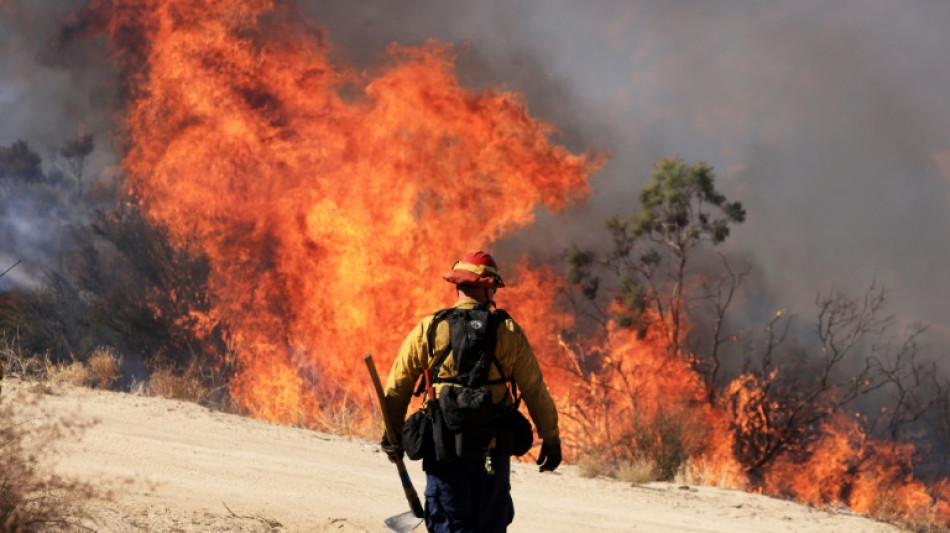
Heat projected to kill nearly five times more people by 2050 / Photo: DAVID SWANSON - AFP/File

 Liverpool boss Iraola urges Isak to raise his level

 Evenepoel wins record 4th straight world time-trial title
 France's Macron, Canada's Carney announce closer ties

 Carrick defends troubled Man Utd after Fulham escape

 Horror movie 'Resident Evil' tops N. American box office

 Germany's Merz vows to stay course despite new vote losses

 Man City outgun Sunderland despite Brobbey hat-trick, Man Utd rescue Fulham draw

 Mourinho blames ref committee for Real Madrid derby defeat

 Maresca craves a 1-0 win after eight-goal Man City thriller
 Atletico Madrid beat Real Madrid in tense derby clash
 Reusser retains world time-trial title

 Man City outgun Sunderland despite Brobbey hat-trick, Liverpool win at Bournemouth

 Top US, Chinese economic officials meet ahead of Trump-Xi summit

 Erdogan's LGBTQ crackdown 'first step of election campaign': activist

 Mass drone barrage on Moscow kills two

 82-year-old dies after beach fight in Greece over sun lounger

 US warns of rapid escalation in Mideast war
 Iran 'put hearts on the court' to win Asian Games basketball bronze

 School girl Yu helps China dominate in Asian Games swimming openers
 Myanmar win first Asian Games teqball gold as Spain great Puyol watches

 China's 13-year-old Yu scorches to first major gold at Asian Games
 Russians vote on last day of parliamentary elections

 Hong Kong pays final respects to former city leader Tung

 Typhoon put people off Asian Games opening ceremony, official says

 China's 13-year-old Yu cruises as Asian Games swimming begins

Nearly five times more people will likely die due to extreme heat in the coming decades, an international team of experts warned on Wednesday, adding that without action on climate change the "health of humanity is at grave risk".
Lethal heat was just one of the many ways the world's still-increasing use of fossil fuels threatens human health, according to The Lancet Countdown, a major annual assessment carried out by leading researchers and institutions.
More common droughts will put millions at risk of starving, mosquitoes spreading farther than ever before will take infectious diseases with them, and health systems will struggle to cope with the burden, the researchers warned.
The dire assessment comes during what is expected to be the hottest year in human history -- just last week, Europe's climate monitor declared that last month was the warmest October on record.
It also comes ahead of the COP28 climate talks in Dubai later this month, which will for the first time host a "health day" on December 3 as experts try to shine a light on global warming's impact on health.
Despite growing calls for global action, energy-related carbon emissions hit new highs last year, the Lancet Countdown report said, singling out still-massive government subsidies and private bank investments into planet-heating fossil fuels.
- 'Crisis on top of a crisis' -
Last year people worldwide were exposed to an average of 86 days of life-threatening temperatures, according to the Lancet Countdown study. Around 60 percent of those days were made more than twice as likely due to climate change, it said.
The number of people over 65 who died from heat rose by 85 percent from 1991-2000 to 2013-2022, it added.
"However these impacts that we are seeing today could be just an early symptom of a very dangerous future," Lancet Countdown's executive director Marina Romanello told journalists.
Under a scenario in which the world warms by two degrees Celsius by the end of the century -- it is currently on track for 2.7C -- annual heat-related deaths were projected to increase 370 percent by 2050. That marks a 4.7-fold increase.
Around 520 million more people will experience moderate or severe food insecurity by mid-century, according to the projections.
And mosquito-borne infectious diseases will continue to spread into new areas. The transmission of dengue would increase by 36 percent under a 2C warming scenario, according to the study.
Meanwhile, more than a quarter of cities surveyed by the researchers said they were worried that climate change would overwhelm their capacity to cope.
"We're facing a crisis on top of a crisis," said Lancet Countdown's Georgiana Gordon-Strachan, whose homeland Jamaica is currently in the middle of a dengue outbreak.
- 'Staring down the barrel' -
"People living in poorer countries, who are often least responsible for greenhouse gas emissions, are bearing the brunt of the health impacts, but are least able to access funding and technical capacity to adapt to the deadly storms, rising seas and crop-withering droughts worsened by global heating," she said.
UN Secretary-General Antonio Guterres responded to the report by saying that "humanity is staring down the barrel of an intolerable future".
"We are already seeing a human catastrophe unfolding with the health and livelihoods of billions across the world endangered by record-breaking heat, crop-failing droughts, rising levels of hunger, growing infectious disease outbreaks, and deadly storms and floods," he said in a statement.
Dann Mitchell, climate hazards chair at the UK's Bristol University, lamented that "already catastrophic" health warnings about climate change had "not managed to convince the world's governments to cut carbon emissions enough to avoid the first Paris Agreement goal of 1.5C".
The UN warned on Tuesday that countries' current pledges will cut global carbon emissions by just two percent by 2030 from 2019 levels -- far short of the 43 percent drop needed to limit warming to 1.5C.
Romanello warned that if more progress is not made on emissions, then "the growing emphasis on health within climate change negotiations risks being just empty words".
R.Chavez--AT



