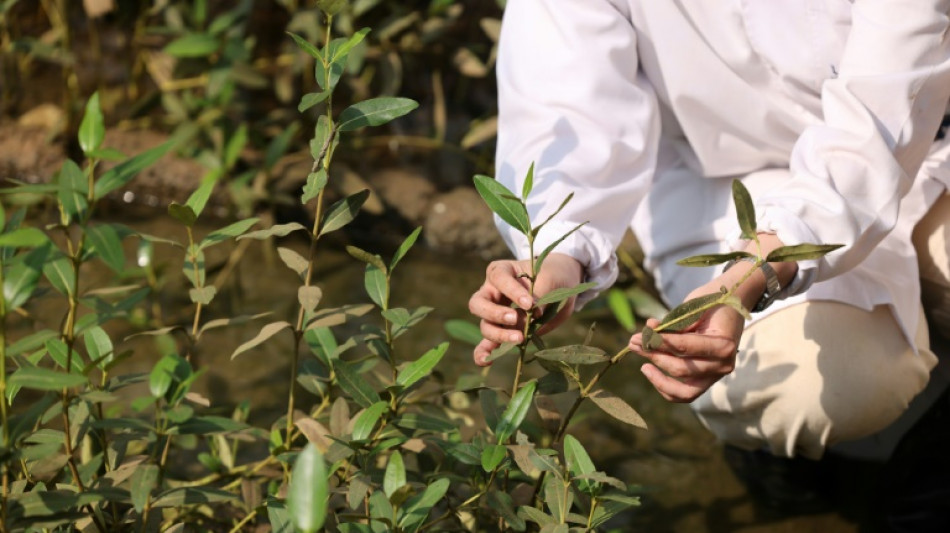
Oman revives CO2-busting mangroves as climate threat lurks / Photo: Karim SAHIB - AFP

 Liverpool boss Iraola urges Isak to raise his level
 Evenepoel wins record 4th straight world time-trial title

 France's Macron, Canada's Carney announce closer ties
 Carrick defends troubled Man Utd after Fulham escape

 Horror movie 'Resident Evil' tops N. American box office

 Germany's Merz vows to stay course despite new vote losses

 Man City outgun Sunderland despite Brobbey hat-trick, Man Utd rescue Fulham draw

 Mourinho blames ref committee for Real Madrid derby defeat

 Maresca craves a 1-0 win after eight-goal Man City thriller

 Atletico Madrid beat Real Madrid in tense derby clash

 Reusser retains world time-trial title

 Man City outgun Sunderland despite Brobbey hat-trick, Liverpool win at Bournemouth

 Top US, Chinese economic officials meet ahead of Trump-Xi summit

 Erdogan's LGBTQ crackdown 'first step of election campaign': activist

 Mass drone barrage on Moscow kills two

 82-year-old dies after beach fight in Greece over sun lounger

 US warns of rapid escalation in Mideast war

 Iran 'put hearts on the court' to win Asian Games basketball bronze

 School girl Yu helps China dominate in Asian Games swimming openers

 Myanmar win first Asian Games teqball gold as Spain great Puyol watches

 China's 13-year-old Yu scorches to first major gold at Asian Games

 Russians vote on last day of parliamentary elections

 Hong Kong pays final respects to former city leader Tung

 Typhoon put people off Asian Games opening ceremony, official says

 China's 13-year-old Yu cruises as Asian Games swimming begins

In a muddy wetland in Oman's capital, environmental scientist Zakiya al-Afifi measures the bark of a mangrove tree, estimating its capacity to absorb the carbon dioxide that is slowly heating the planet.
Standing in the leafy reserve, shielded from the fierce sun, she says the Al-Qurm forest's 80 protected hectares (197 acres) of mangroves could lock away thousands of tons of CO2.
"Mangroves are the richest carbon sink in the world," says Afifi, wearing boots and a white lab coat as she leads a group of university students around the swamp.
If the shoreline trees and bushes have become part of efforts to cut atmospheric CO2, oil-producing Oman, on the Arabian peninsula's southeast, has led the way in this hydrocarbon-rich region.
Inspired by the late ruler Sultan Qaboos bin Said, a renowned conservationist who died in 2020, the country of 4.5 million people has become the Gulf's centre for mangrove restoration and preservation.
Mangrove habitats can remove carbon dioxide from the atmosphere at a faster rate than forests and store it in their soil and sediment for longer periods.
"Mangroves are recognised as one of the nature-based solutions to fight climate change," says Afifi, 41.
Up to 80 tons of CO2 per hectare could be stored in Al-Qurm's above-ground biomass, and even more in the muddy sediments below, she adds.
- 'Maybe we will lose them' -
Oman, a minor oil producer compared with its neighbours the United Arab Emirates and Saudi Arabia, is moving quickly in its project to revive the forests that once covered the country, but died out thousands of years ago because of climatic changes.
The reason for its haste is modern, man-made climate change -- much of it from burning fossil fuels -- which risks destroying the mangroves with higher temperatures, floods and cyclones.
"If we are not going to restore more forests, it means maybe one day we will lose them" due to climate change, Afifi says.
Trudging through a murky creek north of Muscat, Badr bin Saif Al Busaidi of Oman's environmental authority points to a dense thicket of mangrove trees.
"There was not a single tree here" two decades ago, the 40-year-old tells AFP from the Al-Sawadi creek, his boots ankle-deep in water.
"Now, it is a forest that stretches more than four kilometres (2.5 miles)" with 88 hectares of mangrove cover, says Busaidi.
Since 2001, a restoration project has revived these biodiversity hotspots that now cover around 1,000 hectares across the country's coast.
Over the past two years, Oman has planted more than 3.5 million seeds directly in targeted areas, including a record two million this year.
"Next year the numbers will be even higher," Busaidi says, adding: "We are living what we can call a war with nature because of climate change.
"If we don't take action, we will lose these natural resources."
- Sowing the seeds -
Oman's restoration project has evolved slowly. At first it relied on mangrove nurseries, two of which are in Al-Qurm, growing 850,000 seedlings for transfer to coastal areas.
In 2021, the conservationists tried using drones to disperse seeds, but after disappointing results they focused on the current approach of direct, targeted planting.
Oman is also helping fulfil carbon credit schemes which have become popular tools for companies seeking to offset their carbon emissions.
A single credit represents one tonne of carbon dioxide removed or reduced from the atmosphere. Credits are generated through activities such as planting mangroves or rehabilitating forests.
This month, the environment authority signed a contract with Oman's MSA Green Projects Company to plant 100 million trees over four years.
As part of the initiative, 20,000 hectares of land in Al Wusta governorate will be transformed into mangrove habitats, partly using artificial lakes.
Once completed, the project is predicted to eliminate 14 million tonnes of CO2 and generate $150 million through carbon credit certificates, the environmental authority said.
Carbon credits' legitimacy has come under scrutiny as the trees must grow to maturity and never burn down if they are to permanently store CO2. Monitoring and certification standards can be slack, reports have found.
Oman's carbon offsets could also be measured against its emissions, which amounted to 71 million tonnes of CO2 in 2021 according to the Global Carbon Project.
"Past generations didn't think much about the environment because the impact of climate change" was not as apparent then, student Israa al-Maskari says at a mangrove nursery in Al-Qurm.
"What they did, we now face so we have to save our environment for us and for future generations."
K.Hill--AT



