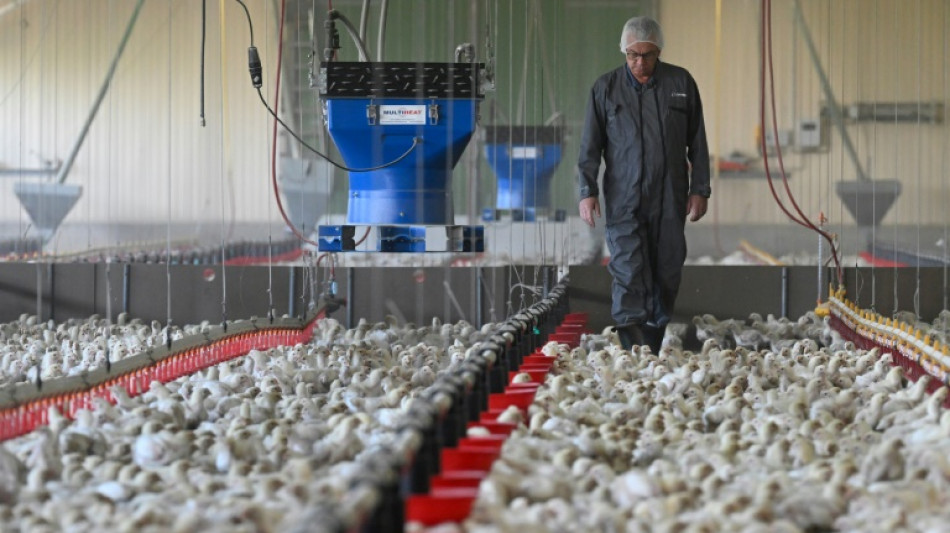
Can factory chicken really help save the climate? / Photo: Damien MEYER - AFP

 Liverpool boss Iraola urges Isak to raise his level

 Evenepoel wins record 4th straight world time-trial title

 France's Macron, Canada's Carney announce closer ties

 Carrick defends troubled Man Utd after Fulham escape

 Horror movie 'Resident Evil' tops N. American box office

 Germany's Merz vows to stay course despite new vote losses

 Man City outgun Sunderland despite Brobbey hat-trick, Man Utd rescue Fulham draw

 Mourinho blames ref committee for Real Madrid derby defeat

 Maresca craves a 1-0 win after eight-goal Man City thriller

 Atletico Madrid beat Real Madrid in tense derby clash

 Reusser retains world time-trial title

 Man City outgun Sunderland despite Brobbey hat-trick, Liverpool win at Bournemouth

 Top US, Chinese economic officials meet ahead of Trump-Xi summit

 Erdogan's LGBTQ crackdown 'first step of election campaign': activist

 Mass drone barrage on Moscow kills two

 82-year-old dies after beach fight in Greece over sun lounger

 US warns of rapid escalation in Mideast war

 Iran 'put hearts on the court' to win Asian Games basketball bronze

 School girl Yu helps China dominate in Asian Games swimming openers

 Myanmar win first Asian Games teqball gold as Spain great Puyol watches

 China's 13-year-old Yu scorches to first major gold at Asian Games

 Russians vote on last day of parliamentary elections

 Hong Kong pays final respects to former city leader Tung

 Typhoon put people off Asian Games opening ceremony, official says

 China's 13-year-old Yu cruises as Asian Games swimming begins

Stephane Dahirel doesn't exactly say eat chicken and save the planet, but that is what he's hinting at as he opens a shed door on his intensive farm in Brittany, western France.
The 30,000 chickens inside will more than triple in size in less than a month and their meat will have a low carbon footprint.
"The objective is to produce the best meat possible, in the least amount of time, with the least amount of food," Dahirel said.
The two million snow-white chickens he produces every year -- bred mostly for McDonald's nuggets -- will reach their slaughter weight in less than half the time it takes on a traditional farm.
At 20 days they already weigh one kilo (two pounds) -- 20 times heavier than at birth. By the time they are slaughtered at 45 days, they will weigh over three kilos.
Chicken has the smallest carbon footprint of any meat, according to the UN's Food and Agricultural Organization (FAO), less than half the two kilos of CO2 produced for a kilo of pork, and 30 times less than that of beef.
While cows produce a lot of planet-warming methane, chickens emit very little. As much, in fact, as rice, the FAO says, or even less if they are intensively farmed.
Dahirel insisted that intensive farming is "the most efficient and rational system" for producing meat "from an economical and ecological perspective".
- Animal welfare -
But there are big drawbacks too. Despite the low emissions he claims for his chickens, producing the grain to feed them requires large amounts of land, synthetic fertilisers and pesticides.
All have effects on biodiversity and water quality. Indeed green algae blooms on beaches in Dahirel's native Brittany -- partly caused by intensive pork, poultry and dairy production -- has caused an environmental outcry and been linked to several deaths.
Intensive farming is also in the dock on animal well-being.
Dahirel raises 20 chickens per square metre (20 chickens per 10 square feet), which are kept on a litter where droppings are absorbed by wood shavings and buckwheat hulls.
Sick or abnormal chickens are killed to avoid further suffering and because the automated slaughterhouse requires a homogenous product.
"They are not robots of course, but we're looking for homogeneity," the farmer said from his veranda overlooking his three sheds, which are covered in solar panels.
- We must 'eat less meat' -
Chickens may be an optimal animal protein for carbon emissions, but not necessarily for nature, experts say.
"If we think only in terms of CO2 emissions per kilo of meat, we'd all start eating chicken. But thinking that's the solution would be a massive mistake," said Pierre-Marie Aubert, of France's IDDRI sustainable development think tank.
"If you only think in terms of carbon, a heap of things would backfire on us in the long run," he added.
Aubert said there had been a "crazy" rise in consumption of chicken in recent years, making it one of the most widely consumed meats in the world, with none of the religious and cultural taboos associated with pork and beef.
The world has become so focused on methane emissions from ruminants like cattle and sheep "that many people think substituting beef with chicken is enough, but really, we need to reduce all meat consumption," said Lucile Rogissart, of the Institute for Climate Economics (I4CE).
A.Taylor--AT