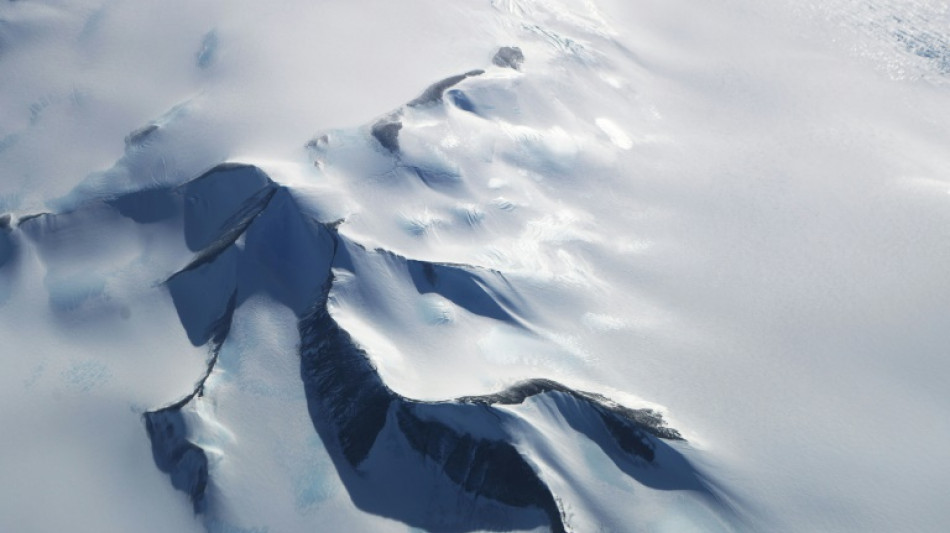
'Frozen in time' landscape discovered under Antarctic ice / Photo: MARIO TAMA - GETTY IMAGES NORTH AMERICA/AFP/File

 Germany's Merz vows to stay course despite new vote losses

 Man City outgun Sunderland despite Brobbey hat-trick, Man Utd rescue Fulham draw

 Mourinho blames ref committee for Real Madrid derby defeat

 Maresca craves a 1-0 win after eight-goal Man City thriller

 Atletico Madrid beat Real Madrid in tense derby clash

 Reusser retains world time-trial title

 Man City outgun Sunderland despite Brobbey hat-trick, Liverpool win at Bournemouth

 Top US, Chinese economic officials meet ahead of Trump-Xi summit

 Erdogan's LGBTQ crackdown 'first step of election campaign': activist

 Mass drone barrage on Moscow kills two

 82-year-old dies after beach fight in Greece over sun lounger

 US warns of rapid escalation in Mideast war

 Iran 'put hearts on the court' to win Asian Games basketball bronze

 School girl Yu helps China dominate in Asian Games swimming openers

 Myanmar win first Asian Games teqball gold as Spain great Puyol watches

 China's 13-year-old Yu scorches to first major gold at Asian Games

 Russians vote on last day of parliamentary elections

 Hong Kong pays final respects to former city leader Tung

 Typhoon put people off Asian Games opening ceremony, official says

 China's 13-year-old Yu cruises as Asian Games swimming begins

 AI 'warning shots' focus Beijing on national security risks

 Philippine tribe in limbo over US-led tech hub

 Leo XIV, first US pope transcends his restrained style

 Singer Ed Sheeran says Gaza situation 'unjustifiable' following controversy

 In 'Tenzing', a Sherpa mountaineer gets his due

Scientists revealed Tuesday that they had discovered a vast, hidden landscape of hills and valleys carved by ancient rivers that has been "frozen in time" under the Antarctic ice for millions of years.
This landscape, which is bigger than Belgium, has remained untouched for potentially more than 34 million years, but human-driven global warming could threaten to expose it, the British and American researchers warned.
"It is an undiscovered landscape -- no one's laid eyes on it," Stewart Jamieson, a glaciologist at the UK's Durham University and the lead author of the study, told AFP.
"What is exciting is that it's been hiding there in plain sight," Jamieson added, emphasising that the researchers had not used new data, only a new approach.
The land underneath the East Antarctic Ice Sheet is less well known than the surface of Mars, Jamieson said.
The main way to "see" beneath it is for a plane overhead to send radio waves into the ice and analyse the echoes, a technique called radio-echo sounding.
But doing this across the continent -- Antarctica is bigger than Europe -- would pose a huge challenge.
So the researchers used existing satellite images of the surface to "trace out the valleys and ridges" more than two kilometres (1.6 miles) below, Jamieson said.
The undulating ice surface is a "ghost image" that drapes gently over these spikier features, he added.
When combined with radio-echo sounding data, an image emerged of a river-carved landscape of plunging valleys and sharply peaked hills similar to some currently on the Earth's surface.
It was like looking out the window of a long-haul flight and seeing a mountainous region below, Jamieson said, comparing the landscape to the Snowdonia area of northern Wales.
The area, stretching across 32,000 square kilometres (12,000 square miles), was once home to trees, forests and probably animals.
But then the ice came along and it was "frozen in time", Jamieson said.
Exactly when sunshine last touched this hidden world is difficult to determine, but the researchers are confident it has been at least 14 million years.
Jamieson said his "hunch" is that it was last exposed more than 34 million years ago, when Antarctica first froze over.
Some of the researchers had previously found a city-size lake under the Antarctic ice, and the team believes there are other ancient landscapes down there yet to be discovered.
- Climate threat -
The authors of the study said global warming could pose a threat to their newly discovered landscape.
"We are now on course to develop atmospheric conditions similar to those that prevailed" between 14 to 34 million years ago, when it was three to seven degrees Celsius warmer (roughly seven to 13 degrees Fahrenheit) than currently, they wrote in the journal Nature Communications.
Jamieson emphasised that the landscape is hundreds of kilometres inland from the edge of the ice, so any possible exposure would be "a long way off".
The fact that retreating ice over past warming events -- such as the Pliocene period, three to 4.5 million years ago -- did not expose the landscape, was cause for hope, he added.
But it remains unclear what the tipping point would be for a "runaway reaction" of melting, he said.
The study was released a day after scientists warned that the melting of the neighbouring West Antarctic Ice Sheet is likely to substantially accelerate in the coming decades, even if the world meets its ambitions to limit global warming.
Y.Baker--AT



