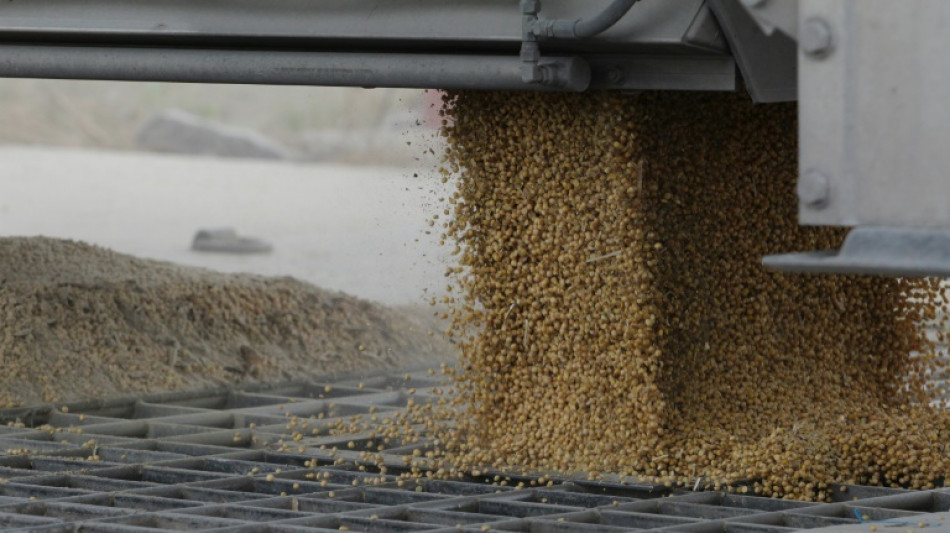
Drought-hit farmers in US heartland hope Mississippi 'comes back' / Photo: Ulysse BELLIER - AFP

 Germany's Merz vows to stay course despite new vote losses

 Man City outgun Sunderland despite Brobbey hat-trick, Man Utd rescue Fulham draw

 Mourinho blames ref committee for Real Madrid derby defeat

 Maresca craves a 1-0 win after eight-goal Man City thriller

 Atletico Madrid beat Real Madrid in tense derby clash

 Reusser retains world time-trial title

 Man City outgun Sunderland despite Brobbey hat-trick, Liverpool win at Bournemouth

 Top US, Chinese economic officials meet ahead of Trump-Xi summit

 Erdogan's LGBTQ crackdown 'first step of election campaign': activist

 Mass drone barrage on Moscow kills two

 82-year-old dies after beach fight in Greece over sun lounger

 US warns of rapid escalation in Mideast war

 Iran 'put hearts on the court' to win Asian Games basketball bronze

 School girl Yu helps China dominate in Asian Games swimming openers

 Myanmar win first Asian Games teqball gold as Spain great Puyol watches

 China's 13-year-old Yu scorches to first major gold at Asian Games

 Russians vote on last day of parliamentary elections

 Hong Kong pays final respects to former city leader Tung

 Typhoon put people off Asian Games opening ceremony, official says

 China's 13-year-old Yu cruises as Asian Games swimming begins

 AI 'warning shots' focus Beijing on national security risks

 Philippine tribe in limbo over US-led tech hub

 Leo XIV, first US pope transcends his restrained style

 Singer Ed Sheeran says Gaza situation 'unjustifiable' following controversy

 In 'Tenzing', a Sherpa mountaineer gets his due

Jonathan Driver, an Arkansas farmer with blackened hands and a thick southern drawl, doesn't have a minute to spare.
He's been working 16 or 17 hours a day to finish harvesting his crops and -- an added stress this year -- to find someplace to store tons of excess soybeans.
"Getting it out of that field is very crucial," Driver said as he stepped out of his white pick-up truck.
But for a second straight year, dangerously low water levels in the Mississippi River have drastically curtailed river transport, and that means added costs and complications for the farmers of the American heartland.
Driver, who sports a light beard and a gray baseball cap, also grows rice, which he stores in three squat corrugated-steel silos.
But the soybean harvest isn't done, and the barges that in normal years would take his product downriver are in terribly short supply, slowing grain shipments to the Gulf of Mexico and points beyond, eventually to feed livestock around the world.
So Driver plans to sell his rice as quickly as possible -- even if it's not for "the price I want" -- to make room for soybeans.
The need is pressing. For in his soybean fields, little yellow pods are already popping open and hitting the ground -- crops that will be lost.
It's a race against the clock.
- Low world prices -
"Every day you see pods popping, you're losing $3,000 a day," Driver said, before glumly adding, "I don't have $3,000 left to lose."
In the barn behind him, two men are busy repairing a massive combine harvester.
Driver's father was in the fields operating another harvester, and his wife was out working as well.
With storage in desperately short supply, the Drivers are employing grain bags -- enormous, long, tube-shaped plastic bags that, in proper conditions, can keep cereals good for some time, hopefully until traffic picks up again on the Mississippi.
"There is a possible scenario that you got to go into long-term storage" using the bags, Driver said, even "into sometime next year."
But this alternative storage method is a risky one, and not just because of possible bad weather.
After record global harvests this year, soybean and corn prices are depressed, and the buildup of grain reserves on US farms due to the problems on the Mississippi could keep prices low for some time.
- 'Going to come back up' -
There are alternatives to river transport -- mainly rail and truck -- but they cost more and emit more carbon dioxide.
Plus, local farmers feel a real attachment to the Mississippi.
Jimmy Moody works on riverfront land inherited from his grandfather in Tennessee, across the river from Driver's land in northern Arkansas.
For as long as he remembers, he said, grain "all gets shipped on a river to the Gulf. You know, if we can't unload on the river, then we've got to go east."
"So we're very dependent on the river," he adds.
The volume of grain shipped on the Mississippi has dropped by half from the average of the past three years, according to the US Department of Agriculture.
Like Driver, Moody is storing excess soybeans in the huge sausage-shaped bags, despite the inherent risks. He is hoping to get better prices for his crops once the Mississippi is again easily navigable.
"I don't have any worry about it," he said. "You know, the river's going to come back up."
At 71, Moody has seen hard times come and go.
"We'll still be shipping grain to the Gulf long after I'm gone," he said.
J.Gomez--AT



