In climate fight, rich nations must give up oil first: report

 Martin wins Austrian MotoGP sprint after Acosta crash

 Japan edge Fiji to win Pacific Nations Cup

 Black smoke, flames rising near Riyadh airport: residents to AFP

 UK actor Naomi Watts honoured at Spain film festival
 Japan emperor declares Asian Games open after turbulent build-up

 Asian Games open with unity message after troubled build-up
 Denmark hails 'binding' Greenland deal with Trump

 We don't want Games host Japan losing money, says Asian Olympic official
 Ed Sheeran returns to stage after Palestinian controversy

 Asian Games to open in Japan after troubled build-up

 Drone owners rush to offload devices ahead of Beijing ban

 Trump's beef policies irk Texas ranchers, testing their loyalty

 Kennedy Center: future unclear for iconic Washington arts hub

 Trump claims 'infinite' Greenland security deal with Denmark

 Helicopters battle wildfire threatening Ecuador's capital

 Brentford batter Chelsea to undo Alonso's promising start

 Kane hits Bundesliga century as Bayern rout Union

 Trump says CNN, MS NOW, Politico banned from White House

 Hushing and hedging: US companies retreat on climate

 Springboks to face Fiji before 2027 Rugby World Cup

 Nigeria miners struggled to breathe in cell before 37 died: survivors

 McIlroy on the charge at PGA Championship as Reed withdraws

 McIlroy on the charge at PGA Championship

 Crisis-wracked Volkswagen warns of 10-bn-euro hit to profits

 Costa Rica's Grynspan tops third informal poll for UN chief: diplomat

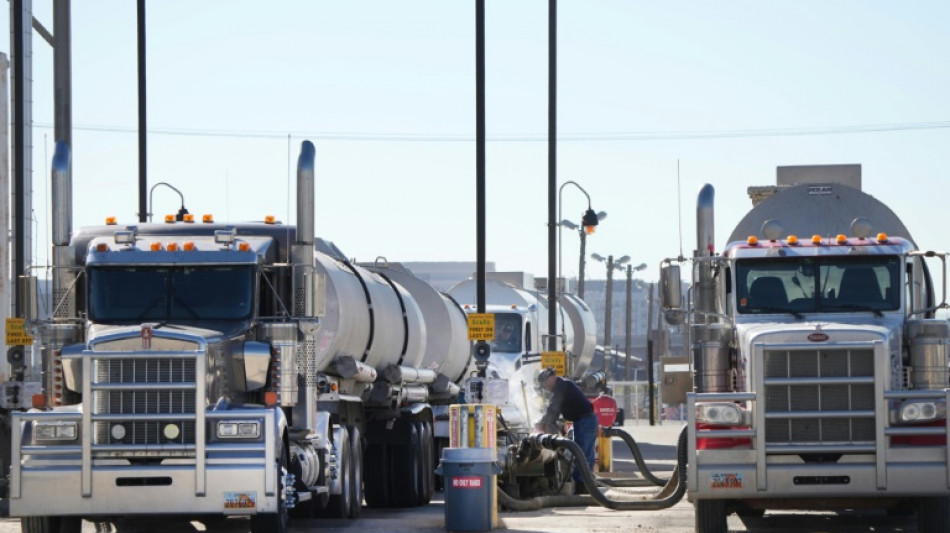
Rich countries must end their oil and gas production by 2034 to cap global warming at 1.5 degrees Celsius and give poorer nations time to replace fossil fuel income, according to a report released Tuesday.
The 70-page analysis from the Tyndall Centre for Climate Change Research comes as nearly 200 nations kicks off a two-week negotiation to validate a landmark assessment of options for reducing carbon pollution and extracting CO2 from the air.
The overarching objective, enshrined in the 2015 Paris Agreement, is to cap global warming "well below" 2C, and 1.5C if possible.
A torrent of research since 2015, along with a crescendo of deadly extreme weather across the globe, has confirmed that the lower aspirational target is by far a safer threshold.
Some poorer nations produce only a tiny percentage of global output but are so reliant on fossil fuel revenues that rapidly removing this income could undercut their economic or political stability, the Tyndall Centre report shows.
Countries such as South Sudan, the Republic of Congo and Gabon have little economic revenue apart from oil and gas production.
By contrast, wealthy nations that are major producers would remain rich even if fossil fuel income were removed.
Oil and gas revenue, for example, contribute eight percent to US GPD, but the country's GDP per capita would still be about $60,000 -- second highest in the world among oil and gas producing nations -- without it, according to the report.
"We use the GDP per capita that remains once we've removed the revenue from oil and gas as an indicator of capacity," lead author Kevin Anderson, a professor of energy and climate change at the University of Manchester, told AFP.
There are 88 countries in the world that produce oil and gas.
"We calculated emissions phase-out dates for all of them consistent with the Paris Agreement temperature goals," Anderson said.
"We found that wealthy countries need to be at zero oil and gas production by 2034."
- First coal, then oil & gas -
The very poorest countries can continue to produce out to 2050, according to the calculation, and other countries such as China and Mexico are somewhere in between.
When countries signed the Paris climate treaty, it was accepted that wealthy nations should take bigger and faster steps to decarbonise their economies and provide financial support to help poorer countries wean themselves of fossil fuels.
The principle has already been applied to coal-power generation, with the UN calling on rich OECD countries to phase out coal use by 2030, and the rest of the world by 2040.
The new report, Phaseout Pathways for Fossil Fuel Production, applies the same approach to oil and gas.
For a 50/50 chance of limiting the rise in global temperatures to 1.5C, 19 countries in which per capita GDP would remain above $50,000 without oil and gas revenue must end production by 2034.
Included in this tranche are the US, Norway, Britain, Canada, Australia and the United Arab Emirates.
Another 14 "high capacity" nations where per capita GDP would be about $28,000 without income from oil and gas must end production in 2039, including Saudi Arabia, Kuwait and Kazakhstan.
The next group of countries -- including China, Brazil and Mexico -- would need to end output by 2043, followed by Indonesia, Iran and Egypt in 2045.
Only the poorest oil and gas producing nations such as Iraq, Libya and Angola could continue to pump crude and extract gas until mid-century.
"This report illustrates only too clearly why there also needs to be an urgent phase-out of oil and gas production," said Connie Hedegaard, former European Commissioner for climate, and Danish minister for climate and energy.
The Russian invasion of Ukraine, she noted, has "made it abundantly clear that there are numerous reasons why the world needs to get off its dependence on fossil fuels."
Romain Ioualalen, global policy lead at Oil Change International, said the report is a "stark indictment of the climate failure" of wealthy nations.
"Rich countries have twelve years to end their production of oil and gas but none has any plans to do so," he said.
"In fact, not only do they still account for more than a third of global production, but they also plan to produce five times as much oil and gas by 2030 as is compatible with the trajectory outlined in this report."
H.Gonzales--AT



