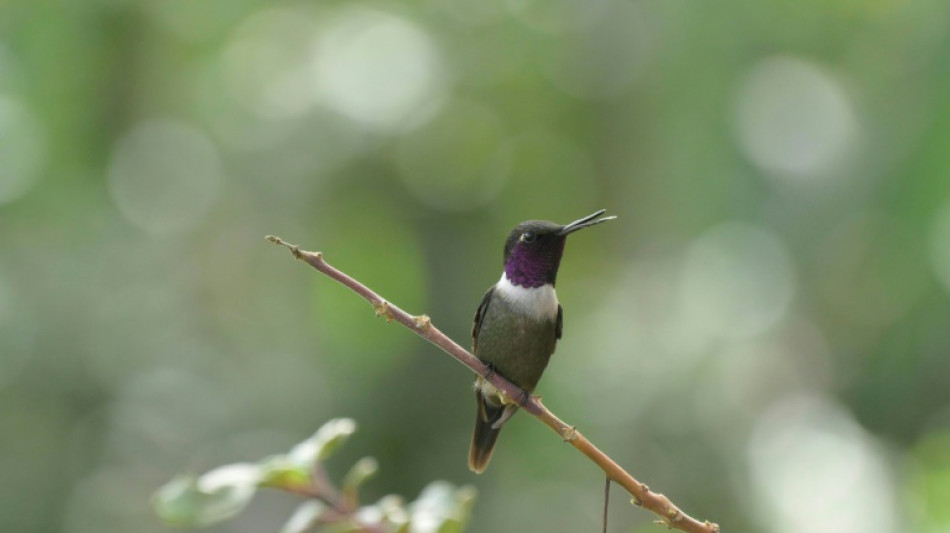
To find out how wildlife is doing, scientists try listening / Photo: Rodrigo BUENDIA - AFP/File

 Germany's Merz vows to stay course despite new vote losses

 Man City outgun Sunderland despite Brobbey hat-trick, Man Utd rescue Fulham draw

 Mourinho blames ref committee for Real Madrid derby defeat

 Maresca craves a 1-0 win after eight-goal Man City thriller

 Atletico Madrid beat Real Madrid in tense derby clash
 Reusser retains world time-trial title

 Man City outgun Sunderland despite Brobbey hat-trick, Liverpool win at Bournemouth

 Top US, Chinese economic officials meet ahead of Trump-Xi summit

 Erdogan's LGBTQ crackdown 'first step of election campaign': activist

 Mass drone barrage on Moscow kills two

 82-year-old dies after beach fight in Greece over sun lounger

 US warns of rapid escalation in Mideast war

 Iran 'put hearts on the court' to win Asian Games basketball bronze

 School girl Yu helps China dominate in Asian Games swimming openers

 Myanmar win first Asian Games teqball gold as Spain great Puyol watches

 China's 13-year-old Yu scorches to first major gold at Asian Games

 Russians vote on last day of parliamentary elections

 Hong Kong pays final respects to former city leader Tung

 Typhoon put people off Asian Games opening ceremony, official says

 China's 13-year-old Yu cruises as Asian Games swimming begins

 AI 'warning shots' focus Beijing on national security risks

 Philippine tribe in limbo over US-led tech hub

 Leo XIV, first US pope transcends his restrained style

 Singer Ed Sheeran says Gaza situation 'unjustifiable' following controversy

 In 'Tenzing', a Sherpa mountaineer gets his due

A reedy pipe and a high-pitched trill duet against the backdrop of a low-pitched insect drone. Their symphony is the sound of a forest, and is monitored by scientists to gauge biodiversity.
The recording from the forest in Ecuador is part of new research looking at how artificial intelligence could track animal life in recovering habitats.
When scientists want to measure reforestation, they can survey large tracts of land with tools like satellite and lidar.
But determining how fast and abundantly wildlife is returning to an area presents a more difficult challenge -- sometimes requiring an expert to sift through sound recordings and pick out animal calls.
Jorg Muller, a professor and field ornithologist at University of Wurzburg Biocenter, wondered if there was a different way.
"I saw the gap that we need, particularly in the tropics, better methods to quantify the huge diversity... to improve conversation actions," he told AFP.
He turned to bioacoustics, which uses sound to learn more about animal life and habitats.
It is a long-standing research tool, but more recently is being paired with computer learning to process large amounts of data more quickly.
Muller and his team recorded audio at sites in Ecuador's Choco region ranging from recently abandoned cacao plantations and pastures, to agricultural land recovering from use, to old-growth forests.
They first had experts listen to the recordings and pick out birds, mammals and amphibians.
Then, they carried out an acoustic index analysis, which gives a measure of biodiversity based on broad metrics from a soundscape, like volume and frequency of noises.
Finally, they ran two weeks of recordings through an AI-assisted computer programme trained to distinguish 75 bird calls.
- More recordings needed -
The programme was able to pick out the calls on which it was trained in a consistent way, but could it correctly identify the relative biodiversity of each location?
To check this, the team used two baselines: one from the experts who listened to the audio recordings, and a second based on insect samples from each location, which offer a proxy for biodiversity.
While the library of available sounds to train the AI model meant it could only identify a quarter of the bird calls the experts could, it was still able to correctly gauge biodiversity levels in each location, the study said.
"Our results show that soundscape analysis is a powerful tool to monitor the recovery of faunal communities in hyperdiverse tropical forest," said the research published Tuesday in the journal Nature Communications.
"Soundscape diversity can be quantified in a cost-effective and robust way across the full gradient from active agriculture, to recovering and old-growth forests," it added.
There are still shortcomings, including a paucity of animal sounds on which to train AI models.
And the approach can only capture species that announce their presence.
"Of course (there is) no information on plants or silent animals. However, birds and amphibians are very sensitive to ecological integrity, they are a very good surrogate," Muller told AFP.
He believes the tool could become increasingly useful given the current push for "biodiversity credits" -- a way of monetising the protection of animals in their natural habitat.
"Being able to directly quantify biodiversity, rather than relying on proxies such as growing trees, encourages and allows external assessment of conservation actions, and promotes transparency," the study said.
A.Anderson--AT



