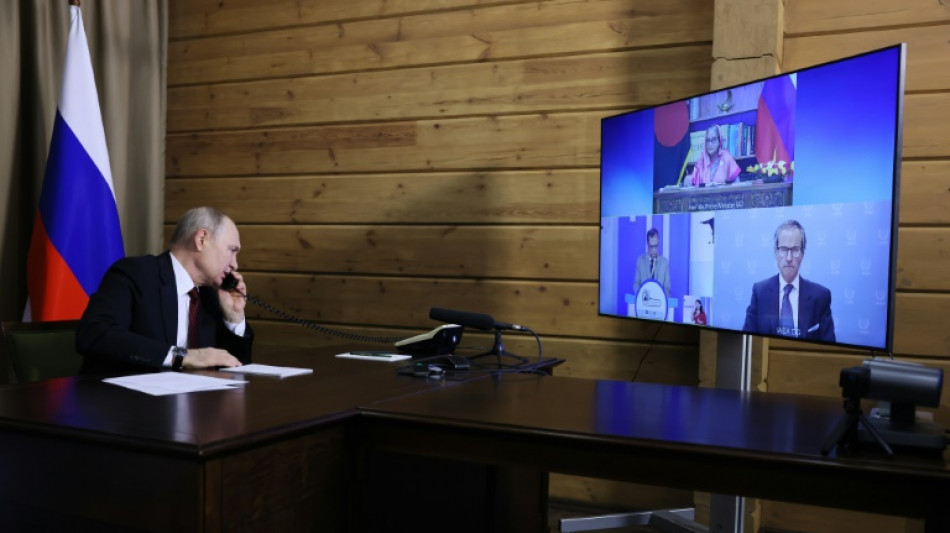
Bangladesh accepts first uranium for Russia-backed nuclear plant / Photo: Mikhail METZEL - POOL/AFP

 Germany's Merz vows to stay course despite new vote losses

 Man City outgun Sunderland despite Brobbey hat-trick, Man Utd rescue Fulham draw

 Mourinho blames ref committee for Real Madrid derby defeat

 Maresca craves a 1-0 win after eight-goal Man City thriller

 Atletico Madrid beat Real Madrid in tense derby clash

 Reusser retains world time-trial title

 Man City outgun Sunderland despite Brobbey hat-trick, Liverpool win at Bournemouth

 Top US, Chinese economic officials meet ahead of Trump-Xi summit

 Erdogan's LGBTQ crackdown 'first step of election campaign': activist

 Mass drone barrage on Moscow kills two

 82-year-old dies after beach fight in Greece over sun lounger

 US warns of rapid escalation in Mideast war

 Iran 'put hearts on the court' to win Asian Games basketball bronze

 School girl Yu helps China dominate in Asian Games swimming openers

 Myanmar win first Asian Games teqball gold as Spain great Puyol watches

 China's 13-year-old Yu scorches to first major gold at Asian Games

 Russians vote on last day of parliamentary elections

 Hong Kong pays final respects to former city leader Tung

 Typhoon put people off Asian Games opening ceremony, official says

 China's 13-year-old Yu cruises as Asian Games swimming begins

 AI 'warning shots' focus Beijing on national security risks

 Philippine tribe in limbo over US-led tech hub

 Leo XIV, first US pope transcends his restrained style

 Singer Ed Sheeran says Gaza situation 'unjustifiable' following controversy

 In 'Tenzing', a Sherpa mountaineer gets his due

Bangladesh on Thursday received the first uranium delivery for its Russia-backed nuclear plant, a project aimed at bolstering its overstretched energy grid but complicated by sanctions on Moscow.
Prime Minister Sheikh Hasina has courted Russian ties with renewed vigour after Western criticism over her government's rights record.
Moscow is bankrolling the $12.65-billion plant with a loan for 90 percent of its cost, with hopes it will alleviate the chronic blackouts plaguing the South Asian nation.
"Today is a day of pride and joy for the people of Bangladesh," Hasina said during a videoconference with Russian President Vladimir Putin to mark the handover.
Hasina thanked Putin for "his guidance and assistance in implementing this project".
Construction on the nuclear plant at Rooppur, a village on the banks of the Ganges river 175 kilometres (110 miles) west of the capital Dhaka, began in 2017.
The first of its twin 1,200-megawatt units is slated to begin operations next year and both reactors should be fully online in 2025, Bangladesh technology minister Yeafesh Osman told reporters on a Wednesday tour of the facility.
Washington's sanctions on key Russian firms since last year's invasion of Ukraine, including state nuclear agency Rosatom, delayed construction work because Dhaka was unable to make loan repayments in US currency.
In April, Bangladesh agreed to make payments of more than $300 million in Chinese yuan in an effort to circumvent the sanctions.
But central bank officials have said that the money has yet to be paid.
"The whole world is facing this payment problem and we're no exception," Osman said. "However, we are trying to solve the problem."
Hasina's government is eager for new friends ahead of general elections due by the end of January, with Western governments and rights groups warning her government is silencing critics and stamping out political dissent.
Washington levelled sanctions against Bangladesh's elite Rapid Action Battalion (RAB) police force in 2021 over accusations of their involvement in the extrajudicial killing of opposition activists.
The lack of payment has not outwardly affected Bangladesh's pursuit of a closer relationship with Moscow.
Russian Foreign Minister Sergei Lavrov visited Dhaka for the first time last month and used the occasion to criticise "the pressure exerted upon Bangladesh by the United States and its allies".
- Power struggles -
The Rooppur plant is the most expensive infrastructure project undertaken by Hasina, who has been in power since 2009, and will be the country's largest power station by generating capacity once fully operational.
Bangladesh has several more coal and gas-fired plants under construction but is desperate to reduce its near total reliance on fossil fuels.
Its electricity grid has shown increasing signs of stress, with a spike in energy prices precipitated by the Ukraine war forcing the government to suspend gas and diesel imports last year.
The result was months of daily power blackouts sometimes lasting up to 13 hours. A separate grid failure last October cut power to more than 80 percent of the country's 169 million people.
This past summer Bangladesh was forced to shut its current biggest power plant because it was unable to afford the coal to fuel it during a sweltering heatwave.
Bangladesh also plans to build a second nuclear power station in the country's south, though a final site has not been decided.
Officials have cast Bangladesh's atomic energy ambitions as a key plank of the fight against climate change in a low-lying country more vulnerable than most to extreme weather.
"It will help Bangladesh cut carbon emissions significantly by 2030," Shawkat Akbar, head of the Rooppur plant, told AFP.
Nuclear energy is one of the world's largest sources of emissions-free energy.
But there are persistent concerns about the safety risks and disposal of nuclear waste, and opponents point out nuclear plants take many years to build compared to more quickly deployable renewable energy sources.
N.Walker--AT



