
Lead poisoning causes far more death, IQ loss than thought: study / Photo: JUSTIN SULLIVAN - GETTY IMAGES NORTH AMERICA/AFP/File

 Reusser retains world time-trial title

 Man City outgun Sunderland despite Brobbey hat-trick, Liverpool win at Bournemouth

 Top US, Chinese economic officials meet ahead of Trump-Xi summit

 Erdogan's LGBTQ crackdown 'first step of election campaign': activist

 Mass drone barrage on Moscow kills two

 82-year-old dies after beach fight in Greece over sun lounger

 US warns of rapid escalation in Mideast war

 Iran 'put hearts on the court' to win Asian Games basketball bronze

 School girl Yu helps China dominate in Asian Games swimming openers

 Myanmar win first Asian Games teqball gold as Spain great Puyol watches

 China's 13-year-old Yu scorches to first major gold at Asian Games

 Russians vote on last day of parliamentary elections

 Hong Kong pays final respects to former city leader Tung

 Typhoon put people off Asian Games opening ceremony, official says

 China's 13-year-old Yu cruises as Asian Games swimming begins

 AI 'warning shots' focus Beijing on national security risks

 Philippine tribe in limbo over US-led tech hub

 Leo XIV, first US pope transcends his restrained style

 Singer Ed Sheeran says Gaza situation 'unjustifiable' following controversy

 In 'Tenzing', a Sherpa mountaineer gets his due

 Gridko's New Live Drive PTO Roll-Off Trailer Wins the Heavy-Duty TRAILmakER Award 2026 at NATDA Awards

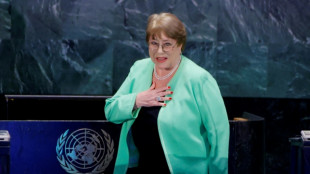 Chile's Bachelet quits race to be next UN chief

 Raphinha treble fires perfect Barca to win at Sevilla

 Thiam makes winning heptathlon return at Decastar meet

 Czechs beat USA to qualify for Davis Cup finals

Lead poisoning has a far greater impact on global health than previously thought, potentially contributing to over five million deaths a year and posing a similar threat to air pollution, modelling research suggested Tuesday.
The study, described as "a wake-up call", also estimated that exposure to the toxic metal causes young children in developing countries to lose an average of nearly six IQ points each.
Lead pollution has been shown to cause a range of serious health problems, particularly relating to heart disease and the brain development of small children, resulting in leaded gasoline being banned worldwide.
But people can still be exposed to the potent neurotoxin via food, soil, cookware, fertilisers, cosmetics, lead–acid car batteries and other sources.
The authors of the new study, two economists at the World Bank, was published in the Lancet Planetary Health journal. They said it was the first to assess the impact of lead exposure on heart disease deaths and child IQ loss in wealthy and developing nations.
Lead author Bjorn Larsen told AFP that when the pair first saw the figure their model calculated, "we didn't even dare to whisper the number" because it was so "enormous".
Their model estimates that 5.5 million adults died from heart disease in 2019 because of lead exposure, 90 percent of them in low- and middle-income countries.
That is six times higher than the previous estimate, and represents around 30 percent of all deaths from cardiovascular disease -- the leading cause of death worldwide.
It would mean that lead exposure is a bigger cause of heart disease than smoking or cholesterol, Larsen said.
- $6 trillion cost -
The research also estimated that children under five lost a cumulative 765 million IQ points due to lead poisoning globally in 2019, with 95 percent of those losses coming in developing countries.
That number is nearly 80 percent higher than previously estimated.
The World Bank researchers put the economic cost of lead exposure at $6 trillion in 2019, equivalent to seven percent of global gross domestic product.
For the analysis, the researchers used estimates of blood lead levels in 183 countries taken from the landmark 2019 Global Burden of Disease study.
Previous research had measured only lead's effect on heart disease when it came to raising blood pressure. But the new study looked at numerous other ways lead affects hearts, such as the hardening of arteries that can lead to stroke, resulting in the higher numbers, Larsen said.
Roy Harrison, an expert in air pollution and health at Birmingham University in the UK, who was not involved in the study, told AFP it was "interesting, but subject to many uncertainties".
For example, the relationship between lead in blood and heart disease is based on a survey in the United States, and whether those findings could be applied worldwide "is a huge jump of faith", he said.
Harrison also pointed out that the model used estimations -- not tests -- of lead in blood in many developing countries.
If the results were confirmed, "they would be of major public health significance, but at present, this is simply an interesting hypothesis", he said.
- 'Piece of the puzzle' -
Richard Fuller, president of the NGO Pure Earth, said that when surveys in developing countries did test for lead in blood, they mostly found higher levels than estimated in the new study.
This means "the impact of lead might be worse than the report describes", he told AFP, calling it a "wake-up call".
Larsen said "we're still a little in the dark" when it came to understanding how much different sources of lead contribute to blood contamination.
Fuller said part of this "missing piece of the puzzle" was revealed in a Pure Earth report released on Tuesday, which analysed 5,000 samples of consumer goods and food in 25 developing countries.
It found high rates of lead contamination in metal pots and pans, ceramic cookware, paint, cosmetics and toys.
"This is why poorer countries have so much lead poisoning," Fuller said. "It's items in the kitchen that are poisoning them."
Th.Gonzalez--AT



