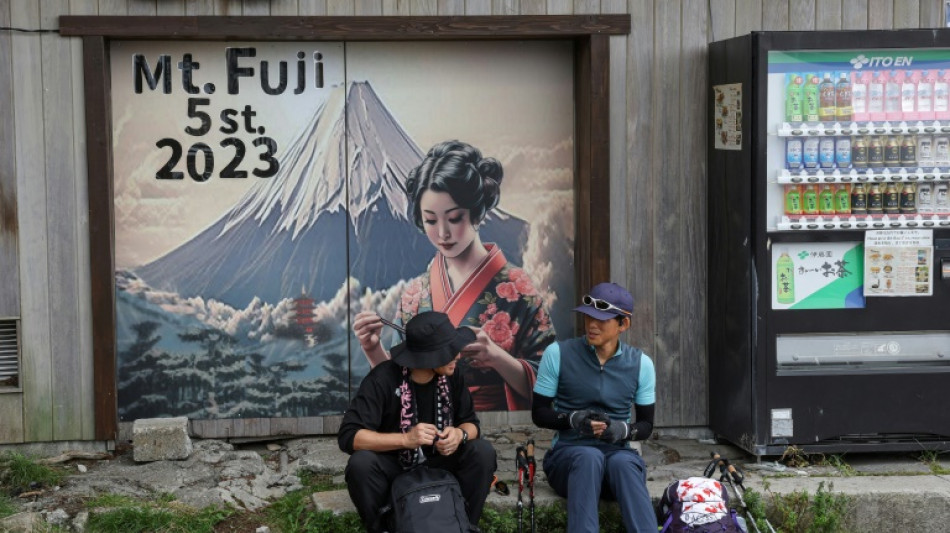
Japan's Mount Fuji 'screaming' from too many tourists / Photo: Mathias CENA - AFP

 Reusser retains world time-trial title

 Man City outgun Sunderland despite Brobbey hat-trick, Liverpool win at Bournemouth

 Top US, Chinese economic officials meet ahead of Trump-Xi summit

 Erdogan's LGBTQ crackdown 'first step of election campaign': activist

 Mass drone barrage on Moscow kills two

 82-year-old dies after beach fight in Greece over sun lounger

 US warns of rapid escalation in Mideast war

 Iran 'put hearts on the court' to win Asian Games basketball bronze

 School girl Yu helps China dominate in Asian Games swimming openers

 Myanmar win first Asian Games teqball gold as Spain great Puyol watches

 China's 13-year-old Yu scorches to first major gold at Asian Games

 Russians vote on last day of parliamentary elections

 Hong Kong pays final respects to former city leader Tung

 Typhoon put people off Asian Games opening ceremony, official says

 China's 13-year-old Yu cruises as Asian Games swimming begins

 AI 'warning shots' focus Beijing on national security risks

 Philippine tribe in limbo over US-led tech hub

 Leo XIV, first US pope transcends his restrained style

 Singer Ed Sheeran says Gaza situation 'unjustifiable' following controversy

 In 'Tenzing', a Sherpa mountaineer gets his due

 Gridko's New Live Drive PTO Roll-Off Trailer Wins the Heavy-Duty TRAILmakER Award 2026 at NATDA Awards

 Chile's Bachelet quits race to be next UN chief

 Raphinha treble fires perfect Barca to win at Sevilla

 Thiam makes winning heptathlon return at Decastar meet

 Czechs beat USA to qualify for Davis Cup finals

With its millions of visitors every year and the buses, supply trucks, noodle shops and fridge magnets, Japan's Mount Fuji is no longer the peaceful pilgrimage site it once was.
Now authorities have had enough, saying the number of hikers trekking up the world-famous volcano -- night and day -- is dangerous and an ecological embarrassment.
"Mount Fuji is screaming," the governor of the local region said last week.
Hailing its religious importance and its inspiration to artists, in 2013 UNESCO added the "internationally recognized icon of Japan" to its World Heritage List.
But as has happened in places such as Bruges in Belgium or Rio de Janeiro's Sugarloaf Mountain, the designation has been both a blessing and a curse.
Visitor numbers more than doubled between 2012 and 2019 to 5.1 million, and that's just for Yamanashi prefecture, the main starting point.
- Day and night -
It's not just during the day that a stream of people trudges through the black volcanic grit on their way up the 3,776-metre (12,388-foot) mountain.
At night, long lines of people -- on their way up to see the sun rise in the morning -- trek upwards with torches on their heads.
The main starting-off point is a car park that can only be reached by taxi or buses that take a couple of hours from Tokyo, around 100 kilometres (60 miles) away.
Greeting visitors is a complex of restaurants and shops selling souvenirs as well as snacks and drinks for walkers before they set off.
They are powered by diesel generators and the thousands of litres of water they use has to be brought up in lorries. Trucks also take all the rubbish down.
"I saw a lot of food waste and empty bottles of drinks lying around the hand-washing area of the toilet," complained Japanese hiker Yuzuki Uemura, 28.
- Dangers -
Masatake Izumi, a local official, said the high numbers of people increased the risk of accidents.
Some people who climb at night "get hypothermia and have to be taken back to first aid stations", he told AFP.
At least one person has died so far this season.
For an optional access fee of 1,000 yen ($6.80), visitors get a booklet in Japanese -- there is a QR code for the English version -- with some dos and don’ts.
But some don't realise how tough the five-to-six-hour climb is to the top, where oxygen levels are lower and where the weather can change quickly.
"It's almost winter up there, it's really cold," Rasyidah Hanan, a 30-year-old hiker from Malaysia, told AFP on her way down.
"People should be filtered a little bit because some people were not ready to climb Mount Fuji. They were like in really light clothes... Some of them really looked sick."
- Crowd control -
As tourist numbers get back to pre-pandemic levels, it's not only Mount Fuji whose returning crowds have authorities worried.
This week government ministers met to discuss measures to tackle what Kenji Hamamoto, a senior Japan Tourism Agency official, called "overcrowding and breaches of etiquette" across heavily touristed sites.
For Mount Fuji, authorities announced last month that they would impose crowd control measures for the first time if paths got too busy.
The announcement alone had an effect and in the end no such measures were taken, Izumi said.
Visitor numbers are expected to be down slightly this year from 2019, but in 2024 they could rise again as tourists -- particularly from China -- return.
Yamanashi's governor Kotaro Nagasaki said last week Japan needed to take measures to ensure Mount Fuji did not lose its UNESCO designation.
One solution, he said, could be constructing a light rail system to replace the main road leading to the main starting point for hikers.
"We firmly believe that with regard to Mount Fuji tourism, a shift from a quantity approach to a quality one is essential," Nagasaki said.
"I think that Mount Fuji is one of the things that makes Japan proud," said Marina Someya, 28, a Japanese hiker.
"There are a lot of people, and lots of foreigners."
D.Lopez--AT



