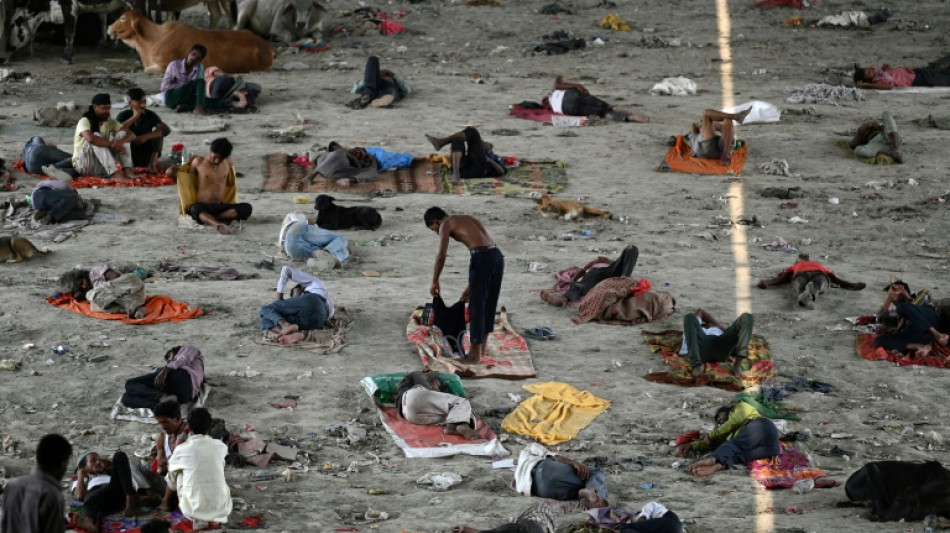
Heat records topple across sweltering Asia / Photo: Sajjad HUSSAIN - AFP/File

 Reusser retains world time-trial title

 Man City outgun Sunderland despite Brobbey hat-trick, Liverpool win at Bournemouth

 Top US, Chinese economic officials meet ahead of Trump-Xi summit

 Erdogan's LGBTQ crackdown 'first step of election campaign': activist

 Mass drone barrage on Moscow kills two

 82-year-old dies after beach fight in Greece over sun lounger

 US warns of rapid escalation in Mideast war

 Iran 'put hearts on the court' to win Asian Games basketball bronze

 School girl Yu helps China dominate in Asian Games swimming openers

 Myanmar win first Asian Games teqball gold as Spain great Puyol watches

 China's 13-year-old Yu scorches to first major gold at Asian Games

 Russians vote on last day of parliamentary elections

 Hong Kong pays final respects to former city leader Tung

 Typhoon put people off Asian Games opening ceremony, official says

 China's 13-year-old Yu cruises as Asian Games swimming begins

 AI 'warning shots' focus Beijing on national security risks

 Philippine tribe in limbo over US-led tech hub

 Leo XIV, first US pope transcends his restrained style

 Singer Ed Sheeran says Gaza situation 'unjustifiable' following controversy

 In 'Tenzing', a Sherpa mountaineer gets his due

 Gridko's New Live Drive PTO Roll-Off Trailer Wins the Heavy-Duty TRAILmakER Award 2026 at NATDA Awards

 Chile's Bachelet quits race to be next UN chief

 Raphinha treble fires perfect Barca to win at Sevilla

 Thiam makes winning heptathlon return at Decastar meet

 Czechs beat USA to qualify for Davis Cup finals

Temperature records are being toppled across Asia, from India's summer to Australia's winter, authorities said Friday, in fresh evidence of the impact of climate change.
The sweltering temperatures match longstanding warnings from climate scientists and come as countries from Greece to Canada battle record heat and deadly wildfires.
In India, the world's most populous country, officials said this August was the hottest and driest since national records began more than a century ago.
The month falls in the middle of India's annual monsoon, which usually brings up to 80 percent of the country's yearly rainfall.
But despite heavy downpours that caused deadly floods in the country's north earlier this month, overall rainfall has been far below average.
August saw an average of just 161.7 millimetres (6.4 inches), 30.1 mm lower than the previous August record in 2005, the India Meteorological Department (IMD) said.
That has left the country baking in unrelenting heat.
"The large rainfall deficiency and weak monsoon condition is the main reason," the IMD said.
Authorities in Japan also said Friday that the country had experienced its hottest summer since records began in 1898.
Temperatures from June to August were "considerably higher" than average across the north, east and west of the country, the weather agency said.
In many locations "not only maximum temperatures but also minimum temperatures" reached record highs, it added.
And in Australia this winter was the warmest on record, with an average temperature of 16.75 degrees Celsius (62.15 Fahrenheit) for the season running from June to August.
That is a hair above a record set in 1996, and the highest average winter temperature since the country's records began in 1910, the Bureau of Meteorology said.
- 'More intense, more frequent' -
Climate change has fuelled searing temperatures across the globe already this year, with July the hottest month ever recorded on Earth.
Scientists have long warned that climate change produces heatwaves that are hotter, longer and more frequent.
And the warming El Nino weather pattern could turbocharge the heat further, though its effects are likely to become more apparent later in the year as it strengthens.
Heatwaves are among the deadliest natural hazards, with hundreds of thousands of people dying from preventable heat-related causes each year.
In developed countries, adaptations including air conditioning can help mitigate the impact.
But even in wealthy Japan, authorities said at least 53 people died of heatstroke in July, with almost 50,000 needing emergency medical attention.
The effects of heat are unevenly distributed, with small children and the elderly less able to regulate their body temperatures and thus more vulnerable.
Those who have to work outside are also particularly at risk.
Even a healthy young person will die after enduring six hours of 35-degree-Celsius (95 Fahrenheit) warmth coupled with 100 percent humidity.
But extreme heat does not need to be anywhere near that level to kill people, experts warn.
John Nairn, a senior extreme heat adviser at the UN's World Meteorological Organization (WMO), said last month that heatwaves are "becoming much more dangerous".
"It's the most rapidly emerging consequence of global warming that we are seeing," he told AFP in an interview.
"People are far too relaxed about the signs," he lamented.
"It will only get more intense and more frequent."
burs-sah/leg
S.Jackson--AT



