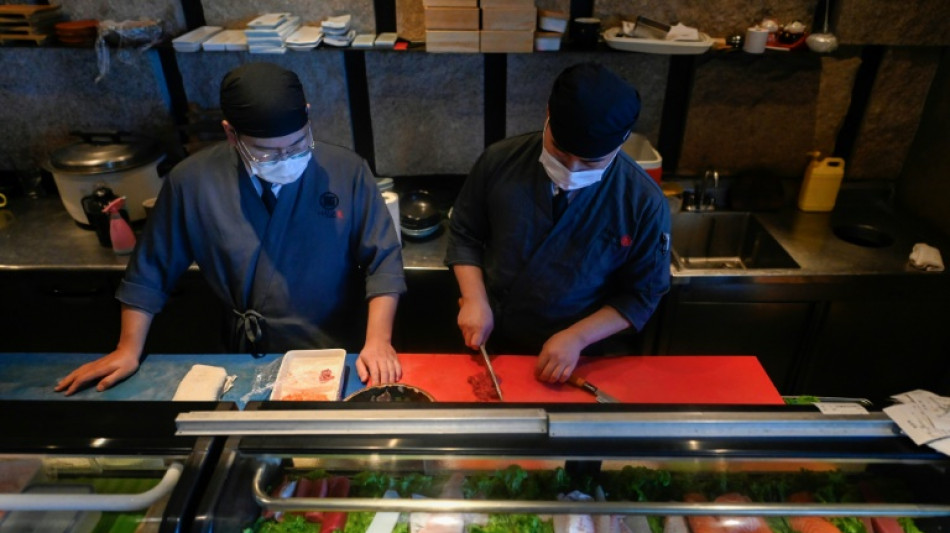
China's sushi fans flounder over Fukushima water release / Photo: Pedro PARDO - AFP

 Reusser retains world time-trial title

 Man City outgun Sunderland despite Brobbey hat-trick, Liverpool win at Bournemouth

 Top US, Chinese economic officials meet ahead of Trump-Xi summit
 Erdogan's LGBTQ crackdown 'first step of election campaign': activist
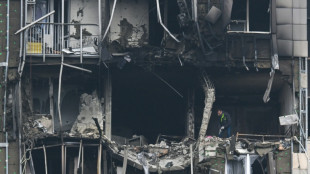 Mass drone barrage on Moscow kills two

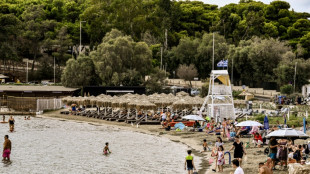 82-year-old dies after beach fight in Greece over sun lounger

 US warns of rapid escalation in Mideast war

 Iran 'put hearts on the court' to win Asian Games basketball bronze
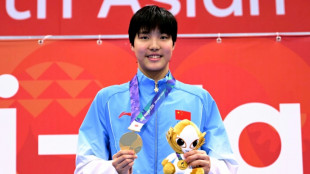
 School girl Yu helps China dominate in Asian Games swimming openers
 Myanmar win first Asian Games teqball gold as Spain great Puyol watches

 China's 13-year-old Yu scorches to first major gold at Asian Games

 Russians vote on last day of parliamentary elections

 Hong Kong pays final respects to former city leader Tung

 Typhoon put people off Asian Games opening ceremony, official says

 China's 13-year-old Yu cruises as Asian Games swimming begins

 AI 'warning shots' focus Beijing on national security risks

 Philippine tribe in limbo over US-led tech hub

 Leo XIV, first US pope transcends his restrained style

 Singer Ed Sheeran says Gaza situation 'unjustifiable' following controversy

 In 'Tenzing', a Sherpa mountaineer gets his due

 Gridko's New Live Drive PTO Roll-Off Trailer Wins the Heavy-Duty TRAILmakER Award 2026 at NATDA Awards

 Chile's Bachelet quits race to be next UN chief

 Raphinha treble fires perfect Barca to win at Sevilla

 Thiam makes winning heptathlon return at Decastar meet

 Czechs beat USA to qualify for Davis Cup finals

At his restaurant in central Beijing, controversy over the release of Fukushima wastewater has left Yao facing a choice: continue stocking his popular Japanese tuna and risk the ire of some consumers or source it from other countries where price and quality could vary.
Chinese sushi and sashimi lovers have expressed reservations after Japan kicked off plans for the disposal of waste from the stricken power plant into the Pacific Ocean, 12 years after one of the world's worst nuclear disasters.
The intended release has been deemed safe by the International Atomic Energy Agency (IAEA), but China nonetheless banned food imports from 10 Japanese prefectures, with Hong Kong following suit this week.
Restaurants in Beijing and Hong Kong are already reeling from the restrictions.
"To tell the truth, we have felt the impact," said Yao at the entrance of his restaurant.
Hong Kong food caterer Jasy Choi, who runs a small kitchen for takeaway Japanese food, told AFP the ban would cause a business overhaul.
"About 80 percent of the seafood products we use come from Japan," the 36-year-old chef said.
"If more than half of my Japan-imported ingredients are affected, then it would be difficult for me to continue to operate."
China and Hong Kong are the largest importers of Japanese foodstuffs in the world, according to Tokyo's agriculture ministry, bringing in around 500 billion yen ($3.44 billion) worth of products from the East Asian country.
But the release has some consumers concerned about safety.
At a chain restaurant in Beijing, as small plates of sushi and other Japanese dishes glided by on a conveyor belt, mother Liu Dan underlined these fears.
"From August 24, I'll specifically tell my child and husband that we will consciously avoid these seafood products when eating at restaurants and shopping," she said.
Asked about scientific reports concluding that Japan's wastewater release plan is safe -- including one published in July by the IAEA -- Liu expressed doubt.
"I have no way of proving whether or not (such reports) are true. I can just say that judging from the plainest of feelings, this definitely isn't rational," she said.
"Otherwise why would there be worries about the release?"
- Rock and hard place -
China's foreign ministry summoned Japan's ambassador on Tuesday to lodge "solemn representations" against the release.
A nuclear expert, however, said the level of tritium in the Fukushima wastewater was well below World Health Organization drinking water limits.
"Tritium has been released (by nuclear power plants) for decades with no evidential detrimental environmental or health effects," Tony Hooker, a nuclear expert from the University of Adelaide, told AFP.
But many restaurant owners in China said they have already stopped buying Japanese fish.
"Before, essentially all of our seafood products were imported from Japan," Fang Changsheng told AFP in one of his two restaurants, located in a Beijing district popular for Japanese cuisine and nightlife.
The 40-year-old restaurateur says he now sources seafood from elsewhere, including Chile, Spain and Russia.
"It wasn't really my decision, but due to this (Fukushima wastewater) issue. Getting products is now more of a pain."
However, at a small sushi restaurant which seats less than 20 people in Hong Kong's bustling Wan Chai district, Jacky Wong said many customers likely wouldn't be put off.
"It very much depends on how many Hong Kong customers would avoid having Japanese food... There are always some people who would not mind," Wong told AFP, adding that he would have to take a few days to see if foot traffic drops post-ban.
"We can only take one step at a time."
And some seafood products traditionally sourced from Japan are proving difficult to replace.
Choi in Hong Kong also said that finding substitutes would be difficult.
"And even if there are substitutes -- say, sea urchin from China, South Korea or Australia, I may not want to offer those to my customers," he fretted.
"Of course, it's not good to release nuclear wastewater into the sea, even if it's treated," he added.
"But many places around the world have been doing this. How can you ban them all and what change can we small citizens bring?"
F.Ramirez--AT



