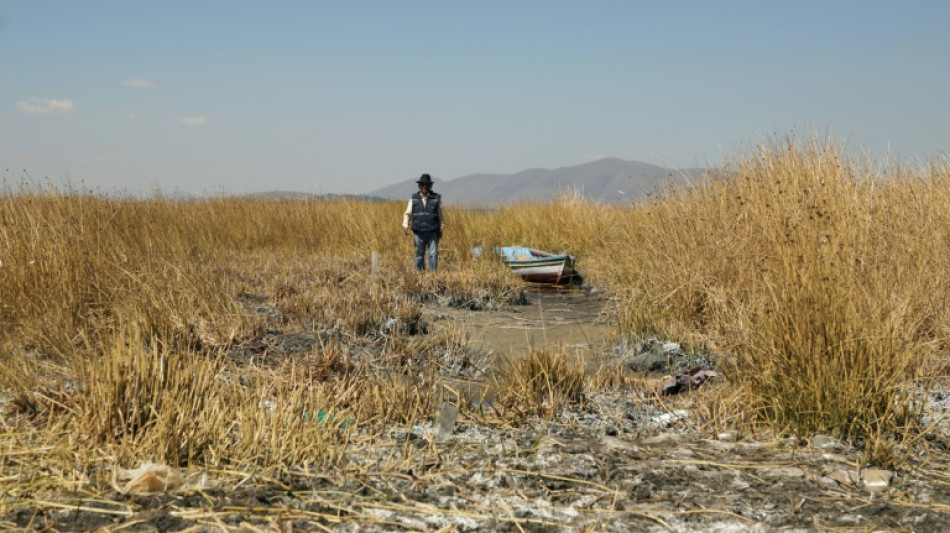
High in the Andes, Lake Titicaca's water levels fall to historic lows / Photo: Aizar RALDES - AFP

 South Korea break Japan hearts to win Asian Games basketball gold
 Acosta takes first victory at Austrian MotoGP

 PSG president Nasser al-Khelaifi under investigation in France for conflict of interest

 China swim sensation, 13, sets Games record after Japan win early

 Drones hit Moscow as Russians go to the polls

 New England boss Fleming says 'wrong' to ask Stokes to end retirement

 Germans vote in elections threatening fresh blow to Merz

 US fears rapid escalation in Mideast after Houthis attack Riyadh

 Japan triathlete Hojo wins first gold of Asian Games

 IOC president impressed by 'beautiful' Asian Games wooden huts

 First Asian Games gold goes to Japan as China's 13-year-old Yu lights up pool

 Data centre command hub keeps AI up and running

 Pope Leo in France: the issues on the table

 Packing for a pope: behind the scenes on foreign trips

 Republicans find transgender issues a powerful political weapon in midterm campaigning

 German state elections threaten new shock waves for Merz

 Ed Sheeran set to return to stage after Palestinian controversy

 Toulouse edge Vannes, Lyon beat Pau to take Top 14 summit

 Germans arrested for Louvre stunt in Mona Lisa hall

 Saudi-led coalition says Houthis fired ballistic missile at Riyadh

 France's debt climbs to highest since 1978: ministry

 McIlroy two shots off the lead at Wentworth after eagle on 18

 Martinez brace saves Inter in Serie A top-two clash with Roma

 Rosenior abused but guides Paris FC past old club Strasbourg

 Seven-try Lyon beat Pau, climb to Top 14 summit

Pedro de la Cruz stands beside his stranded boat and supplicates his God, lifting his arms and praying anxiously for rain to replenish Lake Titicaca, the massive body of water at a breath-sapping altitude in the Andes on the border between Bolivia and Peru.
"Dear God, make more rain come," the 74-year-old says, invoking Pachamama, Mother Earth for Indigenous people of the region. "Help us, please, we are parched here.... Make the rain showers come... Father in heaven, have pity."
De la Cruz, a former state employee, spoke in Aymara, his native language, as he surveyed what was once the shore of Lake Titicaca, some 45 miles (77 kilometers) west of the capital La Paz.
The waters of Lake Titicaca are within 10 inches (25 centimeters) of their all-time low, a record set in 1996, the chief forecaster for Bolivia's weather service (Senhami), Lucia Walper, tells AFP.
Along what was once the 700-mile shoreline of the lake, one now sees boats stranded on dry land and orphan docks stretched over nonexistent water.
Low levels mean that fish that ordinarily spawn near shore are now unable to, and that leads Edwin Katari, a 43-year-old fisherman, to mull a question.
"So where are the fish going to spawn?" Katari asks.
- Dark forecast –
Bolivia's Senhami has measured water levels of the lake since 1974.
At its highest point in 1986, water levels reached 12 feet higher than they are today, topping out at 12,504.2 feet (3,811 meters) above sea level. But in 1996, they had fallen to 12,491.4 feet above sea level.
Walper says falling water levels are "the result of climate change" and the outlook is not good.
"It is very probable that they keep falling until they hit even lower levels," she says.
A satellite survey still has not been made to see how much Lake Titicaca, which once had a surface area of 3,200 square miles (8,300 square kilometers), has shrunk.
It is the highest of the world's large lakes and is one of the largest in South America, after Venezuela's Lake Maracaibo (which is actually connected to the Caribbean Sea) and Brazil's Lagoa dos Patos, a coastal lagoon.
- La Nina and El Nino –
The level of Lake Titicaca "has been progressively decreasing due to many meteorological, hydrological and climatic factors," explains Walper, who emphasizes that "there is less rainfall."
"Over the years, each phenomenon, whether El Nino and/or La Nina, has been presenting a distortion in its parameters and factors," she points out, explaining the characteristics of these events -- associated with rains or droughts -- over time.
The rainfall and the inflow to the lake from Peruvian rivers "were not sufficient to generate the normal rises in times of rain," she says.
El Nino is a natural climatic event, generally associated with increased temperatures, drought in some parts of the world, and heavy rains in others. La Nina, on the other hand, causes the opposite effects, particularly a drop in temperatures.
Other stresses impact the lake. It is heavily polluted by waste from the city of El Alto, a metropolis of one million people in this landlocked country. Additionally, indiscriminate fishing has decimated species.
- Despair sets in –
Because the decline in water levels is linked to climate change, the solution "is a global issue," Walper adds.
The recent summit in Brazil of the Amazon Cooperation Treaty Organization (ACTO) reaffirmed the call for industrialized countries to fulfill their promises of economic resources to finance actions against climate change.
But in the villages around Lake Titicaca, despair has set in that water levels will never return to normal in the world's highest navigable sea.
"If there is no water, if there is no rain, we will not be able to live," frets De la Cruz.
E.Flores--AT



