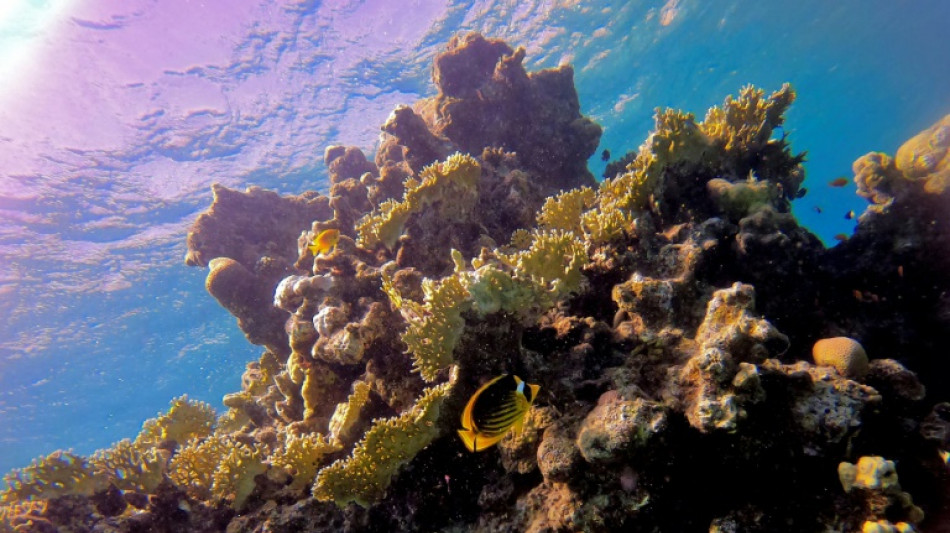
Land and sea efforts to save reefs must work together: study / Photo: MENAHEM KAHANA - AFP/File

 South Korea break Japan hearts to win Asian Games basketball gold

 Acosta takes first victory at Austrian MotoGP

 PSG president Nasser al-Khelaifi under investigation in France for conflict of interest

 China swim sensation, 13, sets Games record after Japan win early

 Drones hit Moscow as Russians go to the polls

 New England boss Fleming says 'wrong' to ask Stokes to end retirement

 Germans vote in elections threatening fresh blow to Merz

 US fears rapid escalation in Mideast after Houthis attack Riyadh

 Japan triathlete Hojo wins first gold of Asian Games

 IOC president impressed by 'beautiful' Asian Games wooden huts

 First Asian Games gold goes to Japan as China's 13-year-old Yu lights up pool

 Data centre command hub keeps AI up and running

 Pope Leo in France: the issues on the table

 Packing for a pope: behind the scenes on foreign trips

 Republicans find transgender issues a powerful political weapon in midterm campaigning

 German state elections threaten new shock waves for Merz

 Ed Sheeran set to return to stage after Palestinian controversy

 Toulouse edge Vannes, Lyon beat Pau to take Top 14 summit

 Germans arrested for Louvre stunt in Mona Lisa hall

 Saudi-led coalition says Houthis fired ballistic missile at Riyadh

 France's debt climbs to highest since 1978: ministry

 McIlroy two shots off the lead at Wentworth after eagle on 18

 Martinez brace saves Inter in Serie A top-two clash with Roma

 Rosenior abused but guides Paris FC past old club Strasbourg

 Seven-try Lyon beat Pau, climb to Top 14 summit

A new study offers a glimmer of hope in efforts to save the world's coral reefs, which play a vital role in underwater life but have been put under threat by rising ocean temperatures.
The study published Wednesday, which is based on 20 years of data from the US island of Hawaii, says that combining local efforts to limit the impact of humans on both the land and sea give coral reefs a greater chance at bouncing back.
"We found that both land-based (for example wastewater pollution) and sea-based human impacts (for example fishing) must be reduced together to ensure coral reef persistence," the study's co-lead author Gareth Williams, a marine ecologist at the UK's Bangor University, told AFP.
Using high-resolution data and thousands of hours of underwater surveys, the researchers looked at connections between human impacts and the recovery of the reef.
They found that not all coral reefs suffer equally during heatwaves.
In 18 percent of the reefs surveyed during an unprecedented marine heatwave in Hawaii in 2015, coral cover remained unchanged -- and in some cases, increased -- despite the heat.
Their ability to recover was dependent on how strained they were by various human pollutants and how many algae-eating fish were around to pave the way for regrowth, the study said.
The more negative impacts that were remedied, the better the reefs recovered, offering a potential path ahead for conservation efforts.
The researchers carried out modelling which indicated that simultaneously reducing these problems on land and sea gave reefs an up to six times higher chance of regrowing after a heatwave than if the efforts were carried out separately.
They called for more cooperation.
"Resource managers have aspired to manage land and sea together, but because governance tends to be centralised, most terrestrial- and ocean-management efforts remain siloed," said the study's co-lead author Jamison Grove of the US National Oceanic and Atmospheric Administration.
But the researchers warned that the frequency and severity of coral bleaching as ocean temperatures rise due to human-caused climate change could "simply overwhelm the positive effects of local management actions".
The study, published in the journal Nature, came just days after it was revealed that the temperature of the world's oceans rose to their hottest level ever recorded on July 30.
Last year most nations committed to protecting 30 percent of the planet's land and ocean by 2030 to safeguard biodiversity.
N.Mitchell--AT



