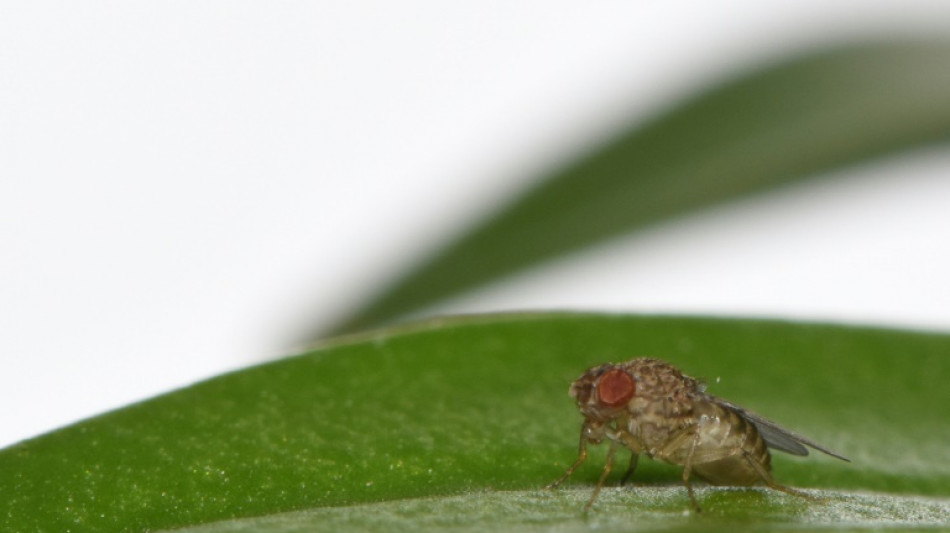
Scientists engineer fruit flies capable of 'virgin birth' / Photo: Jose Cacal, Peter Lawrence - University of Cambridge/AFP

 PSG president Nasser al-Khelaifi under investigation in France for conflict of interest

 China swim sensation, 13, sets Games record after Japan win early

 Drones hit Moscow as Russians go to the polls

 New England boss Fleming says 'wrong' to ask Stokes to end retirement

 Germans vote in elections threatening fresh blow to Merz

 US fears rapid escalation in Mideast after Houthis attack Riyadh

 Japan triathlete Hojo wins first gold of Asian Games

 IOC president impressed by 'beautiful' Asian Games wooden huts

 First Asian Games gold goes to Japan as China's 13-year-old Yu lights up pool

 Data centre command hub keeps AI up and running

 Pope Leo in France: the issues on the table

 Packing for a pope: behind the scenes on foreign trips

 Republicans find transgender issues a powerful political weapon in midterm campaigning

 German state elections threaten new shock waves for Merz

 Chile's Bachelet quits race to be next UN chief

 Raphinha treble fires perfect Barca to win at Sevilla

 Thiam makes winning heptathlon return at Decastar meet

 Czechs beat USA to qualify for Davis Cup finals

 Dortmund sink Stuttgart to climb to Bundesliga summit

 Trump says will not tolerate attempts to slow AI growth

 'It has to stop': runners protest women's murders in S.Africa district

 Fire erupts near Riyadh airport as Houthis claim strikes

 Cuba works to restore power after another blackout

 England thrash Sri Lanka again to return to top of T20 rankings

 Arsenal thrashed by Brighton, sorry Spurs lose again

Scientists said on Friday they have genetically engineered female fruit flies that can have offspring without needing a male, marking the first time "virgin birth" has been induced in an animal.
The offspring of the flies were also able to give birth without mating, showing that the trait could be passed down generations, in another first revealed in a study in the journal Current Biology.
Virgin birth, also called parthenogenesis, is rare but not unheard of in the animal kingdom.
The females of some egg-laying animals -- such as lizards and birds -- are capable of giving birth without mating, usually later in life when no males are available.
"For the first time, scientists have managed to induce virgin birth in an animal that usually reproduces sexually: the fruit fly Drosophila melanogaster," Cambridge University said.
Scientists revealed last month that a female crocodile in a Costa Rican zoo who had never been near a male laid an egg containing a fully formed foetus, the first recorded virgin birth for the reptile.
Sexual reproduction usually involves a female's egg being fertilised by sperm from a male. But for parthenogenesis, the female develops the egg into an embryo all on her own.
Alexis Sperling, a researcher at the UK's Cambridge University and lead author of the new study, told AFP that she had wanted to study virgin births ever since her pet praying mantis had one.
Seeking to find a genetic cause for the phenomenon, Sperling and several US-based researchers decided to experiment on the fruit fly Drosophila melanogaster.
The fly, which sexually reproduces normally, is one of the most studied animals for genetic research, meaning they could take advantage of more than a century's worth of knowledge.
- 'Exciting' -
First the team sequenced the genomes of two strains of another fruit fly, Drosophila mercatorum. One strain reproduces solely via virgin birth, while the other needs a male.
The researchers then compared the results, aiming to pinpoint the genes behind virgin births.
They then manipulated the genes of the Drosophila melanogaster to match what they saw in its close relative.
The result was "fully parthenogenetic flies, which was much to my delight", Sperling said.
The research, which took six years, involved more than 220,000 fruit flies.
If the genetically engineered flies had access to males, they would reproduce as normal.
But among those kept in isolation, one to two percent seemingly gave up on ever seeing a male around halfway through their life -- around 40 days -- and had a virgin birth.
Their offspring -- which were all female, as is the case with all virgin births -- had young of their own at around the same rate.
Sperling said that the feat would have been almost impossible to achieve in any other animal because of the wealth of data about fruit flies -- and because of how difficult parthenogenesis is to study.
Mammals -- including humans -- are not capable of having virgin births anyway because their reproduction requires certain genes from sperm.
But Sperling said that more animals are probably capable of virgin births than is currently known, pointing to the recent crocodile discovery.
And while virgin births are thought to be "a last-ditch effort" to keep a species going, that theory has not been proven, she said.
Herman Wijnen, a researcher at the UK's University of Southampton not involved in the study, said it was "exciting because it demonstrates how parthenogenesis can evolve in a sexually reproducing species as a back-up strategy for females that are unable to find a partner."
"The genes that were manipulated in the fruit fly are ones that are shared with humans, but there are substantial differences between early development in flies and humans."
Ch.Campbell--AT



