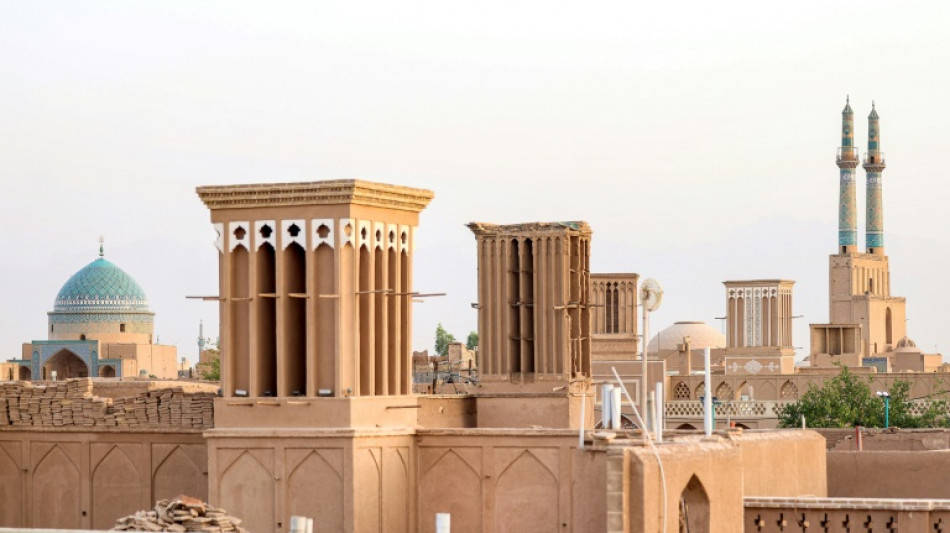
Iran's ancient 'wind catchers' beat the heat naturally / Photo: ATTA KENARE - AFP

 PSG president Nasser al-Khelaifi under investigation in France for conflict of interest

 China swim sensation, 13, sets Games record after Japan win early

 Drones hit Moscow as Russians go to the polls

 New England boss Fleming says 'wrong' to ask Stokes to end retirement

 Germans vote in elections threatening fresh blow to Merz

 US fears rapid escalation in Mideast after Houthis attack Riyadh

 Japan triathlete Hojo wins first gold of Asian Games

 IOC president impressed by 'beautiful' Asian Games wooden huts

 First Asian Games gold goes to Japan as China's 13-year-old Yu lights up pool

 Data centre command hub keeps AI up and running

 Pope Leo in France: the issues on the table

 Packing for a pope: behind the scenes on foreign trips

 Republicans find transgender issues a powerful political weapon in midterm campaigning

 German state elections threaten new shock waves for Merz

 Chile's Bachelet quits race to be next UN chief

 Raphinha treble fires perfect Barca to win at Sevilla

 Thiam makes winning heptathlon return at Decastar meet

 Czechs beat USA to qualify for Davis Cup finals

 Dortmund sink Stuttgart to climb to Bundesliga summit

 Trump says will not tolerate attempts to slow AI growth

 'It has to stop': runners protest women's murders in S.Africa district

 Fire erupts near Riyadh airport as Houthis claim strikes

 Cuba works to restore power after another blackout

 England thrash Sri Lanka again to return to top of T20 rankings

 Arsenal thrashed by Brighton, sorry Spurs lose again

Tall, chimney-like towers rise from centuries-old adobe houses in Iran's desert city of Yazd, drawing in a pleasant breeze for residents of one of the hottest cities on earth.
The wind catchers, called badgirs in Persian, are just one of the engineering marvels inhabitants have developed in this ancient city in central Iran -- where temperatures reach well over 40 degrees celsius (104 Fahrenheit) in the summer.
And, unlike energy-guzzling air-conditioners, they're cost and carbon-free.
"For centuries, before we had electricity, they made it possible to cool dwellings," said Abdolmajid Shakeri, the provincial deputy of Iran's cultural heritage and tourism ministry.
The oldest of the city's 700 wind catchers dates back to the 14th century, but the architectural feature is believed to date back as far as 2,500 years when the Persian Empire ruled over much of the Middle East.
"The badgirs played a key role in the city's prosperity," said Shakeri about the desert city that was a caravan stop on the ancient Silk Road.
"Thanks to them, people lived at ease," he added, describing how the wind catchers pull fresh air into buildings and allow hot air to ventilate out through large vertical slots.
Majid Oloumi, the head of Dowlatabad garden, home to a towering 33-metre (100 foot) wind catcher -- one of the tallest in the world -- described the cooling method as "totally clean because it uses neither electricity nor polluting materials".
UNESCO listed Yazd as a World Heritage Site in 2017, describing the city as a "living testimony to intelligent use of limited available resources in the desert for survival".
-'Simplicity'-
The bioclimatic architecture which provides thermal comfort for the people of Yazd has attracted interest elsewhere on a heating planet.
"Badgirs demonstrate that simplicity can be an essential attribute to sustainability," said Paris-based architect Roland Dehghan Kamaraji, who has studied Iran's wind catchers.
"It goes against the common misconception that sustainable solutions need to be complex or high-tech."
At a sustainable urban community called Masdar city in the United Arab Emirates, buildings have been "designed to make use of the natural ventilation for cooling, like badgirs," he said.
Similarly, ventilation inspired by "termite mounds, an approach similar to that of badgirs" were built atop Eastgate Centre, a shopping mall and office complex in Harare, Zimbabwe.
However, Yazd's unique architectural traditions have largely been abandoned at their birthplace.
"Unfortunately, our ancestral heritage has been forgotten," especially since the emergence of air conditioners, said Oloumi.
Yazd's old town is a labyrinth of narrow streets and roofed alleyways. Its centuries-old edifices made of clay, mud-brick and adobe all provide insulation against the torrid heat.
But the old houses stand in sharp contrast to modern cement buildings and multi-lane roads.
"Today, house architecture imitates that in other countries, and cement-based construction does not correspond to the climate of Yazd," he added.
Kamaraji says bioclimatic architecture has waned due to economic constraints and modern construction methods that "largely favour the use of energy and fossil fuel intensive materials".
- Old but effective -
Another sustainable architectural feature of Yazd is its system of underground aqueducts called qanats, which transport water from underground wells, aquifers or the mountains.
"These underground aqueducts have great utility," said Zohreh Montazer, an expert on the water system. "They constitute a source of water supply and make it possible to cool the dwellings and to preserve food at an ideal temperature."
Iran is estimated to have around 33,000 operational qanats today, a significant drop from the 50,000 in use in the mid-20th century.
UNESCO says the decline in qanats is driven in part by the drying up of underground water sources due to overconsumption.
Iranian authorities have in recent years sought to rehabilitate the qanat of Zarch -- considered the longest and oldest, dating to some 3,000 years ago.
The water network -- which stretches over 70 kilometres across Yazd, and runs at a depth of around 30 metres -- stands as a reminder for Yazd's residents of the challenges ahead.
"The day when fossil fuels run out," said Montazer, "we will have to return to these methods."
R.Garcia--AT



