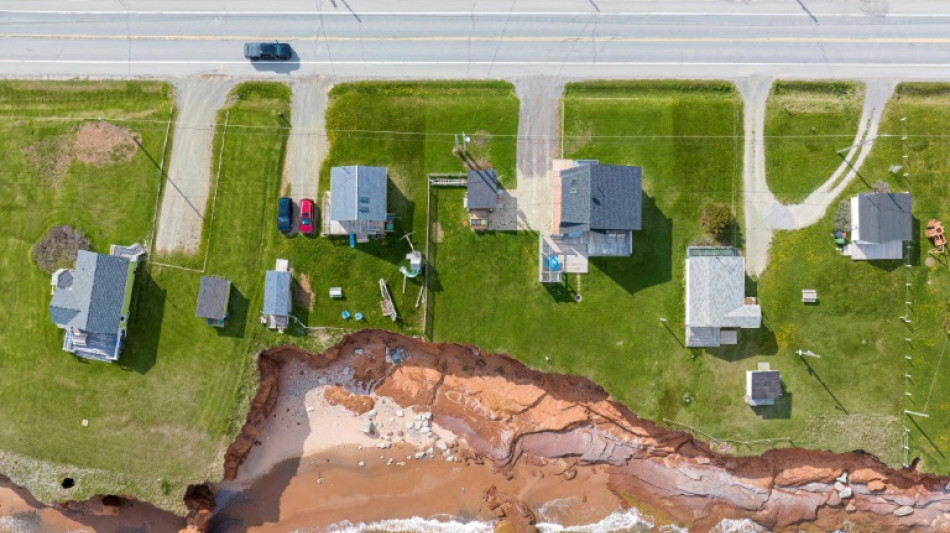
Canada's Magdalen islands have 'front row' seat to climate change / Photo: Sebastien ST-JEAN - AFP

 PSG president Nasser al-Khelaifi under investigation in France for conflict of interest

 China swim sensation, 13, sets Games record after Japan win early

 Drones hit Moscow as Russians go to the polls

 New England boss Fleming says 'wrong' to ask Stokes to end retirement

 Germans vote in elections threatening fresh blow to Merz

 US fears rapid escalation in Mideast after Houthis attack Riyadh

 Japan triathlete Hojo wins first gold of Asian Games

 IOC president impressed by 'beautiful' Asian Games wooden huts

 First Asian Games gold goes to Japan as China's 13-year-old Yu lights up pool

 Data centre command hub keeps AI up and running
 Pope Leo in France: the issues on the table

 Packing for a pope: behind the scenes on foreign trips

 Republicans find transgender issues a powerful political weapon in midterm campaigning

 German state elections threaten new shock waves for Merz

 Chile's Bachelet quits race to be next UN chief

 Raphinha treble fires perfect Barca to win at Sevilla

 Thiam makes winning heptathlon return at Decastar meet

 Czechs beat USA to qualify for Davis Cup finals

 Dortmund sink Stuttgart to climb to Bundesliga summit

 Trump says will not tolerate attempts to slow AI growth

 'It has to stop': runners protest women's murders in S.Africa district

 Fire erupts near Riyadh airport as Houthis claim strikes

 Cuba works to restore power after another blackout

 England thrash Sri Lanka again to return to top of T20 rankings

 Arsenal thrashed by Brighton, sorry Spurs lose again

In the Gulf of Saint Lawrence, on the small Magdalen islands, foot paths are caving in, cliffs are receding and the sand dunes are disappearing, leaving homes vulnerable to the lashing waves.
The archipelago, part of Quebec province in eastern Canada, is in a race against time -- and the elements -- to survive global warming. Residents are feeling the effects of climate change on a daily basis.
"The Magdalen islands are in the front row when it comes to the changes taking place. We are miniscule faced with the immensity of it all," says Mayka Thibodeau from CERMIM, a research center focused on sustainable development.
The changes seem to be coming fast and furious, leaving the roughly 13,000 residents reeling, as they realize their island home will need to adapt quickly and radically in the decades to come if it is to survive.
The islands' picturesque shores have already been eroded, receding by an average of half a meter (1.6 feet) a year, according to a study by the University of Quebec at Rimouski (UQAR).
It's a figure that concerns Diane Saint-Jean and her partner -- they live on the coast and worry the next big storm could sweep their home into the water.
"We were rather naive, we were sure there would be a solution. But nature proved us wrong," says Saint-Jean, her voice shaky as she stares at the nearby cliffs, which are slowly disappearing.
The two women live in La Martinique, a slim band of territory that links the archipelago's two main islands.
They have spent thousands of dollars to reinforce the cliff at the foot of their yard, but in September 2022, Hurricane Fiona struck with brute force, quickly washing away the giant rocks meant to protect their property.
"We woke up one morning and realized we'd thrown away our money. But what can we do?" rues Saint-Jean, a retired nurse.
- Costly emergency work -
Erosion is a bit of a sensitive topic for most residents on the Magdalen islands, which were first populated in the 18th century and are located more than five hours by boat from continental Canada.
Everyone here remembers spots that are now gone -- especially houses that had to be moved because of the risk of flooding.
The situation is a headache for local authorities, who must invest millions of dollars for emergency work.
In Cap-aux-Meules, in the center of town, part of the pedestrian walkway collapsed in 2018, leaving the hospital, a retirement home and a cemetery in the direct path of dangerous waves.
Last year, local authorities built a huge gravel beach, using 143,000 tonnes of stones along an 800-meter (half-mile) stretch to raise the shoreline. It was not the first time the tactic had been used.
"Solutions exist but they are extremely expensive and these projects have to be maintained. So each time we intervene, it's a tax burden for the future," explains Jasmine Solomon, who monitors erosion for the local government.
"We likely won't be able to protect everything. There are spots that are going to need to change, that's for sure."
- Vanishing ice -
In recent years, extreme weather events have become more frequent and more devastating as a result of climate change.
The Magdalen islands are notably losing one of their most important defenses in winter: ice. It has always served as a sort of shield, but without it the coasts are completely exposed when rough storms hit.
With each cycle of freezing and thawing, the red sandstone cliffs crumble more easily.
"One storm can erase a dune, a cliff, or even open up a breach" in the coastline, says Marie-Eve Giroux, the director of local environmental organization Attention Fragiles.
In addition to raising awareness about ecological issues in local schools, her group works on dune restoration, especially by replanting them with beachgrass, which helps keep the sand in place as its roots create a natural net.
Many times, the dunes are the shoreline's only defense against the waves.
The islands are in danger of being lost to rising waters, a fate shared by other low-lying areas around the world. They are also gradually sinking.
"We must look at all realistic scenarios and not bury our heads in the sand," says Thibodeau. "We don't just want to endure what is to come. We want to be part of the solution."
She explains the many projects undertaken by CERMIM to restore the beaches including the use of mollusk shells to make concrete. The idea is to turn the islands into a sort of living laboratory in the global battle against climate change.
For Marianne Papillon, a doctor and public health advisor, the time to act is now.
Papillon has taken up a relatively new job -- tackling climate change-related issues.
"We must do something collectively. Individual action won't make sense if everyone is not on board, " she explains.
"Faced with the storms we are seeing, people must make the mental link with climate change. They must feel more involved, and personally invested, without becoming too stressed about it all."
W.Nelson--AT