'Drive-throw' recycling aims to ease Lebanon garbage crisis / Photo: JOSEPH EID - AFP

 Drones hit Moscow as Russians go to the polls

 New England boss Fleming says 'wrong' to ask Stokes to end retirement

 Germans vote in elections threatening fresh blow to Merz

 US fears rapid escalation in Mideast after Houthis attack Riyadh

 Japan triathlete Hojo wins first gold of Asian Games

 IOC president impressed by 'beautiful' Asian Games wooden huts

 First Asian Games gold goes to Japan as China's 13-year-old Yu lights up pool
 Data centre command hub keeps AI up and running

 Pope Leo in France: the issues on the table
 Packing for a pope: behind the scenes on foreign trips

 Republicans find transgender issues a powerful political weapon in midterm campaigning

 German state elections threaten new shock waves for Merz

 Chile's Bachelet quits race to be next UN chief

 Raphinha treble fires perfect Barca to win at Sevilla

 Thiam makes winning heptathlon return at Decastar meet
 Czechs beat USA to qualify for Davis Cup finals
 Dortmund sink Stuttgart to climb to Bundesliga summit
 Trump says will not tolerate attempts to slow AI growth

 'It has to stop': runners protest women's murders in S.Africa district
 Fire erupts near Riyadh airport as Houthis claim strikes

 Cuba works to restore power after another blackout
 England thrash Sri Lanka again to return to top of T20 rankings
 Arsenal thrashed by Brighton, sorry Spurs lose again

 South Korea, Austria qualify for Davis Cup finals
 Seare shocks Ingebrigtsen to win world 5km gold
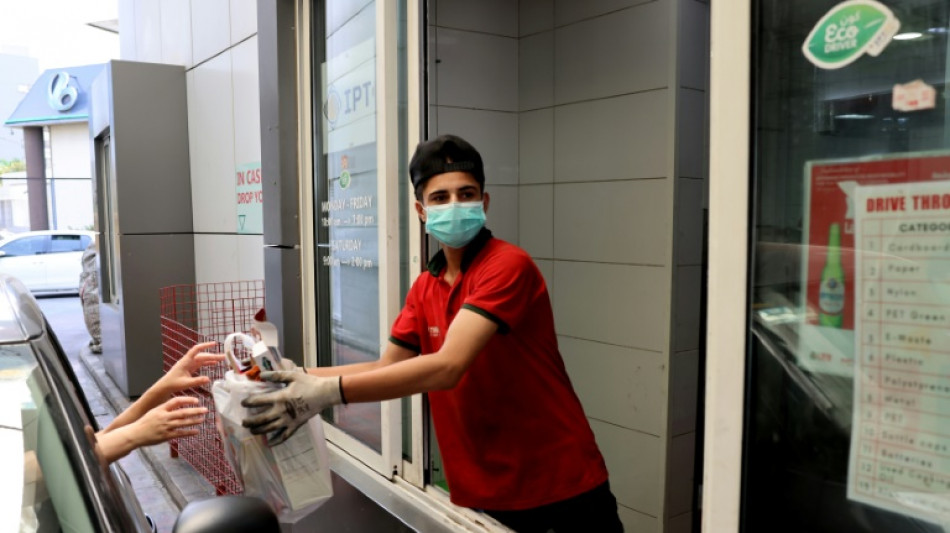
Beirut motorists pull up to a drive-through counter -- not for fast-food, but to exchange empty bottles and cardboard for cash, a novelty in a country long plagued by garbage crises.
Festering landfills often overflow in crisis-hit Lebanon, waste is burnt illegally at informal dump sites and rubbish floats off the coast in the Mediterranean Sea.
State-run recycling has largely fallen by the wayside in a nation that has been grappling with a three-year-long economic collapse.
"The government used to be in charge of this sector and now it is bankrupt," said Pierre Baaklini, 32, founder of Lebanon Waste Management.
Around a year ago he started the first "Drive Throw" recycling station and opened a second in February in Burj Hammoud, a Beirut suburb known for its proximity to a landfill.
With more than 80 percent of Lebanon's population living in poverty, the poorest eke out a meagre living picking through dumpsters for anything they can sell for recycling or scrap.
Baaklini said his customers are generally environmentally conscious and among the minority "with sufficient income".
People drive up to the station in their cars, register their details and place bags and boxes of loosely sorted recyclables on the counter. Workers accept everything from cardboard to plastic, glass, metal, e-waste, batteries and even used cooking oil.
A sign lists the prices -- a kilogram (2.2 pounds) of cardboard is worth 2,000 Lebanese pounds (around two cents), while aluminium cans are worth 50,000 pounds a kilogram.
Rony Nashef, 38, handed over bulging bags of plastic, in a country where many rely on bottled water for drinking.
Recycling "is definitely a much better solution to Lebanon's trash problem", he said.
Incompetence and corruption caused a spectacular waste crisis in Lebanon in 2015, when rivers of garbage filled the streets and ran into the sea, leading to protests by thousands and harming the country's image.
No viable long-term solution has since been found, and the destruction of two sorting plants in a catastrophic August 2020 explosion at Beirut port worsened the problem.
- 'For the community' -
Behind the scenes at Drive Throw, the recyclables are sorted carefully, while the plastic is later shredded and cleaned.
The two facilities have taken in a total of 450 tonnes of recyclables, founder Baaklini said, adding that the materials are sold to both local and international clients.
"What we are doing here is also about education" and awareness-raising, he said, as school students sometimes visit the facility to learn about recycling.
Environmental engineer Ziad Abichaker said recycling had always been neglected by authorities.
Only "about 10 percent" of Lebanon's daily waste load of 5,000 tonnes is recycled, said Abichaker, who heads Cedar Environmental, a group that specialises in "zero waste" technologies.
Authorities were studying a national waste management plan but there has been no progress due to institutional deadlock, he said.
A caretaker government with limited powers has been at the helm for more than a year.
Abichaker said "90 percent of the sorting plants built over the years" with money from international donations had stopped working, pointing to "faulty designs" and "corruption".
In Burj Hammoud, Renata Rahme, 47, said the first time she rolled up to the Drive Throw recycling station, she didn't know she was supposed to separate the materials.
"Now I'm trying to do more sorting," said Rahme, a film producer who brought in a crate with lights and other small electrical appliances.
"The point is not the monetary return as much as participating in the initiative," she said. "We're trying to do something better for the community, for the country, for society."
W.Stewart--AT